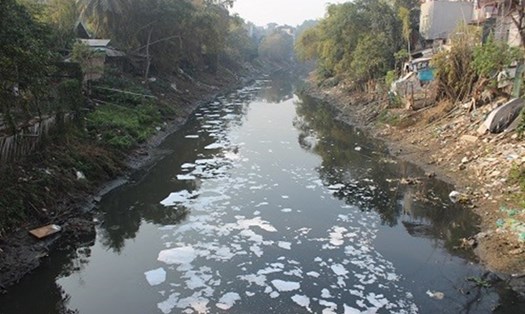
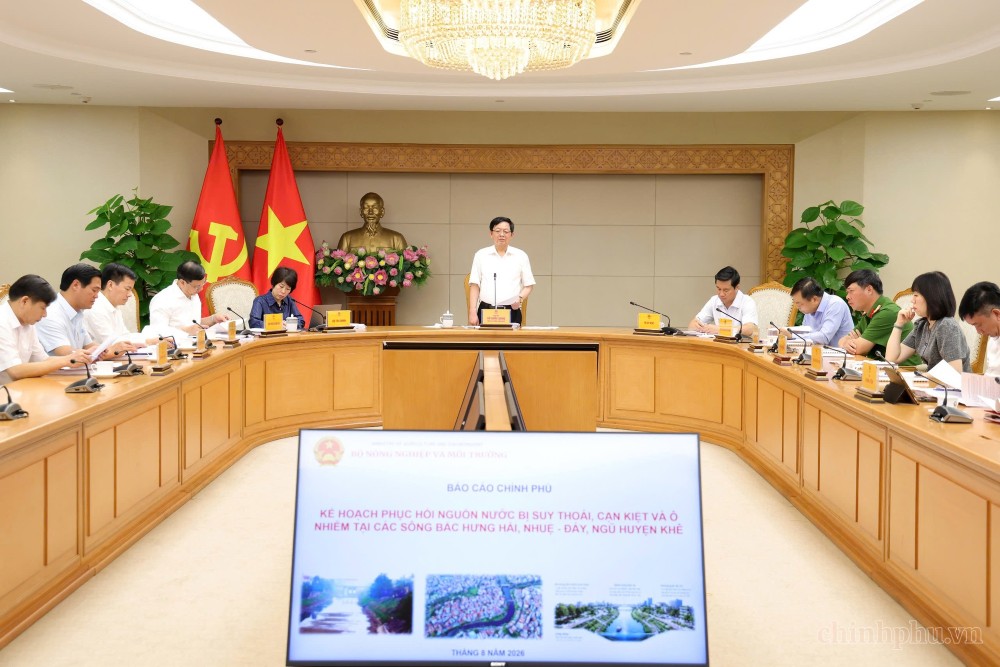
On September 4, at the Government Headquarters, Member of the Party Central Committee, Deputy Prime Minister Ho Quoc Dung chaired a meeting on the plan to restore degraded, depleted and polluted water sources of the Bac Hung Hai, Nhue - Day, and Ngu Huyen Khe rivers.
Concluding the meeting, Deputy Prime Minister Ho Quoc Dung emphasized that in the past time, localities have gradually implemented a number of tasks, but there is still a situation where each locality implements individually, lacking synchronous coordination, so the effectiveness is not high.
The construction of a project to renovate and restore degraded, depleted and polluted water sources in the Bac Hung Hai, Nhue - Day and Ngu Huyen Khe rivers is extremely necessary, contributing to improving the environment and serving sustainable economic development.
In the context of limited resources, it is necessary to identify priority projects that can be implemented immediately, controlled and ensure feasibility; and at the same time arrange priorities, clearly identify what to do first and what to do later. The goal is that after investment, the works must be operated effectively immediately, gradually creating changes in water quality.
The Deputy Prime Minister requested the Ministry of Agriculture and Environment to clarify 3 major issues during the project construction process.
First, it is necessary to build a list of projects in order of priority, clearly identifying projects that need to be implemented first to create efficiency, and at the same time ensure feasibility in each stage.
Second, it is necessary to specifically identify resources for implementation, including clarifying how much the State invests, how much socialization, where socialized capital is mobilized and in what form.
Third, it is necessary to clarify the operating mechanism when the projects are completed, ensuring synchronization in the exploitation process. In particular, the wastewater collection and treatment system must be deployed synchronously and effectively.
For localities, focus on reviewing and carefully evaluating planning related to the river system, ensuring unity and synchronization between localities. This is a linked system, so it is impossible to let planning and implementation plans of this locality be different from other localities, leading to conflicts or overlaps.
One content that the Deputy Prime Minister especially noted is the effective management and exploitation of the land fund formed after the restoration of rivers. This area has about 2,100ha of land. This is a very large resource if managed, planned and exploited effectively.
The Deputy Prime Minister requested localities in the process of performing tasks to simultaneously manage strictly, plan and effectively exploit land funds, avoid encroachment or ineffective use, thereby supplementing resources for the process of restoring rivers.
Along with improving water sources, localities need to have plans to improve the landscape and reorganize development space along the rivers. In which, focus on urban landscape, green corridors, public spaces, riverside economic development and improving the quality of life of people.
The Deputy Prime Minister emphasized that the goal of the project is not only to restore water sources but also to create a new development space, a new face for riverside cities.