
In the afternoon of June 11, Politburo Member, Prime Minister Le Minh Hung worked with the Standing Committee of the Hanoi City Party Committee on the situation of implementing socio-economic development tasks, "double-digit" growth targets, disbursement of public investment capital, operation of local governments at 2 levels, implementation of Resolution No. 57-NQ/TW of the Politburo, removing difficulties and obstacles for backlog projects.
Attending the working session were Comrade Pham Gia Tuc - Member of the Politburo, Standing Deputy Prime Minister; Comrade Tran Duc Thang - Member of the Politburo, Secretary of the City Party Committee, Head of the National Assembly Delegation of Hanoi City; Comrade Nguyen Van Thang - Member of the Party Central Committee, Deputy Prime Minister; Comrades Members of the Party Central Committee, leaders of central ministries and branches and Hanoi City.
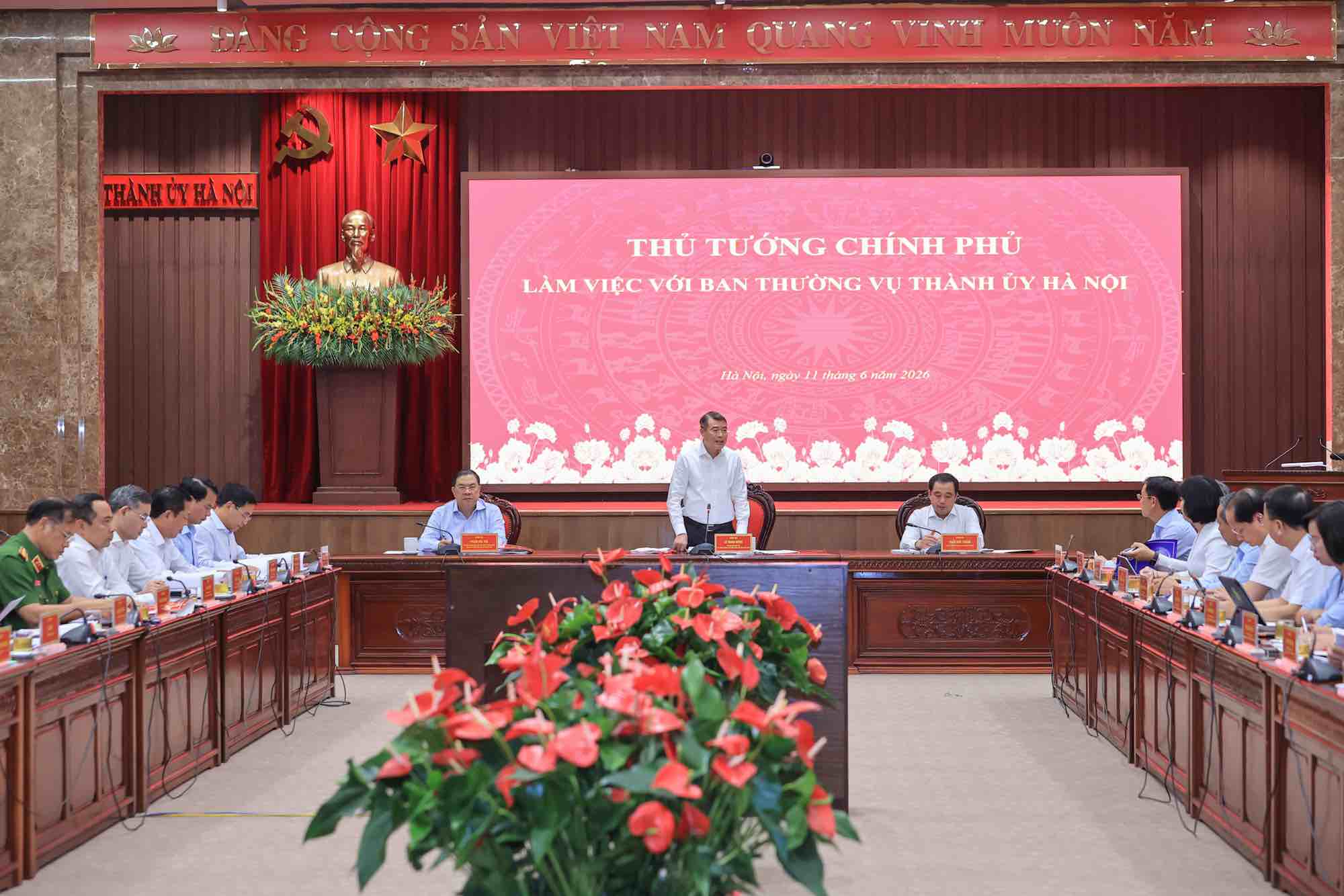
Effectively, synchronously, and unifiedly implement the Hanoi Capital Master Plan with a 100-year vision
At the working session, Prime Minister Le Minh Hung basically agreed with the reports and opinions and on behalf of the Government acknowledged and praised the efforts and important results that the Party Committee, government and people of Hanoi City have achieved in the past time, making positive contributions to the common achievements of the whole country.
Besides the achieved results, the Prime Minister frankly pointed out the limitations, difficulties, and challenges for the Capital such as the development potential that has not been exploited with maximum efficiency.
According to the Capital Law, Hanoi is granted the authority to design policies and implement policies, but to have a strong, breakthrough, and feasible mechanism, there are still many contents that need to be continued and the companionship of central ministries and sectors is needed.
The GRDP growth rate in the first quarter of 2026 has not reached the set scenario, creating great pressure for the remaining months to achieve the full-year target (11%). The 5-month consumer price index (CPI) is higher than the national average.
Mobilizing social resources, especially private capital and foreign investment capital, is a bottleneck; the number of businesses withdrawing from the market is increasing; the export turnover of some key commodity groups has decreased.
The development of strategic technology products, attracting new generation FDI associated with high technology transfer has not made a breakthrough. Hanoi must continue to make great efforts, change the working methods of departments, branches and grassroots levels to create a transparent mechanism and mobilize more resources.
The progress of some key projects is still slow due to site clearance problems, lack of land funds, resettlement housing funds... Electricity supply is a major challenge in the context of high growth.
Urban management and development are still inadequate; there are still violations of construction order and land management. Many environmental issues have not been addressed; infrastructure overload leads to traffic congestion, urban flooding, air pollution, water sources and waste treatment are still inadequate.
High-quality human resources in the fields of digital technology, artificial intelligence, big data, semiconductors, as well as connecting with institutes and schools to deploy research orders are still limited. School shortages and overload are concentrated at some levels of education.
The Prime Minister clearly stated that, with a particularly important role, which is of great concern to the Central Government, levels, and sectors, the city needs to identify higher goals and standards to contribute more to the common goals of the whole country.
The economic scale of Hanoi in 2025 accounts for 12.5% of the whole country, so every 1% growth of Hanoi makes a very important contribution to the "double-digit" growth target of the whole country" - Prime Minister Le Minh Hung emphasized.
The Head of Government requested to study, thoroughly grasp, and strongly implement the following tasks and solutions.
Accordingly, effectively, synchronously, and uniformly implement the Master Plan of Hanoi Capital with a 100-year vision associated with the "2-digit" growth requirement and in accordance with the planning of the Red River Delta region for the period 2021-2030. Complete the thorough handling of difficulties and obstacles related to backlog projects and land use projects. At the same time, complete the handling of obstacles for traffic infrastructure, digital infrastructure, cultural and social infrastructure projects.
Deploy synchronously solutions to handle air pollution, water sources, traffic congestion, flooding and treat domestic and industrial waste in the area.
Continue to strive to immediately cut 50% of the number of administrative procedures related to life and production and business. Connect and interconnect with national and specialized databases and promote processing on the network environment. Implement 100% of eligible online full-service public services from the third quarter of 2026.
Organize periodic health check-ups and free screening for people at least once a year.
The Head of Government requested Hanoi to focus on removing difficulties and obstacles, striving to disburse 100% of public investment capital in 2026. Effectively implement 8 key projects of the City to promote growth. Urgently handle backlog and prolonged projects to release resources for development (currently there are 661 projects including both public and non-budget investment).
Promote selective foreign investment attraction associated with technology transfer and supply chain connection. Implement strong solutions to develop the private economy. Develop industries and sectors of industry, trade, and services to ensure the growth goals of each industry and sector.
Highly appreciating that Hanoi will soon start construction of rental housing projects, the Prime Minister especially emphasized that Hanoi's very important responsibility is not only to implement specific projects but also to propose to central agencies to supplement, amend, and improve the common institutions, mechanisms, and policies for the whole country on land, real estate market, housing and especially rental housing.
Ensure the smooth and effective operation of the local government apparatus at 2 levels and propose and recommend to the Central Government to improve policies, especially on clearly defining authority and arranging the contingent of cadres; strengthen discipline and order in parallel with innovation and creativity, immediately replace cadres who do not meet task requirements and encourage and protect cadres who dare to think and dare to do for the common good.
The Prime Minister requested Hanoi to continue to drastically and effectively implement Resolution No. 57; promote the development of core technology systems, focusing on 10 strategic technology groups with specific output products such as artificial intelligence, big data, semiconductor chips, robots, automation, aerospace, network security and quantum; accelerate the progress of building a Smart City, developing digital infrastructure, telecommunications infrastructure and connecting with national and specialized databases, striving to have the digital economy account for 22% of the City's GRDP by the end of 2026;
Determined to build Hanoi into a leading science and technology center, innovation center in the country, on par with the Asian region (promoting the core role of Hoa Lac Hi-Tech Park, Biotech Park, National Innovation Center, research institutes, universities...). Focus on developing high-quality human resources, especially semiconductor, artificial intelligence, automation, railway human resources...
The Prime Minister requested to organize periodic health check-ups and free screening for people at least once a year. Strive for 100% of hospitals to deploy electronic medical records. Expand the model of health care for the elderly associated with the development of the silver economy. SOON allocate land funds to build schools, prioritize allocating 5% of land funds for public services and unexploited land to build schools. Effectively implement social security, ethnic, and religious policies.


