
To realize the goal of forming a hydrogen industry, experts believe that Vietnam needs to soon remove bottlenecks in technology, infrastructure and legal aspects, and at the same time accelerate the development of a system of standards and technical regulations as a foundation for market development.
At the Hydrogen Energy and Emission-Free Industry Future Forum on July 29, Dr. Mai Duy Thien, Chairman of the Vietnam Clean Energy Association (VCEA) said that according to Decision No. 165/QD-TTg approving the Strategy for Hydrogen Energy Development to 2030, vision to 2050, Vietnam aims to build a synchronous hydrogen ecosystem from production, storage, transportation to use, gradually participating deeply in the regional and global hydrogen value chain.
According to Assoc. Prof. Pham Hoang Luong, Vice President of the Vietnam Clean Energy Association, senior lecturer at Hanoi University of Science and Technology, it is necessary to soon remove three major bottlenecks in transmission and connection infrastructure; technological capacity and legal framework. In which, Vietnam needs to gradually master electrolysis technology, hydrogen production equipment and promote training of high-quality human resources to reduce dependence on imported technology.
From the perspective of state management, Mr. Dang Hai Anh, Deputy Director of the Department of Oil and Gas and Coal (Ministry of Industry and Trade) said that after a period of implementing the Hydrogen Energy Development Strategy, awareness of this new energy sector has changed significantly. The Strategy not only creates a basis for building mechanisms and policies but also promotes research and investment activities related to hydrogen.
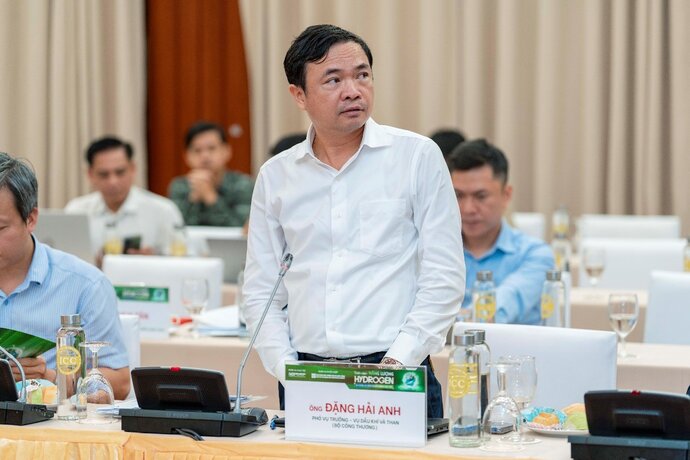
According to Mr. Dang Hai Anh, if hydrogen research was still quite new in the past, now many universities, research institutes and science centers have gradually identified technologies suitable for Vietnamese conditions. Domestic research groups have also begun to approach and assess the ability to master many key technologies in the hydrogen value chain.
He said that some new research directions are being interested in, including sustainable aviation fuel production technology (E-SAF) through the combination of hydrogen with CO2. This is a field that was previously not focused on but has now been put into research and pilot implementation in some projects in Vietnam.
Besides technology, Mr. Dang Hai Anh especially emphasized the role of the national standard and technical regulation system for the development of the hydrogen industry. TCVN and QCVN are not only management tools but also a science and technology platform to help Vietnam gradually master the entire hydrogen value chain, from production, storage, transportation to use, ensuring safety and in accordance with international practices.
In the past time, the Ministry of Industry and Trade has coordinated with relevant units to review the current system of standards and regulations and develop a roadmap for TCVN and QCVN development for the hydrogen sector to 2030, orienting towards the next stages. However, the number of specialized hydrogen standards and regulations is still very limited compared to practical development requirements.
According to Mr. Dang Hai Anh, in the period from now to 2030, the construction and completion of TCVN and QCVN will be promoted to create a technical corridor for hydrogen projects. At the same time, the review process also shows that Vietnam needs to study a more appropriate development roadmap, focusing on hydrogen derivatives to take advantage of existing energy infrastructure.
In addition, completing the policy framework will be a prerequisite for attracting investment, forming a green hydrogen market and realizing Vietnam's energy transition goals.
Experts believe that with great renewable energy potential and determination to transition to green, Vietnam has the opportunity to participate more deeply in the global hydrogen value chain. It is necessary to soon complete the legal corridor, develop synchronous infrastructure and promote technological innovation. When these bottlenecks are removed, green hydrogen can become a new growth engine, contributing to improving the competitiveness of the economy and realizing the goal of green and sustainable development.
The Hydrogen Energy Forum and Emission-Free Industry Future program is pleased to have the companionship of Vietnam National Industry - Energy Group (Petrovietnam).


