
Gold spot prices last night at one point retreated to nearly 4,432.6 USD/ounce, down 1.24% in the session. Meanwhile, silver spot prices fell deeper, to nearly 72.755 USD/ounce, equivalent to a decrease of 3.17%.
At the time of writing (8:45 AM on June 4, 2026 - Vietnam time), world gold prices recovered to around the threshold of 4,465.3 USD/ounce.
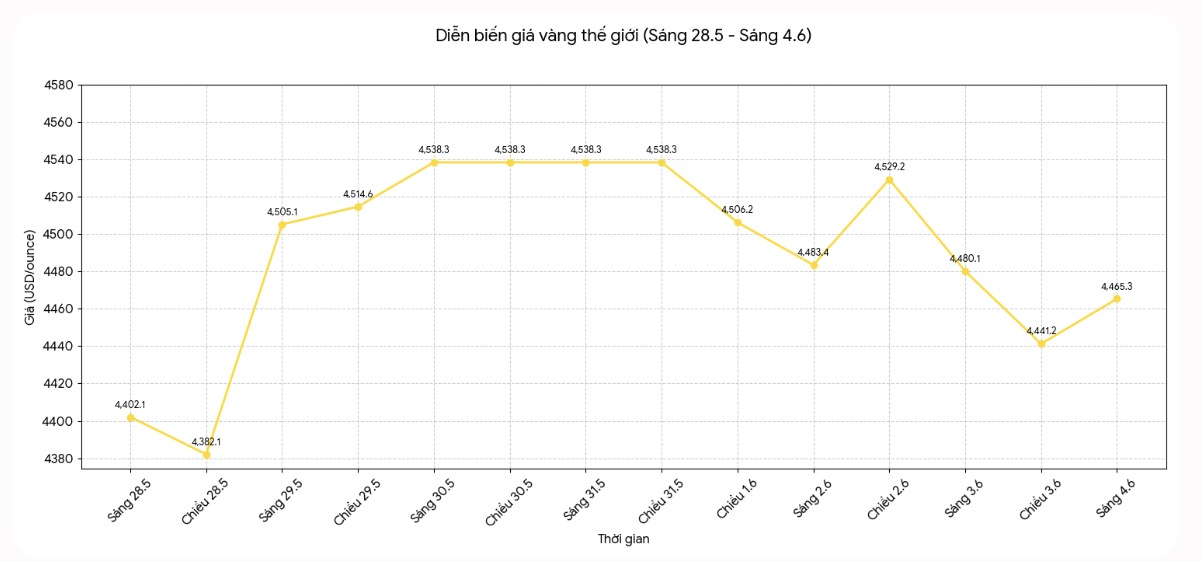
This development shows that gold is being negatively affected by geopolitical tensions. On the one hand, conflict in the Middle East may support safe-haven demand. On the other hand, rising oil prices, stronger USD and rising US bond yields are putting great pressure on non-performing assets like gold.
Recent US economic data also contributed to making the market more cautious. The US private sector created 122,000 jobs in May, higher than the forecast of 110,000 jobs and the strongest increase in 16 months according to the ADP report.
The ISM service PMI index increased to 54.5 points in May, compared to 53.6 points in April. In which, the business activity index reached 57.7 points, new orders reached 57.3 points. However, the employment index was only at 47.9 points, continuing to be in the narrow range. Mr. Steve Miller - Chairman of the ISM Service Business Survey Committee - said the employment index has decreased for the third consecutive month.
The Beige Book report of the US Federal Reserve (Fed) shows that economic activity increased from slight to moderate in 10 out of 12 regions. Meanwhile, prices increased from moderate to strong, due to energy costs related to Middle East tensions spreading to transportation, packaging, food and fertilizers.

On the energy market, oil prices rose for the third consecutive session after US and Iranian forces continued to fight, while negotiations on reopening the strait were stalled. WTI oil prices closed around 96.02 USD/barrel, while Brent oil was near 97.81 USD/barrel. Some experts warn that about 11-14 million barrels of oil/day could face risks if this important shipping route continues to be closed.
This development has caused inflationary pressure to return, pulling US bond yields up and reducing the attractiveness of gold. The yield of 10-year US Treasury bonds is currently fluctuating near the 4.5% zone, while the USD index is increasing.
The US stock market also fell as investors re-evaluated Middle East risks. The S&P 500 index fell 0.7% to 7,553.68 points, ending a 9-session winning streak. Dow Jones lost 1.2% to 50,687.07 points, Nasdaq Composite fell 0.9% to 26,853.98 points, and Russell 2000 fell 1.3% to 2,893.50 points.
Technically, gold buyers need to bring prices back above the resistance zone of 4,436-4,460 USD/ounce to restore the upward momentum. If this zone is sustainably surpassed, the next target for gold prices may be 4,500 USD/ounce, followed by 4,526 USD/ounce.
In the opposite direction, the near support zone of gold prices is at 4,426.4 USD/ounce. If losing this mark, gold prices may face additional downward pressure to 4,400 USD/ounce, or 4,367 USD/ounce deeper.
For silver, buyers need to bring the price back above the 73.20-73.84 USD/ounce range. If it passes this range, the silver price may reach 74.5 USD/ounce and 75.5 USD/ounce. Conversely, if it falls below 72.63 USD/ounce, this precious metal may fall back to 72 USD/ounce, even 70 USD/ounce.
In the short term, analysts believe that gold prices are still heavily dependent on US-Iran tensions, oil price trends, the USD and US bond yields.


