
According to Kitco, in the early morning of Saturday, February 28, 2026, coordinated airstrikes by the US and Israel attacked military facilities, leadership complexes and nuclear-related sites across Iran.
Just a few hours later, Iranian state media confirmed that Supreme Leader Ayatollah Ali Khamenei had been killed, followed by a state of national mourning and launches of missiles and drones targeting US military assets.
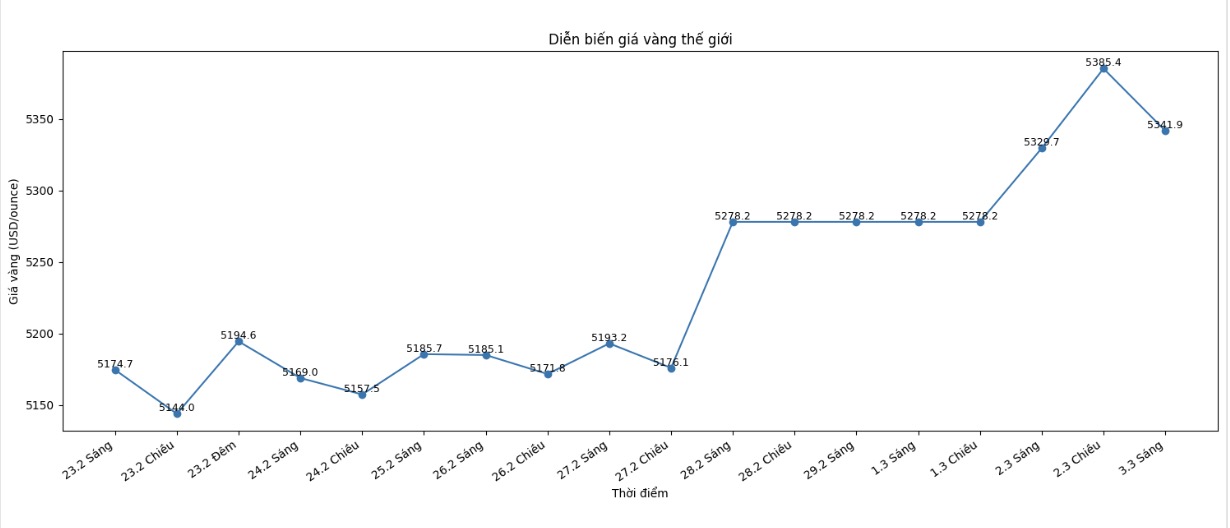
Spot gold prices, which fluctuated around 5,100 USD/ounce before the airstrikes, jumped past the 5,300 USD mark in just one session - up more than 200 USD, belonging to the group of the largest daily increase in the history of this precious metal in absolute value.
By Monday morning, when the conflict entered its third day and there was no sign of a ceasefire, gold prices continued to climb to a peak in the session of 5,418 USD before falling back to around 5,384 USD/ounce, up 2% during the day.
Gold is perhaps the most subtle measure of global instability - and the mercury pillar is rising" - said Ross Norman, an independent analyst.
Before the conflict broke out, gold recorded a 7-month consecutive increase - the longest since 1973 - thanks to persistent inflation, net buying activity by central banks and investor concerns about US trade policy.
J.P. Morgan and Bank of America just days before the airstrikes reaffirmed their price targets towards the $6,000/ounce mark.
J.P. Morgan even forecasts gold could rise to $6,300/ounce by the end of the year, based on the persistent buying demand of central banks.
Now, the calculation factors are leaning even more towards gold. Iran's statements about closing the Strait of Hormuz - a route that transports about 20-30% of global crude oil by sea - are no longer just deterrent statements but have become real risks.
Oil prices rose more than 6% on Monday, the largest daily increase in 4 years, raising inflation expectations in the context of the swap market starting to decline betting on the possibility of the US Federal Reserve (Fed) cutting interest rates. The oil - gold inflation spiral, which was only theoretical, has now become a reality.
The conflict also revealed a little-mentioned bottleneck in the gold market: the physical delivery stage.
Dubai International Airport - an important transit hub for gold bars from London to Asia - has suspended commercial flights after Iran's missile and drone attacks on the UAE.
Traders said they must urgently redirect shipments on the way, recalling the early disruptions of the pandemic when flight delays caused large price differences between London, New York and Asian centers. This disruption, although only temporary, also shows a structural weakness in the global logistics network of gold, right at the time of soaring demand.
However, not all signals indicate that prices will continue to rise sharply. Gold has narrowed down part of its gains at the beginning of Monday's session as analysts consider the possibility of prolonged inflation due to rising oil prices that could force the Fed to tighten instead of easing monetary policy.
High real interest rates are often detrimental to gold - an asset that does not generate yields. Mr. Frank Monkam - Head of Multi-Asset Macrostrategy at Buffalo Bayou Commodities, said that the scenario of interest rate hikes is beginning to curb gold's upward momentum.
Meanwhile, ING analysts have a more cautious view, saying that if the conflict spreads in the region or the disruption in the Strait of Hormuz lasts, the positive impact on gold will overwhelm pressure from interest rates, thanks to expectations of strong inflation while real yields are controlled by cash flow hovering in US Treasury bonds.
Widespread conflict in the region will significantly boost gold through higher oil prices, increased inflation expectations and low real yields" - ING experts said.
Mr. David Meger - Director of Metal Trading at High Ridge Futures, said briefly: Uncertainty is the main driving force of the market - and uncertainty shows no signs of being resolved soon.
Technical analysts believe that if gold decisively breaks out of the January record high of 5,594 USD/ounce, the price may head towards the 6,000 - 6,500 USD/ounce range.


