
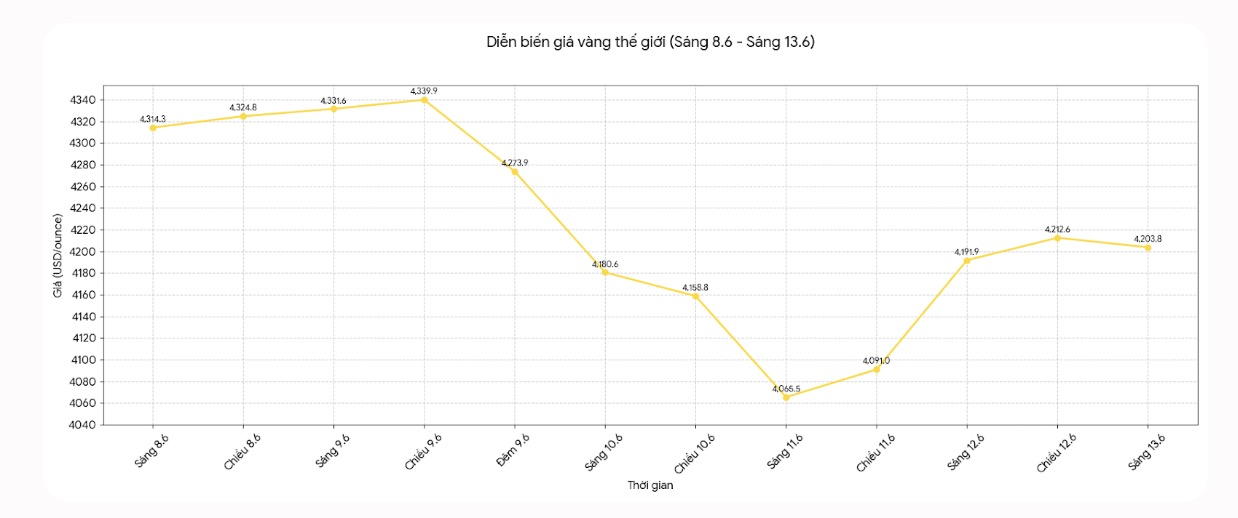
Gold prices fell in May as China ended its 8-month consecutive withdrawal of capital into gold ETFs. Gold wholesale demand also fell sharply. Meanwhile, the People's Bank of China (PBoC) continued to increase gold purchases, according to Mr. Ray Jia - Head of China Market Research at the World Gold Council (WGC).
In the latest updated report on the Chinese gold market, Mr. Jia said that both international gold prices and domestic gold prices in China closed May in a slight downward trend.
The LBMA PM gold price fell 1.4%, while the Shanghai PM Standard Gold (SHAUPM) price fell 2.7%. The strengthening of the yuan has increased weakening pressure on Chinese gold prices," he wrote.
According to WGC experts, instability in the Middle East and related inflation concerns, which pushed bond yields and the USD up, were the main factors dominating the gold market in the month.
Meanwhile, gold ETF funds in China recorded their first month of capital withdrawal since August 2025, with a net withdrawal of 1.2 billion USD in May. "Along with the fall in gold prices, total managed assets decreased by 5%, to 289 billion yuan, equivalent to 43 billion USD," Mr. Jia said.
By the end of the month, gold holdings of Chinese gold ETFs decreased by 8.3 tons, to 293 tons.
Mr. Jia said that the sustainable increase of the domestic stock market in the month has pulled cash flow away from gold. In addition, the lack of a clear trend in gold prices has also caused some investors to sell gold ETF fund certificates.
Trading volume of gold futures contracts on the Shanghai Futures Exchange (SHFE) remained relatively stable, reaching an average of 301 tons/day in May. This figure is almost unchanged compared to 307 tons/day in April, due to trading activities being restrained by sideways domestic gold prices and increased investor interest in the domestic stock market.
On the wholesale side, demand continued to decline in the previous month.
Gold withdrawals from the Shanghai Gold Exchange (SGE) reached 64 tons, down 38% compared to the previous month. Compared to the same period last year, gold withdrawals decreased by 36%, marking the weakest May since 2010" - Mr. Jia wrote.
According to WGC experts, weakening gold prices in the month, along with the attractiveness of the stock market, has reduced safe-haven demand for gold investment products. Meanwhile, the gold jewelry sector continues to be weak due to payment capacity and additional tax burdens. Although demand has slightly increased in May when gold prices are more stable, jewelry businesses are still cautious in supplementing inventory.
Combining the above factors, wholesale demand in May was strongly affected, falling to its lowest level in many years" - Mr. Jia assessed.
Contrary to the above developments, the central bank of China continued to take advantage of the low price period to increase gold purchases.
“PBoC announced its 19th consecutive month of gold reserve increase in May, thereby raising its official gold holdings by 10 tons, to 2,332 tons. This is the official sector's strongest gold buying month since December 2024,” Mr. Jia said.
Since the beginning of the year, China's official gold reserves have increased by 25 tons and currently account for 8.9% of the country's total foreign exchange reserves. In the past 19 months, China's official sector has accumulated a total of 67 tons of gold.
Gold imports also increased in April, thanks to the difference in domestic gold prices compared to international prices.
According to the latest data from Chinese Customs, net gold imports into the country reached 157 tons in April, an increase of 10% compared to the previous month and 40% compared to the same period last year. This is the strongest import level since March 2024. Mr. Jia said that the positive difference in domestic gold prices continues to be an important factor driving imports.
Looking ahead, Mr. Jia said that seasonal factors show that the gold jewelry sector may be more stable as the industry replenishes goods after a weak buying period in previous months.
Lower gold prices may support this restocking activity, although jewelry businesses may continue to stand aside and observe if the price decline accelerates," he added.
In the investment segment, the cooling upward momentum of gold prices may continue to limit the demand for buying gold bars and physical gold.


