
Closing the trading session last week (June 7), Saigon SJC Jewelry Company listed the price of SJC gold bars at the threshold of 146.2-150.2 million VND/tael (buying - selling). Compared to the session on May 31, the price of SJC gold bars at this unit decreased by 9.8 million VND/tael in both buying and selling directions.
At DOJI, SJC gold bar prices were also listed at the threshold of 146.2-150.2 million VND/tael, down 9.8 million VND/tael in both directions compared to the May 31 session.
With this development, if investors buy SJC gold bars in the May 31 session and sell in the June 7 session, the loss at Saigon SJC and DOJI Jewelry Company will both reach 12.8 million VND/tael.

This loss is not only due to the sharp drop in gold prices during the week, but also due to the high difference between buying and selling prices. Closing the previous week's session, the buying - selling difference of SJC gold bars at the above two units was at 3 million VND/tael. This means that right after buying, investors have faced the risk of losses if the price does not continue to increase strongly enough to compensate for the difference.
Not only SJC gold bars, buyers of 9999 gold rings also suffered heavy losses after a week. At DOJI, the price of gold rings closed last week at the threshold of 146.2-150.2 million VND/tael, down 9.8 million VND/tael in both buying and selling directions compared to the May 31 session. If buying in the May 31 session and selling in the June 7 session, gold ring buyers at DOJI lost 12.8 million VND/tael.
At Phu Quy Gold and Gems Group, the price of gold rings was listed at the threshold of 146.2-149.6 million VND/tael, down 9.3 million VND/tael on the buying side and down 8.9 million VND/tael on the selling side compared to a week ago. With a buying - selling difference of up to 3.4 million VND/tael, gold ring buyers at Phu Quy, if sold after a week, would also lose about 12.3 million VND/tael.
The above developments show that in the context of strong gold price fluctuations, the decrease in listed prices is only part of the reason why investors suffer losses. The high buying-selling difference is a factor that significantly increases actual losses. When the market reverses to decrease, buyers not only suffer losses from falling gold prices, but also lose an additional difference between buying and selling prices.
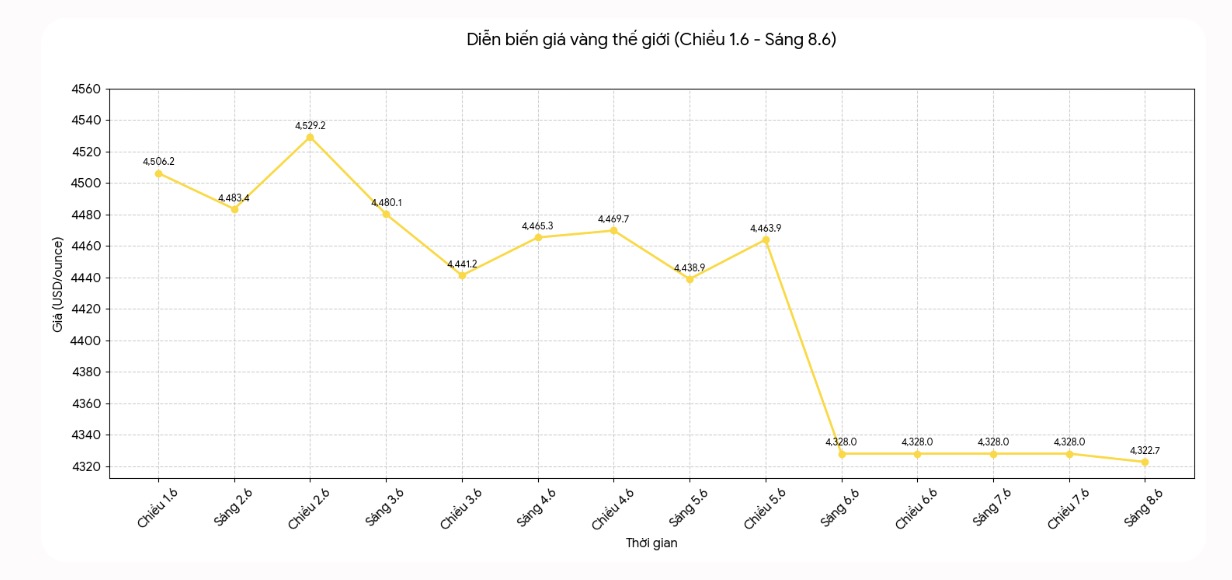
The downward pressure of domestic gold prices appeared in the context that world gold prices had just had a sharp week of decline. Closing the trading session last week, world gold prices were listed at the threshold of 4.328 USD/ounce, down 210.3 USD compared to a week ago.
According to international market developments, world gold prices are under pressure from many unfavorable factors. Although tensions in the Middle East still create a certain shelter demand, this factor is not enough to help the precious metal maintain its upward momentum against the strength of the USD, US Treasury bond yields and monetary policy expectations of the US Federal Reserve (Fed).

In addition to macroeconomic factors, technical developments also contribute to making gold's decline stronger. When gold prices break through some important support zones, selling pressure may be further triggered by short-term investors and trend trading orders.
Investors need to be cautious with the psychology of chasing when gold prices rise sharply. The psychology of fearing missing opportunities, buying in just because of fear of missing opportunities, can cause investors to buy at high prices and bear great risks when the market reverses direction.
Especially, in the context that the buying - selling difference between SJC gold bars and gold rings is still high, short-term investors are even more likely to lose money if prices do not increase strongly enough. The difference of several million VND per tael pushes the breakeven point up, making risks greater for those who buy and sell in a short time.
Gold prices during this time are still at risk of strong fluctuations due to US economic data, Fed interest rate expectations, USD developments, bond yields and geopolitical risks. Therefore, investors need to carefully consider risk appetite, avoid using leverage or pouring all capital into gold when the market is fluctuating strongly.


