
According to Kitco - Gold futures opened the trading session on Thursday in a state of near immobility. In the first 8 hours of trading, price movements were almost sideways, creating two consecutive "doji candles" (a type of candle in the technical chart, appearing when the opening and closing prices are almost equal) on the 4-hour chart - technical signals often show hesitation, when both buyers and sellers are not ready to act decisively.
Observing more closely on the hourly chart, this state of stalemate is even clearer. In the first 13 hours of the session, gold prices only moved around 5 USD, opening at 4,094 USD/ounce and rising to 4,101 USD/ounce at 7 pm US Eastern time. With a market continuously fluctuating strongly throughout the week, this calm wave is noteworthy.
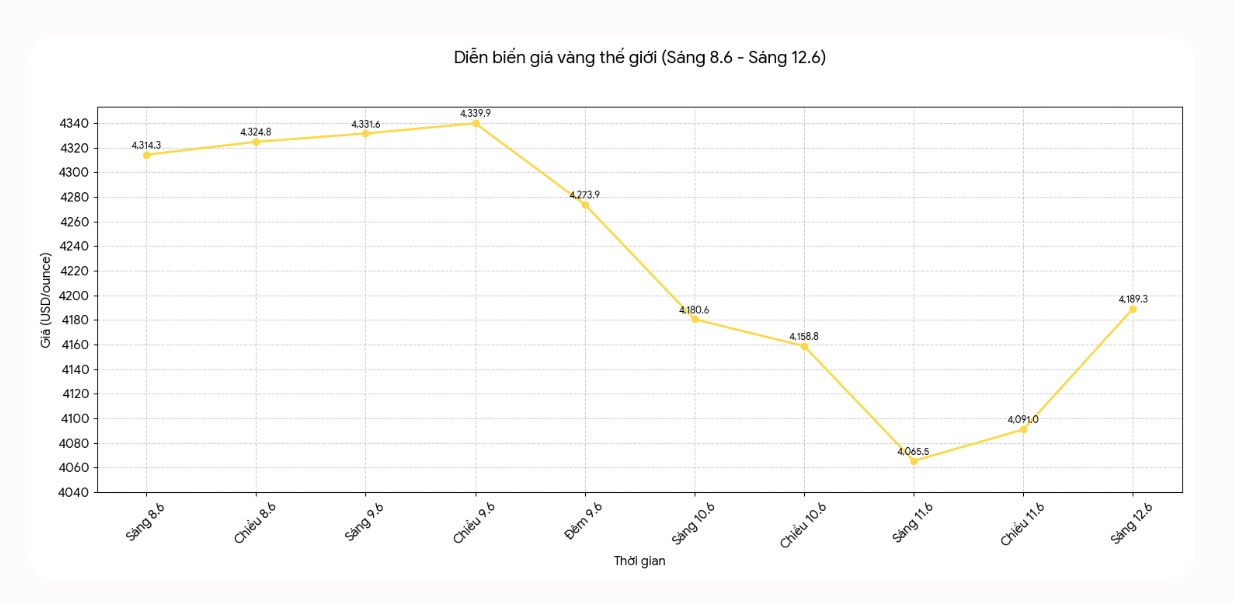
To understand the developments in Thursday's session, it is necessary to look back at the large selling pressure that gold had to absorb in the past week. Before this session, gold prices had fallen for 4 consecutive days, losing a total of 408 USD, equivalent to 9.08% of their value - a quick adjustment and causing a lot of pressure after leaving the peak zone.

The initial catalyst for the plunge was the jobs report released last Friday, which was stronger than forecast. This data surprised the market, pushing gold prices down from over 4,500 USD/ounce to 4,353 USD/ounce in just one session. More notably, that decrease caused gold prices to close below the 200-day moving average - a technical threshold that the precious metal has never broken since October 2023.
For technical traders, losing this threshold is an important warning signal, showing that market momentum has clearly tilted towards decline.
By Wednesday, gold prices continued to show no signs of recovery. The May Consumer Price Index (CPI) report was released, adding more reason for the selling side, causing gold prices to fall by another 190 USD, equivalent to 4.45% in the session.
Usually, rising inflation data can support gold prices as a hedging asset against rising price risks. However, the market's reaction this time reflects a more complex calculation: CPI hotter than forecasts reinforces expectations that the US Federal Reserve (Fed) will maintain a tighter stance for longer. This keeps real yields at a high level and reduces the relative attractiveness of gold - an asset that does not yield interest.
The combination of a strong labor market and persistent inflation creates an unfavorable picture, making it difficult for gold buyers to find a convincing argument to counterattack.
After that, the market saw a turning point. After most of the trading time in a sideways state, gold prices suddenly reversed sharply around 7 pm US Eastern time, thereby recording an increase of 140 USD in the session.
The most likely driving force, based on available information, is a headline from Washington: US President Donald Trump announced that the military attack on Iran, which was planned earlier, has been cancelled. He cited the reason as a more optimistic outlook for the possibility of reaching a diplomatic agreement with Iranian leaders.
Geopolitical risk has long been one of the most reliable supporting factors for gold. The risk of escalating tensions in the Middle East is quietly supporting gold prices, even when macroeconomic factors create great pressure.
The immediate removal of the military threat seems to have triggered a sell-by-sell wave, as sellers do not want to continue to increase their positions in the context that the market may reverse sharply just because of a new news item.
Whether the reversal of gold prices in Thursday's session is a real turning point or just a technical recovery in a larger correction trend still needs more time to be verified. The damage in the past week is significant, while the technical picture is still challenging if gold prices continue to trade below the 200-day moving average.
Reclaiming this threshold on the basis of a sustainable shutdown will be the first important signal showing that buyers are regaining control. In the short term, traders also need to closely monitor new developments related to US-Iran negotiations, because any breakdown in the diplomatic process can quickly reignite safe haven demand.
Currently, the buying side has had a successful session. However, the recovery path of gold prices will need more than one single increase session to rebuild confidence that has been eroded strongly in recent days.


