
According to StoneX (a global financial services group based in New York), the decline in net buying positions in the gold and silver markets in recent times may open up new room for price increases.
However, geopolitical tensions related to Iran and instability surrounding the leadership position of the US Federal Reserve (Fed) are making major investors cautious, causing the precious metals market to continue to fluctuate strongly.
In an update released on Wednesday, Ms. Rhona O'Connell - Head of Market Analysis at StoneX - said that the gold and silver markets have recently been greatly affected by developments in the Strait of Hormuz.
According to Ms. O'Connell, silver in general still follows the trend of gold, but the volatility is significantly stronger. Notably, last weekend, silver prices jumped by about 5% after information that the Strait of Hormuz was fully opened and would maintain a smooth state during the ceasefire.
However, this information was later withdrawn, while the strait is currently continuing to be closed, said to be in response to the US maintaining the blockade.
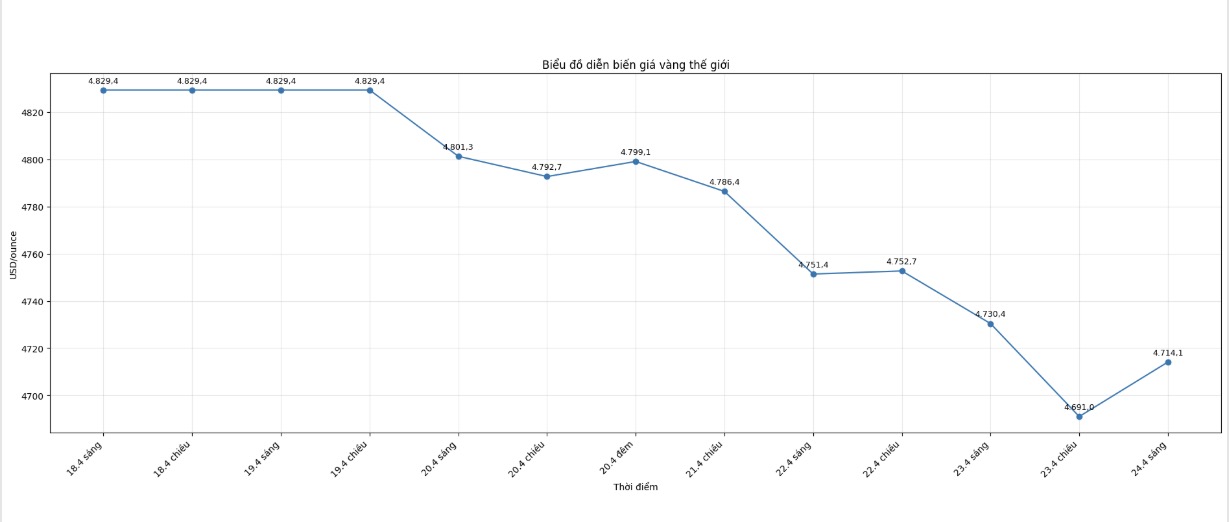
StoneX believes that although negotiations are still ongoing, the gap between the parties is still large, so gold and silver prices are likely to continue to fluctuate cautiously and unpredictably in the short term.
Ms. O'Connell said that professional trading organizations are not yet ready to make large bets in the context of too sensitive geopolitics. Along with that, ETF funds have reduced their holdings of metals in recent days, while short-term speculators are still divided into two buying and selling directions in the market.
Regarding speculative cash flow, StoneX said that net buying positions on the COMEX exchange for gold decreased in the last week of March, then gradually recovered, but still about 15 tons lower than the level of 3,190 tons recorded on March 17. Meanwhile, the amount of short selling positions also increased, although slower, causing the net buying status of gold to fluctuate in a narrow range, around 280 - 310 tons.
For silver, speculative positions peaked in the last week of March and then gradually weakened until mid-April. Recently, the market has shown signs of regaining momentum thanks to bottom-fishing buying power.
However, the rate of selling position closing is still not as large as the previous withdrawal of the buyer, causing the net buying status of silver to decrease slowly, currently about 1,830 tons, much lower than the 12-month average of 4,126 tons.
According to StoneX, the narrowing of speculative positions in both gold and silver means that the "overheated" part of the market has been released, thereby leaving some room for price increases for these two precious metals.
Not only geopolitics, political developments in the US are also creating more psychological pressure on the precious metals market.
According to this expert, gold is currently mainly dominated by the USD and US Treasury bond yields. When positive information appears, the USD and yields tend to cool down, thereby supporting buying activities on the gold market, mainly stemming from speculative trends.
From a technical perspective, market analyst Razan Hilal of StoneX also issued a cautious warning. According to her, gold and silver are entering a sensitive phase when prices accumulate close to important technical thresholds but cannot establish a sustainable upward trend.
Ms. Hilal believes that recent rebounds are not strong enough to restore the upward momentum, putting both metals at risk of reversal. The current context reflects the tug-of-war between recovery efforts and structural weakening signs, creating a key phase where technical signals will determine the next direction of the market.
With gold, the price is still accumulating below important resistance levels, while repeating the weakening pattern that appeared earlier in 2026. According to StoneX, the fact that gold cannot return to the 4,880 USD/ounce level increases the possibility of bearing downward pressure if the support zone continues to weaken. In other words, gold prices are still vulnerable to the risk of deeper correction if there is no clear breakthrough to confirm a new upward momentum.
Meanwhile, silver prices are fluctuating in a continuing price channel pattern, increasing the risk of a strong fluctuation in either direction. StoneX warns that if silver loses the lower bound around 75 USD/ounce, the decline may accelerate and pull the price back to test lower support zones.


