
According to Kitco, the gold market continues to decline despite reduced existing housing sales in the US, as consumers in this country remain cautious when buying houses.
According to the US National Association of Realtors (NAR) announced on Tuesday, total existing housing sales, including detached houses, townhouses, apartments and housing cooperatives, fell 3.6% in March, down to an annual adjustment of 3.98 million units. Previously, the figure for February was adjusted to 4.13 million units.
This decrease is stronger than economic experts' forecasts, when experts previously expected sales to reach 4.07 million units. In the past 12 months, existing US housing sales have decreased by 1%.
Commenting on this development, NAR Chief Economist Lawrence Yun said that the housing market in March was still gloomy and lower than the same period last year. According to him, weakening consumer confidence and slowing job growth are continuing to hinder homebuyers from returning to the market.
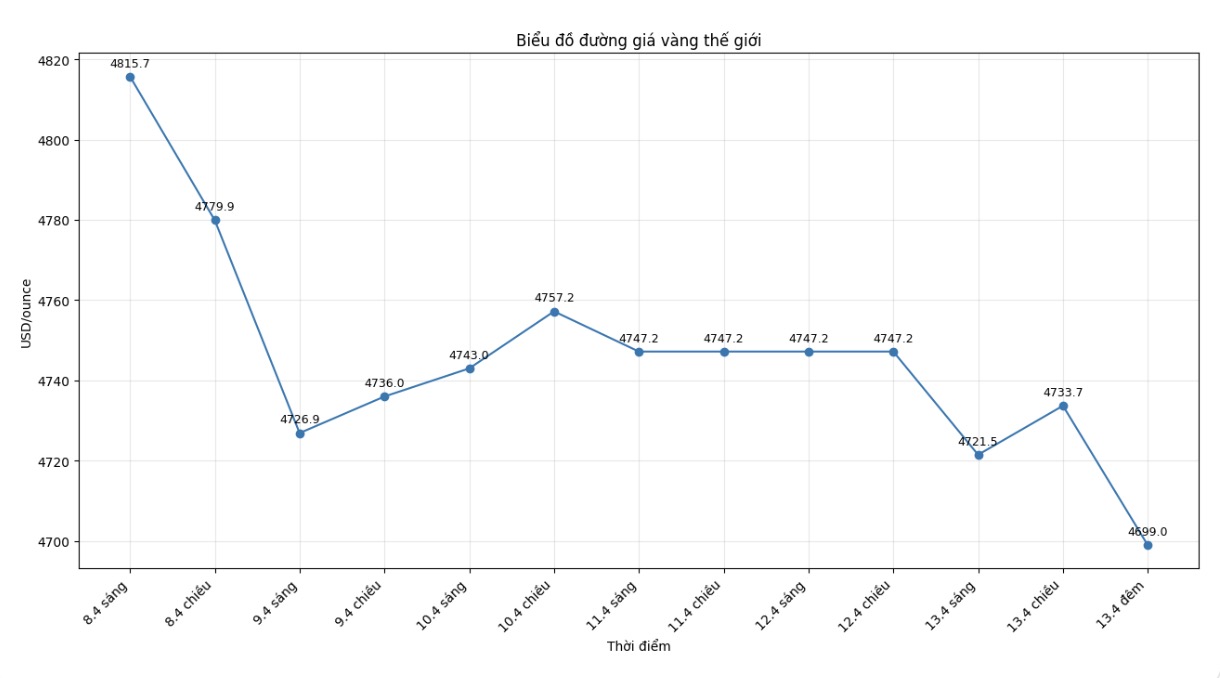
Despite disappointing housing data, gold prices have hardly fluctuated sharply. At 10:10 PM on April 13 (Vietnam time), world gold prices were listed around the threshold of 4.699 USD/ounce.
Some analysts believe that weakening signals from the housing market may support gold prices in the medium term. The reason is that the decline in this sector is likely to slow down US economic growth, thereby putting pressure on the US Federal Reserve (Fed) to consider easing interest rates, even when inflation remains high.

Not only did March data disappoint, NAR also lowered the housing market outlook for this year. The organization currently forecasts that existing housing sales will only increase by 4%, lower than the previous forecast. Meanwhile, new housing sales are forecast to remain flat, instead of increasing by 5% as previously estimated.
Separately, the forecast of neutral house prices remains unchanged, with an expected increase of 4% in 2026.
According to Mr. Yun, low supply continues to be a major drag on the housing market as prices are pushed up. The inventory-to-sales ratio is still lower than the historical average. NAR believes that the market needs about 300,000 to 500,000 more houses to be put up for sale to bring supply and demand back to a normal state, helping buyers have more time to consider instead of being pressured to make decisions.
Also according to NAR, the supply shortage has caused neutral house prices in March to set a new record high for this month alone. That price increase helped a typical homeowner in the US accumulate about $128.100 in housing assets in the past 6 years.
Regarding inventory, the report said that by the end of March, the supply of housing nationwide reached 1.36 million units, an increase of 3% compared to February and equivalent to 4.1 months of unsold supply. Meanwhile, the average price of all existing housing types increased by 1.4% compared to the same period last year.


