
World gold prices fell sharply last night as newly released economic data showed that the US economy is still sending relatively solid signals. This further narrowed the expectation that the US Federal Reserve (Fed) would soon ease monetary policy.
According to data from the US Department of Labor, the number of initial jobless claims in the week ending June 13 reached 226,000, close to the expert forecast of 225,000. Data from the previous week was adjusted to 230,000, from the initial announcement of 229,000.
After the report was released, spot gold prices fell to 4,240.07 USD/ounce. At 11:40 PM on June 18 (Vietnam time), world gold prices were listed around the threshold of 4,216.1 USD/ounce, a sharp decrease of about 141 USD compared to the previous day.
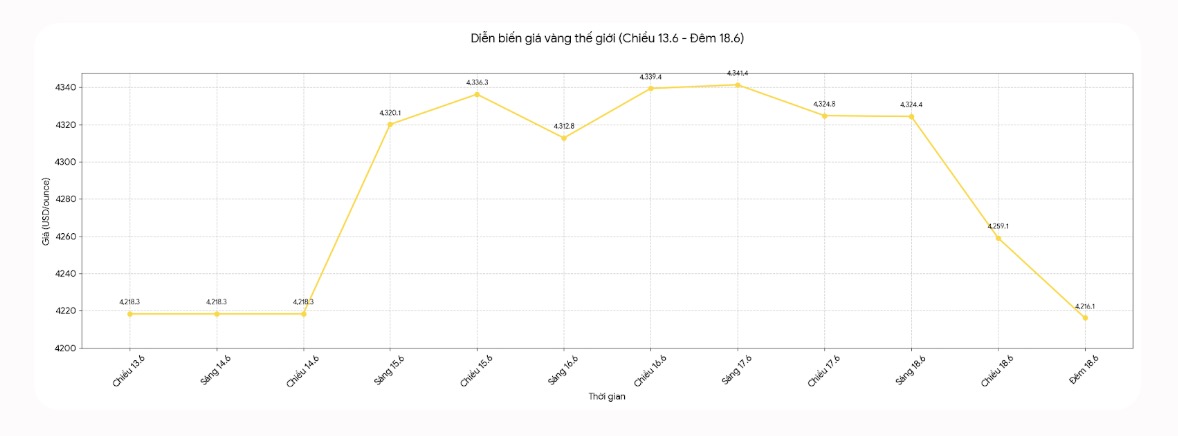
This development shows that the gold market is still struggling to find a balance after the previous sharp decline. Employment data is not too hot but not weak enough to strengthen expectations that the Fed will soon switch to a softer stance.
The 4-week average of first-time jobless claims in the US reached 223,250 claims, close to the forecast level of 223,000 claims. This is a measure that the market is closely monitoring because it helps flatten short-term weekly fluctuations.
Meanwhile, the number of people continuing to receive unemployment benefits in the week ending June 6 reached 1.81 million people, higher than the forecast of 1.800 million people. However, this figure has not created a strong enough signal of a clear weakening of the US labor market.
Pressure on gold increased further after the Federal Reserve of Philadelphia released its June production report. The region's manufacturing business outlook index rose to 10.3 points, higher than May's -0.4 points and exceeded forecasts by 9.8 points.
The report said that production activities in the region have generally expanded again. Indicators of current operations, new orders and delivery have all increased and returned to positive areas. At the same time, businesses continue to record increased input prices.

According to Kitco, the US new order index increased sharply to 27.3 points, compared to a negative 1.7 points in May. The delivery index increased to 14.9 points, significantly higher than the previous 4.9 points. The number of employees index also improved, increasing to 7.9 points from a negative 2.8 points in May.
However, inflationary pressure is still a noteworthy point. The payables index increased to 53.2 points, from 47.9 points last month. This shows that business input costs are still high, which may continue to make it difficult for the Fed's inflation control process.
Gold prices have been under pressure since the most recent Fed policy meeting. Although the US central bank has kept interest rates unchanged, updated economic forecasts show that there is still a possibility of an interest rate hike this year. This signal gives the USD and bond yields more momentum, thereby reducing the attractiveness of gold - a non-performing asset.
Although the manufacturing sector in the Philadelphia region is recovering, the US economic picture is not completely unified. Previously, the Federal Reserve of New York noted that manufacturing activity in this agency's region slowed down. This differentiation makes the monetary policy outlook of the Fed more unpredictable.
In the short term, gold is still heavily affected by interest rate expectations. If US economic data continues to be positive, the possibility of the Fed maintaining a cautious stance may be prolonged, thereby limiting the recovery momentum of the precious metal. Conversely, clearer weakening signals from the labor market or growth may help gold regain its shelter role.


