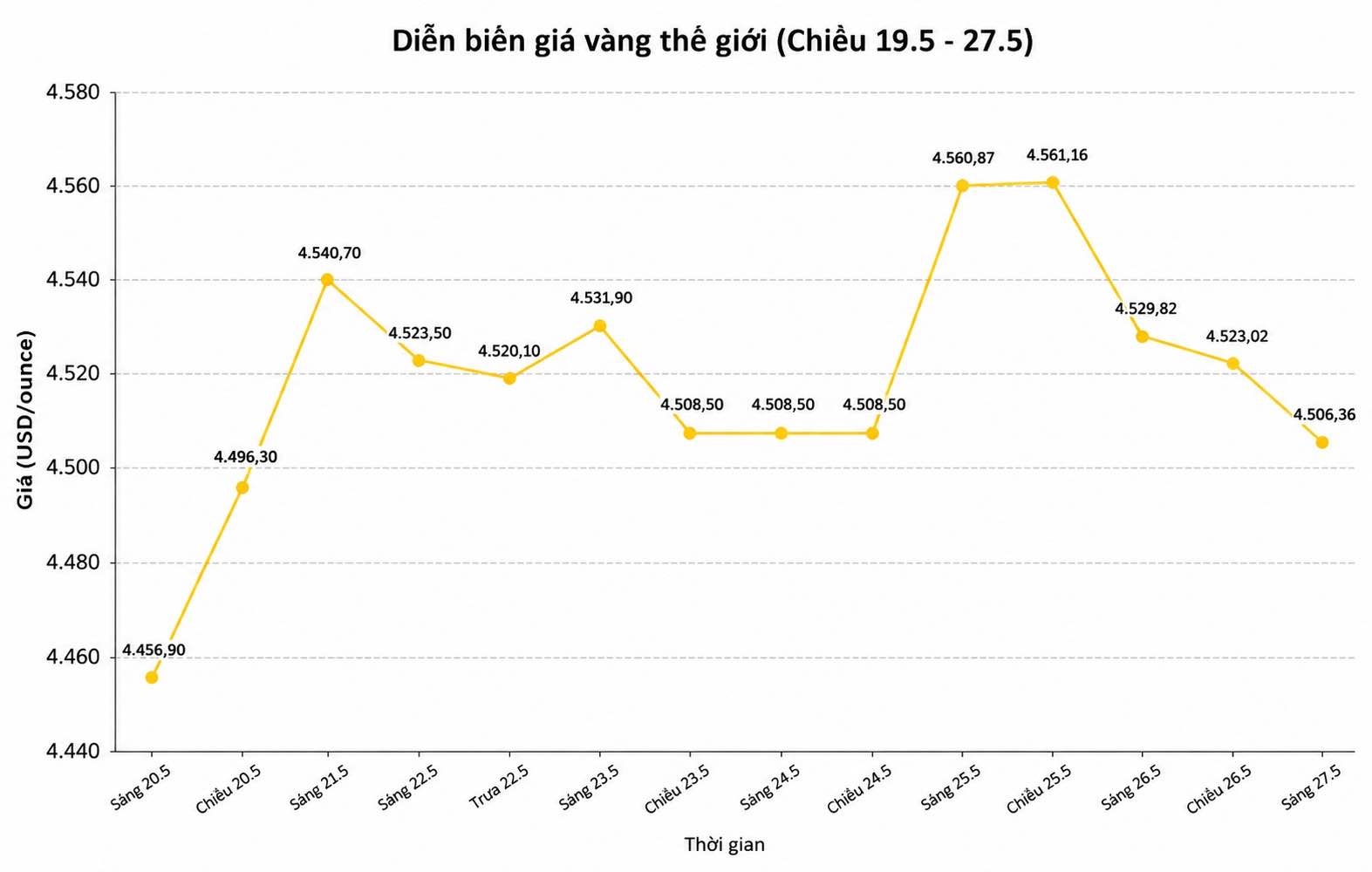
Gold prices maintained a downward trend as new clashes in the Persian Gulf weakened expectations of a peace agreement between the US and Iran, while strengthening concerns that inflation could cause interest rates to remain high longer.
This precious metal traded around the threshold of 4,500 USD/ounce in the first session of the day, after falling 1.4% in the previous session.
Confrontations between US and Iranian forces near the Strait of Hormuz continue to occur, even as both sides signal that the negotiation process is making certain progress. US Secretary of State Marco Rubio said that any agreement could take several more days to complete.
Although the negotiation process is not really clear, the market still increases expectations that the conflict that has lasted for the past three months will be controlled and not escalate widely. This positive sentiment has supported the global stock market to rise to new highs.
Mr. Ryan McKay – an analyst at TD Securities – said that expectations for a US-Iran deal have somewhat supported gold, but the precious metals market is still under great pressure from inflation concerns.
The current price outlook is still leaning more towards the risk of decline," he said.
Since the conflict broke out at the end of February, gold prices have fallen by about 15%.
The market is currently increasing bets on the possibility of the US Federal Reserve (Fed) raising interest rates as the war in the Middle East pushes energy prices up sharply and raises inflationary pressure.
Higher interest rates are often detrimental to gold because this precious metal does not yield yields.
As of 10:02 a.m. Vietnam time, spot gold price decreased 1.42% to 4,506.36 USD/ounce.
Meanwhile, silver prices slightly decreased by 0.1% to $76.93/ounce. Platinum and palladium prices also recorded a downward trend.
The Bloomberg Dollar Spot Index – a measure of the strength of the USD – was almost flat after increasing by 0.1% in the previous session.