
According to Jeremy Szafron - an expert from Kitco, the world is witnessing an unprecedented period of strong volatility, as economic, geopolitical and energy factors simultaneously put pressure on the global financial system. In that context, many experts believe that a major upward cycle of gold and silver may be beginning.
Recently, the US Federal Reserve (Fed) decided to keep interest rates unchanged at 3.5% - 3.75%, while acknowledging that inflation has not been fully controlled. Although it is expected to reduce interest rates in 2026, the Fed has raised its core inflation forecast to 2.7%, showing that price pressure is still prolonged.
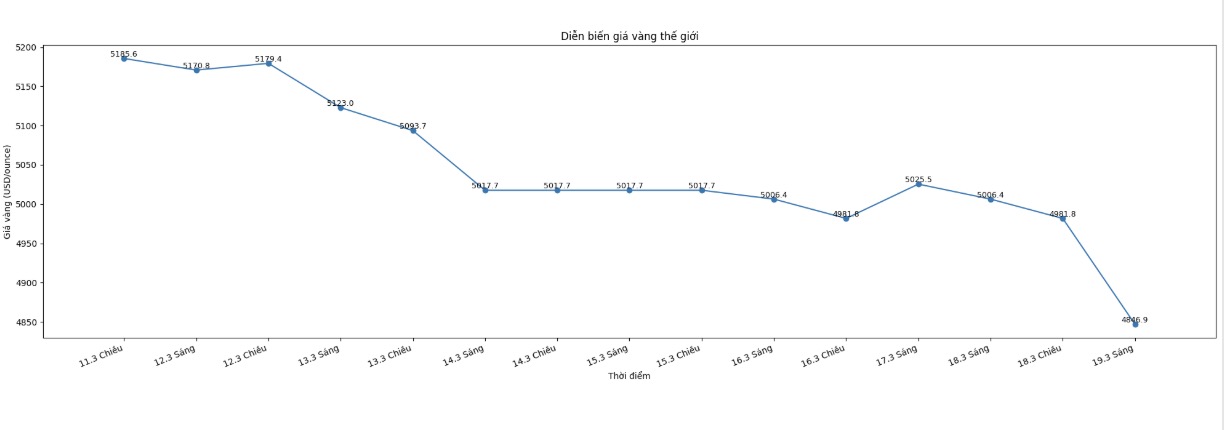
According to Mr. Philippe Gijsels - Strategy Director at BNP Paribas Fortis, the current fluctuations in the precious metal market are only temporary. He said this is a period of "reduction of leverage" before entering a major price increase cycle, even possibly the "largest in history".
One of the main reasons lies in the risk of "inflation stagnation" - that is, high inflation but weak economic growth. In this situation, central banks may be forced to accept high inflation to avoid deep recession. This means that the value of legal tender (paper money) will decrease over time.
Mr. Gijsels believes that when people realize that cash is depreciating rapidly, they will switch to holding tangible assets such as gold and silver. He even made a bold forecast: gold prices could reach 10,000 USD/ounce in the next few years, while silver could rise to about 200 USD/ounce.
Not only monetary factors, geopolitical situations are also contributing to pushing commodity prices up. Attacks on Iran's energy infrastructure, especially the South Pars gas field, have caused oil prices to rise sharply. Gas exports to Iraq are disrupted, affecting electricity sources and energy supply chains.
More worryingly, the Strait of Hormuz - which transports about 20% of global oil - is facing the risk of being blockaded. If this situation continues, oil prices could rise to 150 USD/barrel, leading to many serious consequences for the world economy.
In that context, Mr. Gijsels believes that the world is shifting to a new model where material assets play a central role. He calls this the "HALO" framework - meaning heavy, less outdated assets such as metals, energy or industrial materials.
Even in the era of technology and artificial intelligence, digital systems are still dependent on physical resources such as copper, silver or energy. This makes demand for basic commodities increasing.
At the same time, traditional investment models such as the portfolio of 60% shares - 40% bonds are gradually losing their effectiveness in a high inflation environment. Institutional investors are therefore starting to shift to directly holding tangible assets, even checking the actual amount of gold reserves to ensure transparency.
In short, the current fluctuations are not just a short-term crisis, but may be a sign of a profound change in the way the world values assets. In this new era, "real value" - that is, what can be held and used - is gradually returning to the central position of the global economy.


