
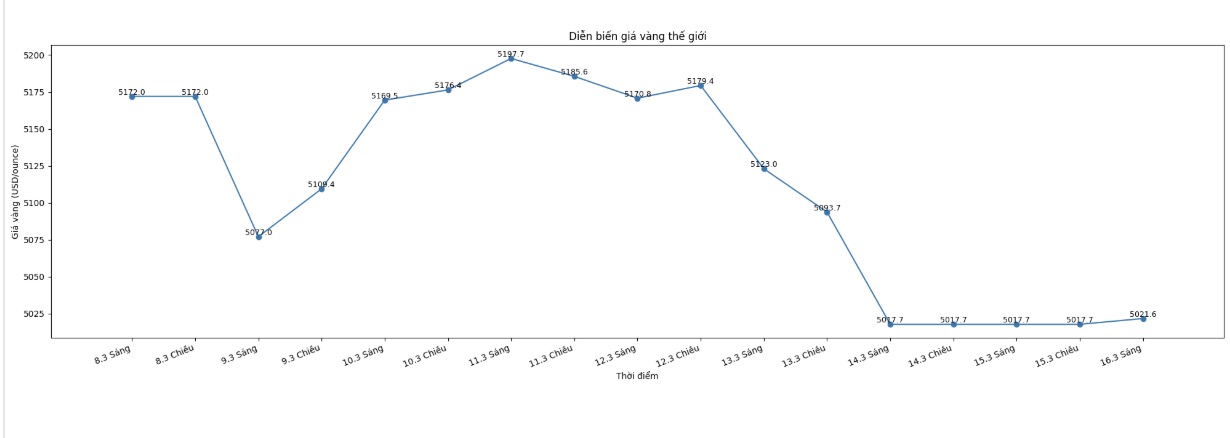
At 7:51 AM on March 16 (Vietnam time), spot gold prices on the international market were listed at 5,021.6 USD/ounce, only slightly higher than the important support zone of 5,000 USD/ounce.
According to Mr. James Stanley - senior market strategist at Forex. com, the fact that gold is maintained above the 5,000 USD/ounce mark is of great psychological significance to the market.
Gold prices have maintained the 5,000 USD/ounce mark on the spot market, which I think is much more important than the majority think. This shows that the acceptance level is increasing, and as long as that trend persists, I believe that buyers still have a chance to create a new rally" - he said.
However, some other experts are more cautious about the short-term outlook for the precious metal.
Mr. Daniel Pavilonis - senior commodity broker at RJO Futures, said that the developments of gold and silver are currently closely linked to the stock market, while stocks are heavily influenced by US Treasury bond yields.
“All movements of metals are linked to the energy market and focus on the yield curve, especially the yield of 10-year term bonds. As long as yields continue to rise, it will put pressure on gold and silver,” he said.
According to Mr. Pavilonis, tensions in the Middle East are creating many unpredictable variables for the global energy and financial markets. He said information about the possibility of the US deploying Marine Corps forces to this region, as well as the fact that Indian and possibly Chinese oil tankers continue to pass through important straits, could directly affect oil supply and market sentiment.
If most of the oil continues to flow through the straits, it could help cool down the situation and stabilize the market. However, everything remains a big question mark and depends a lot on what happens in the weekend," he said.
Mr. Pavilonis believes that rising oil prices could cause inflation to escalate, push US bond yields up and put pressure on precious metals.
As long as interest rates continue to rise due to rising oil and energy prices, because energy transportation to Europe and Asia is facing risks - then I think metals will be sold off as well," he explained.
According to him, in a negative scenario, gold may even fall sharply.
Could there be a scenario where gold prices return to around 4,200 USD/ounce? I think that is likely to happen," he said.
From a technical perspective, Mr. Marc Chandler - Managing Director of Bannockburn Global Forex - said that gold is still fluctuating within the range set from the beginning of the month.
“This precious metal is still fluctuating in the range set from March 3, in the range of 4,996 - 5,381 USD/ounce. The resistance zone may be around 5,160 USD, and if it exceeds 5,207 USD/ounce, the technical trend will improve," he said.
According to Mr. Chandler, disappointing US economic data along with the temporary stagnation of oil prices may create conditions for gold to increase next week.

Meanwhile, Mr. Alex Kuptsikevich - senior market analyst at FxPro, believes that gold may weaken again.
“In the past week, gold prices only fluctuated within a range of more than 3%, which can be considered quite quiet considering the current geopolitical context. What is more difficult to understand is the increase in selling volume when prices increase, which at first glance does not fit the story that gold is a safe haven,” he said.
According to senior Kitco analyst Jim Wyckoff, inflationary pressure due to the war in the Middle East pushing up energy costs is making precious metal traders cautious.
Technically, he said that the next goal of the buying side is to bring the April gold futures price to close above 5,434.10 USD/ounce, corresponding to the peak of the previous week. Conversely, the goal of the selling side is to pull the price down below 5,000 USD/ounce.
In the short term, important technical milestones of gold include the nearest resistance at 5,132.40 USD and 5,200 USD, while the first support is at 5,058.20 USD and 5,021.20 USD.


