
Because the end of the ongoing war in Iran has not yet been seen, some analysts warn that gold investors may suffer further losses, as rising energy prices are creating an inflation risk, forcing central banks to temporarily suspend policy easing and switch to a "wait and see" attitude.
The gold market has been significantly technically affected after prices fell below the 50-day moving average, just below 5,000 USD/ounce.
Kelvin Wong - senior market analyst at OANDA - said that the sharp drop on Wednesday along with further selling pressure created a turning point for the gold market.
He said that in terms of price structure, the 23% increase from the low of February 2, 2026 ($4,020 USD) to the high of March 2, 2026 ($5,420 USD) may just be a temporary recovery (also known as "dead cat bounce"), and the next trend is likely to be a sharp decline lasting for many weeks.
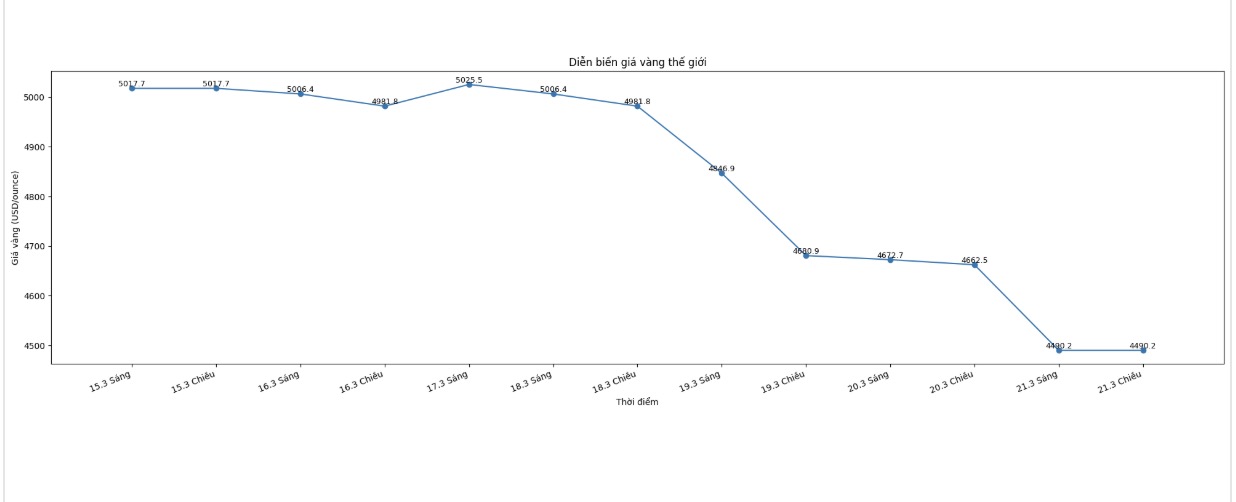
The gold market is expected to end the week with a decrease of more than 8% - the largest weekly decrease in 6 years, since the global economy closed due to the COVID-19 pandemic. Spot gold price is currently at 4,584.10 USD/ounce, down more than 1.7% in the day.
Meanwhile, silver may end the week with a decrease of nearly 14% - the strongest since January. Spot silver price is currently at 68.96 USD/ounce, down more than 5% on the day.
Rob Haworth - senior investment strategist at U.S. Bank Wealth Management, said that the gold sell-off was not surprising, as the market was previously driven by strong speculation from the beginning of the year.
He said gold prices could fall further as investors buying over 5,000 USD/ounce begin to cut losses.
Speculators are facing a difficult decision. Many people have tried to get through the fluctuations in February, but currently many investments are losing money. The situation could get worse," he said.
Analysts believe that everything currently depends on developments in the Middle East and whether supply chain issues will be resolved if the Strait of Hormuz is reopened or not.
Bernard Dahdah - a precious metals expert at Natixis, said that gold prices could fluctuate in the range of 4,600-4,700 USD/ounce while the world is waiting for war developments with Iran, but warned that downside risks are increasing.
He believes that if energy infrastructure continues to be destroyed and the war lasts, gold prices could fall to nearly 4,000 USD/ounce, because even the Fed will have to raise interest rates when energy prices remain high.
However, he does not believe that the long-term trend of gold will be at this low level. If energy damage is limited and oil prices fall rapidly to pre-war levels, central banks may increase gold purchases, helping prices return to above 5,000 USD/ounce.
Despite facing many short-term difficulties, experts remain optimistic about gold in the long term. Ole Hansen, Head of Commodity Strategy at Saxo Bank, believes that the reasons why investors buy gold at the beginning of the year are still there, as the global economy remains unstable due to geopolitical tensions and rising public debt.
He said investors need to "lose interest" before returning more strongly - that is, they need to see signs that the worst period has passed.
A major reason why gold does not increase in price as a wartime refuge is inflationary pressure due to rising energy prices.
This week, major central banks have kept interest rates unchanged and switched to neutral status to wait and see how war affects inflation.
Haworth said the next 4-6 weeks will be very important as businesses adjust their financial plans before the summer.
Meanwhile, the market has quickly reduced expectations that the Fed will cut interest rates this year.
Economic data to watch next week
US S&P Preliminary PMI.
Number of US weekly jobless claims.


