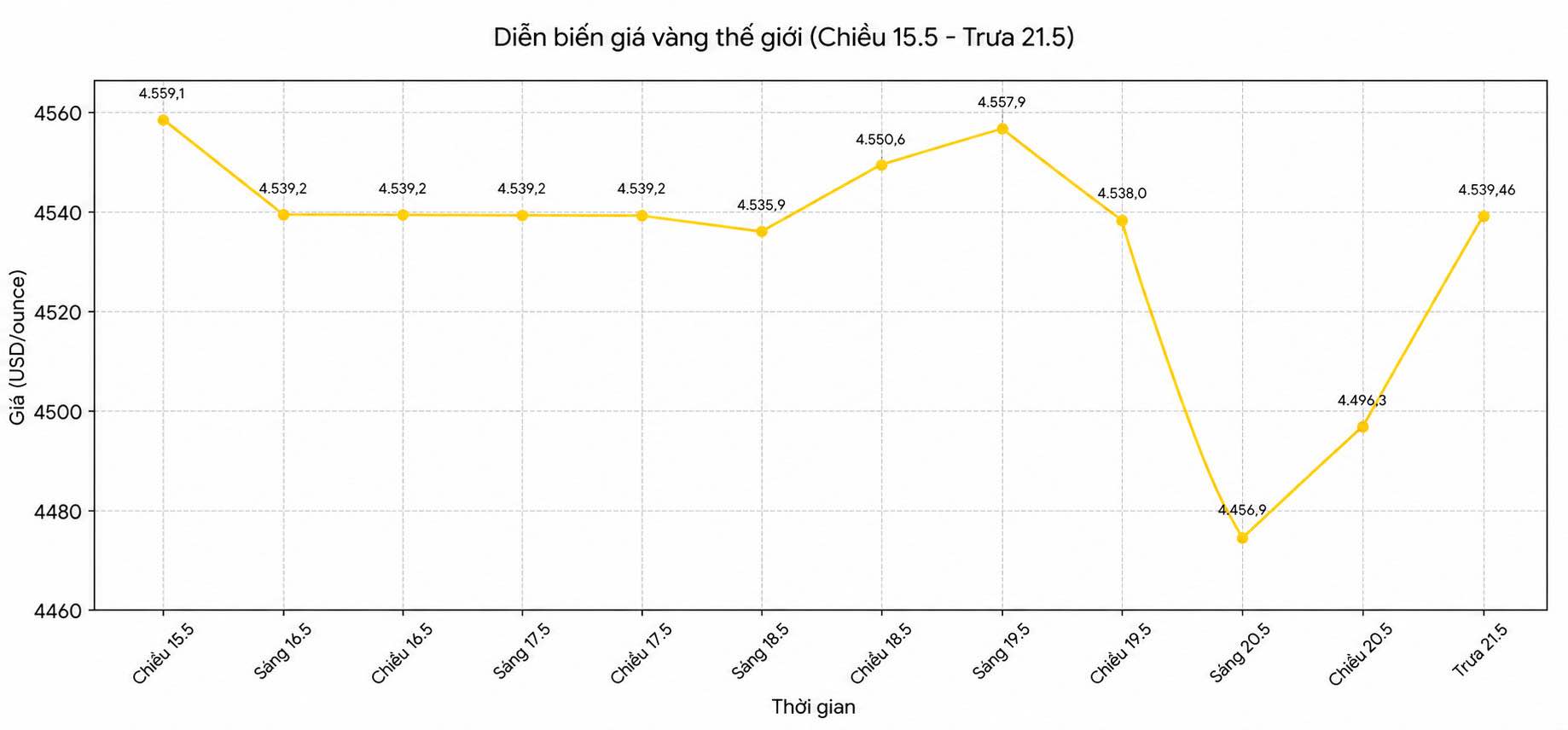
Gold prices went sideways in the latest trading session as the market continued to monitor efforts to cool down the conflict in the Middle East, thereby somewhat reducing expectations about the possibility of central banks continuing to raise interest rates.
Spot gold prices fluctuated around 4, 540 USD/ounce in the morning session in Asia after increasing by about 1.4% in the previous session.
US President Donald Trump said Washington is entering a "final stage" in the negotiation process with Iran. This information contributed to pulling down the USD and US bond yields in the May 20 session, thereby supporting the gold market.
According to analysts, if the conflict cools down soon and the Strait of Hormuz resumes normal operation, inflationary pressure from energy prices may ease. This will reduce expectations that interest rates will remain high longer – a factor that is often beneficial for gold because the precious metal does not generate profits.
However, market sentiment is still quite cautious as statements and developments related to the Middle East conflict have continuously changed recently.
Since the war broke out at the end of February, gold prices have still fallen by about 14%, while the yield of 10-year US Treasury bonds continues to linger near the highest level in about a year.
The minutes of the most recent policy meeting of the US Federal Reserve (Fed) also show that many Fed officials believe that the central bank may need to consider raising interest rates if inflation continues to remain higher than the target for a long time.
The gold market is currently still fluctuating in a narrow range after a sharp decline in the early stages of the Middle East conflict. Investors are considering the balance between pressure from high interest rates and the possibility of the global economy facing a slow growth scenario accompanied by high inflation – a capital environment that usually supports gold.
Citigroup experts believe that if the situation in the Strait of Hormuz gradually cools down, macroeconomic pressures that are adversely affecting gold may weaken and gold prices are likely to create a more stable bottom.
Meanwhile, if the disruption lasts longer than expected, concerns about the risk of an inflation pause may increase – the capital environment usually supports the precious metal group.
As of 12:02 Vietnam time, spot gold prices were almost flat at 4,539.46 USD/ounce. Silver prices slightly decreased by 0.1% to 75.83 USD/ounce, while the Bloomberg Dollar Spot Index slightly increased after falling 0.3% in the previous session.