
Changes in interest rate expectations and liquidity demand in USD are putting pressure on gold prices. However, analysts warn investors not to confuse this short-term correction with the long-term upward trend of the market.
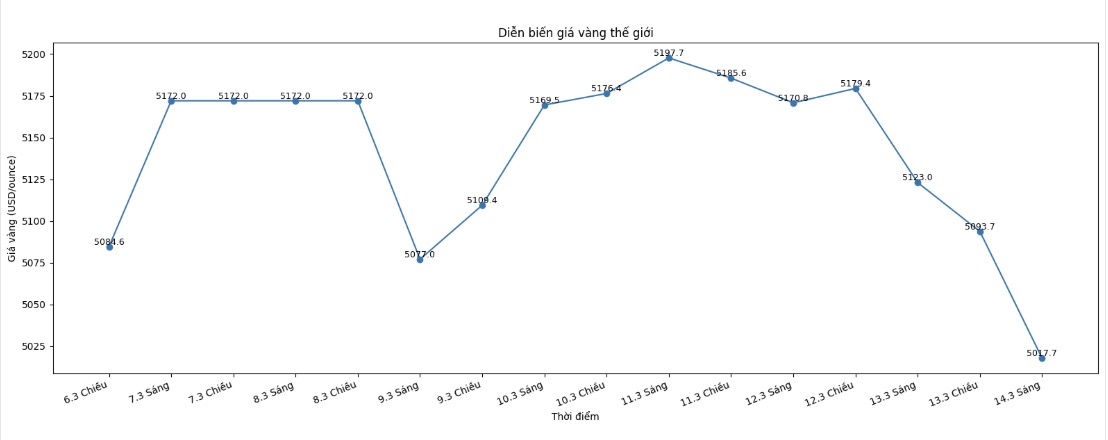
The gold market is experiencing its second consecutive week of decline as prices test the support zone above the 5,000 USD/ounce mark. The nearest spot gold price traded at 5,017.7 USD/ounce.

I am holding a gold buy position and the past two weeks have really been uncomfortable" - Christopher Vecchio - Head of Futures and Foreign Exchange Strategy at Tastylive.com, said.
However, looking at the overall picture of the financial market, Vecchio believes that the gold sell-off is understandable, because the joint war between the US, Israel and Iran has created a strong liquidity demand for the USD.
Although the gold market in general has very high liquidity, the physical gold market during economic tensions can quickly fall into a state of low liquidity. In that context, Vecchio believes that there is only one type of asset that investors really need.
In the current uncertainty, investors need to calculate the liquidity of the global reserve currency - the USD," he said.
Vecchio believes that the sale of US government bonds causing yields to return above 4% shows that demand for safe-haven assets is still weak. However, as emergency liquidity demand decreases, he expects gold demand and gold prices to increase again.
The liquidity demand phase of the crisis is still ongoing, so I am still cautious with precious metals. It is difficult to determine when liquidity scarcity will end, so gold may not increase immediately. It may only be stable for a while," he said.
In addition to the latest geopolitical tensions, the USD is also supported by changes in interest rate expectations ahead of the monetary policy meeting of the US Federal Reserve (Fed) next week.
The war with Iran has caused major disruptions in the global supply chain, especially causing energy prices to rise sharply. Rising oil and other commodity prices are raising concerns that inflationary pressure in the US may force the Fed to maintain a neutral monetary policy stance longer than expected.
In a report released on Friday, economists at BMO Capital Markets said they currently forecast that the Fed will cut interest rates twice this year, with the first cut in September. Previously, this Canadian bank expected three cuts starting from June.
The sharp increase in oil prices due to the Iranian conflict is increasing the risk of an inflationary period, in the context that job growth has slowed down significantly and inflation is still persistently at an uncomfortable level," analysts said.
Julia Khandoshko - CEO of European brokerage firm Mind Money - told Kitco News that as inflation risks increase, the Fed does not have many reasons to rush to ease policy.
Geopolitics is often exaggerated in monetary policy debates, but oil prices are a factor the Fed cannot ignore. If crude oil remains around $100/barrel or higher, gasoline prices in the US will rise sharply and directly impact consumer spending baskets. In such an environment, discussing interest rate cuts is almost becoming inappropriate," she said.
Lukman Otunuga - senior market analyst at FXTM - believes that gold testing the 5,000 USD/ounce support zone before next week's Fed meeting is not surprising. However, risks still lean towards decline.
Currently, traders are only valuing 80% of the Fed's ability to cut interest rates once in 2026, in the context that oil prices are still around the three-digit level. The short-term outlook for gold may be affected by the developments of the USD, but the Fed's decision next week will shape the medium and long-term outlook for the precious metal," he said.
According to Otunuga, the market does not expect the Fed to change interest rates in the upcoming meeting, but the central bank may be forced to reconsider its policy strategy for 2026 as energy prices soar.
If the "hawks" prevail, gold may face more pressure, especially as this precious metal has fallen more than 3% since the beginning of the month. On the chart, gold is still under pressure below $5,100, with downward targets at $5,000 and $4,900/ounce.


