
Gold prices stabilized around the psychological level of 4,000 USD/ounce in the last trading session of the week after the latest US inflation data was lower than expected, helping to cool down concerns about the US Federal Reserve (Fed) raising interest rates soon.
However, the precious metal is still heading towards its fourth consecutive week of decline as the USD remains at a high level and the Fed's monetary policy continues to be a major drag on the market.
Spot gold prices almost went sideways in the first trading session of the day, after recovering 0.7% in the previous session. By 10:03 am Vietnam time, spot gold prices decreased slightly by 0.04%, to 3,989.25 USD/ounce.
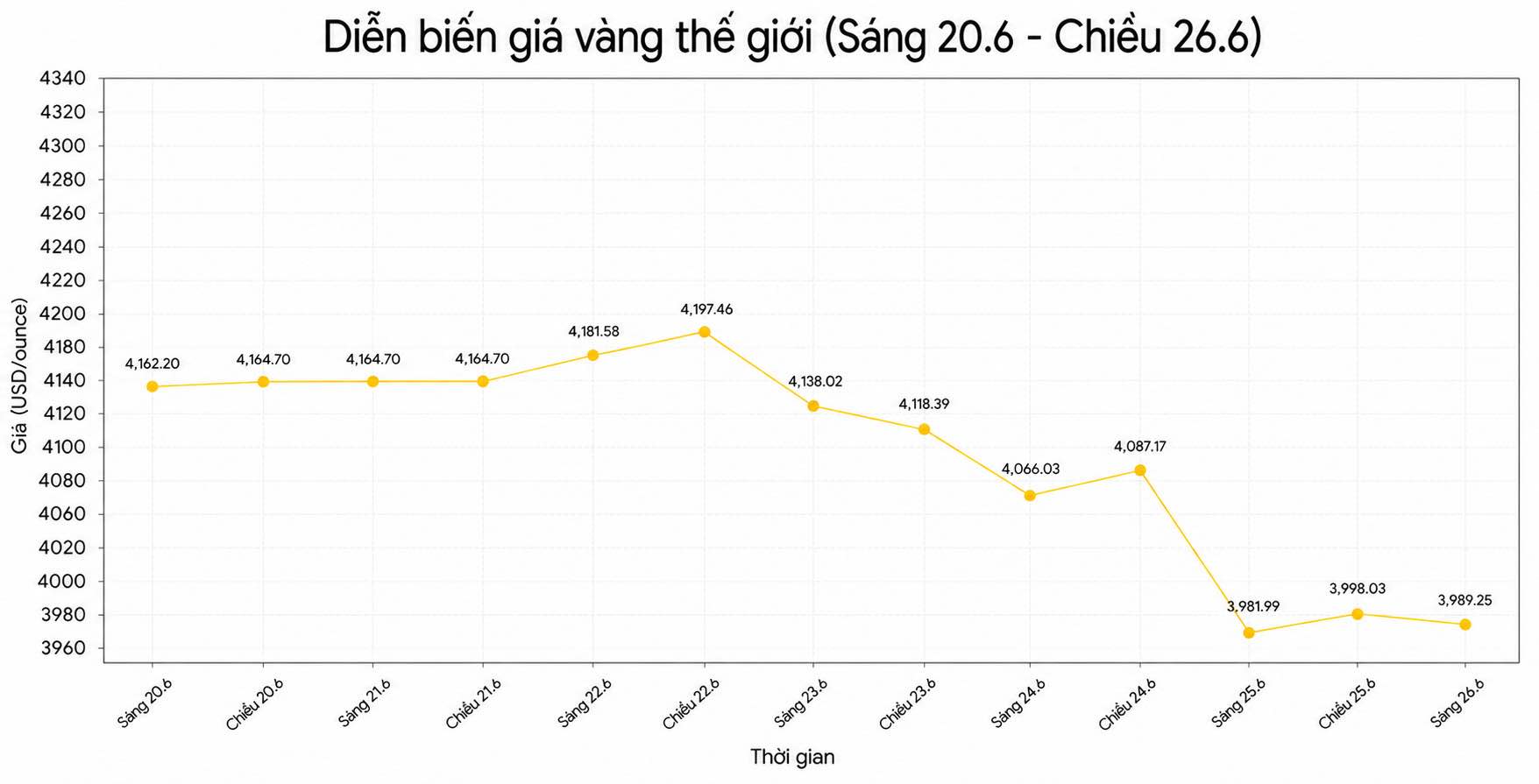
The driving force supporting gold comes from the US Personal Consumption Price Index (PCE) report – an inflation measure prioritized by the Fed. In May, this index only increased by 0.4%, lower than market expectations, pulling US Treasury bond yields down in the trading session on June 25.
The above developments caused investors to reduce expectations that the Fed will soon raise interest rates. On the bond market, the probability of the Fed raising interest rates right at next month's meeting has decreased to about a third, and expectations for interest rate hikes this year have also been adjusted down.
However, pressure on gold has not disappeared.
According to Mr. Ole Hansen – Head of Commodity Strategy at Saxo Bank, a strong USD and the Fed's tough stance after last week's meeting are still the two biggest factors putting pressure on the precious metals market.
He said gold and silver are in a defensive state as many investors continue to reduce their holdings or withdraw capital from the market.
Considering the total yield, gold prices are currently down 8.4% from the beginning of the year but still 18.5% higher than the same period last year. Meanwhile, silver has decreased by 19% from the beginning of the year, although it has still increased by about 56% in the past 12 months.
According to Mr. Hansen, the fact that gold prices lost the 4,000 USD/ounce mark this week has significantly weakened market sentiment and may cause investors holding buy positions to continue selling. Since the historical peak of over 5,600 USD/ounce in January, gold prices have adjusted by about 26%.
However, Saxo Bank's experts also noted that some unfavorable factors are gradually weakening.
The sharp drop in oil prices has contributed to easing inflationary pressure, thereby reducing the need for the Fed to continue to tighten monetary policy. This trend is also reflected in the futures contract market as expectations of additional interest rate hikes are starting to cool down, while long-term US Treasury bond yields are also declining.
In addition, major Chinese banks have tightened the trading of precious metals by individual investors by stopping opening new accounts, stopping intermediary trading services and sharply increasing margin requirements to limit speculation using high leverage.
According to Mr. Hansen, considering fundamental factors, the environment for the gold market is actually becoming less disadvantageous than a week ago. However, for gold prices to regain their upward momentum, the market needs to witness capital withdrawal from gold ETF funds stagnate and the USD gradually loses its upward momentum.
Meanwhile, the USD ended its rally in the trading session on June 25 after increasing by about 1.8% since the most recent Fed meeting. At this meeting, policymakers signaled to continue prioritizing inflation control, while new Fed Chairman Kevin Warsh maintained a tough stance on monetary policy.
In addition to gold, silver prices also slightly decreased by 0.1% to 57.80 USD/ounce after increasing by 0.8% in the previous session. Platinum and palladium prices also recorded a slight decrease. Experts believe that in the short term, the diễn biến of the group of precious metals is likely to still be dominated by the strength of the USD, Fed policy expectations and investment capital flows, instead of basic supply-demand factors.


