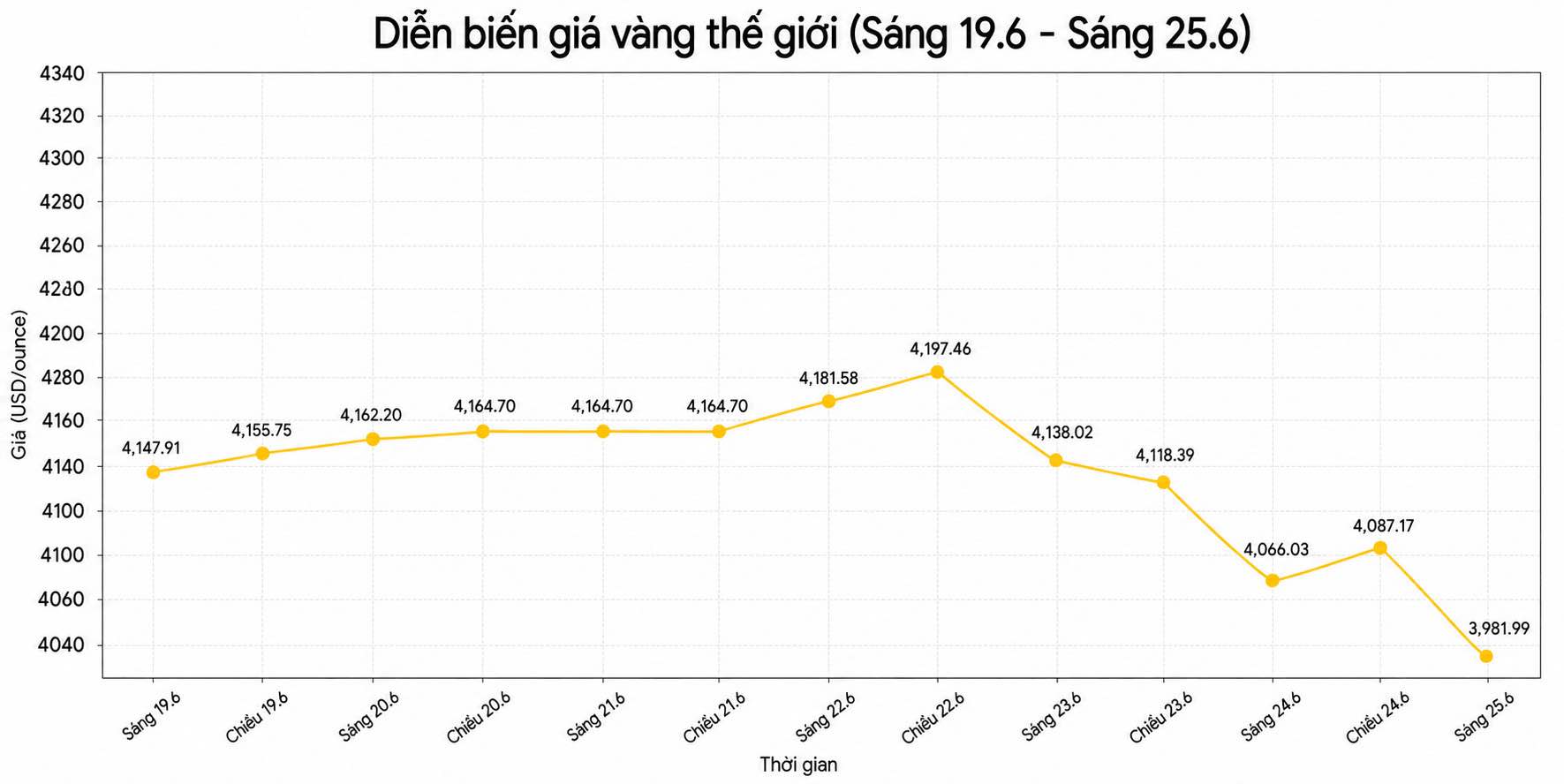
Spot gold prices almost went sideways in the first trading session on Thursday after falling below the 4,000 USD/ounce mark for the first time since November last year. The strengthening USD along with expectations that the US Federal Reserve (Fed) will continue to raise interest rates is putting great pressure on the precious metals market.
Spot gold prices remained almost unchanged after falling nearly 3% in the previous session. The USD strength index increased by about 0.8% this week, making gold valued in greenbacks more expensive for investors holding other currencies.
Fed officials also continuously sent signals in support of raising borrowing costs. At the first policy meeting last week, new Fed Chairman Kevin Warsh expressed a tough stance on inflation control, thereby strengthening expectations that interest rates will continue to rise. Tightening monetary policy makes gold - an asset that does not yield yields - less attractive than profitable assets such as US Treasury bonds.
Traders also increased their bets on the possibility that the Fed will raise interest rates this year as concerns about inflationary pressure arising from the war between the US and Iran have not cooled down.
The market's expectation that the Fed may raise interest rates right from September, along with the Fed's tough stance, the USD rising to a 13-month high and the expectation of declining inflation are putting great pressure on the precious metals market," said Tai Wong, an independent metal trader.
According to Mr. Wong, gold is having an important support zone right below the 3,900 USD/ounce mark.
For gold, the support zone is right below the 3,900 USD/ounce mark and buying pressure from central banks is still maintained, so the possibility of a sharp price drop is not high. However, the market may enter a prolonged accumulation phase when gold is no longer a preferred asset for investors," he said.
The recent decline also marked the end of the nearly three-year upward cycle of gold. In the past three consecutive years, this precious metal has recorded a double-digit increase, with value increasing more than double thanks to strong buying power from central banks, fund managers and individual investors.
However, the upward momentum began to weaken from the end of January, not long after gold hit a historical peak of nearly 5,600 USD/ounce. By June, gold prices had fallen more than 20% compared to the nearest peak - a threshold often seen as a sign that the market is entering a bear market.
One of the main factors putting pressure on gold's developments is the war between the US and Iran, which has caused energy prices to rise and increased inflationary pressure. This forces the market to adjust expectations in the direction that the Fed will maintain a tougher monetary policy for longer.
In that context, a series of large investment banks simultaneously lowered their gold price forecasts.
Most recently, ING experts also adjusted down the outlook for precious metals, forecasting that the average gold price will reach about 4,300 USD/ounce in Q3/2026 and 4,600 USD/ounce in Q4/2026, significantly lower than previous forecasts of 4,850 USD/ounce and 5,000 USD/ounce respectively.
By 10:35 am Vietnam time, spot gold prices fell 3.8% to 3,981.99 USD/ounce. Silver prices fell 1.17% to 56.73 USD/ounce after plunging 6.8% in the previous session to the lowest level since December. Platinum and palladium prices also simultaneously fell sharply, the Bloomberg Dollar Spot Index slightly decreased after increasing by 0.3% in the trading session on Wednesday.