
Gold price adjusts sharply
The domestic and world gold markets recorded a strong correction in the past two months. From the peak of mid-May, the prices of SJC gold bars, 9999 gold rings and world gold simultaneously decreased sharply, putting great pressure on many investors if they buy at high prices.
According to recorded data, on May 1, DOJI Group listed SJC gold bar prices at 156-159 million VND/tael for buying - selling. At the same time, 9999 gold ring prices were also listed at 156-159 million VND/tael. World gold prices closed the weekly trading session at 4,531.3 USD/ounce.
By May 15, the gold market continued to increase sharply. SJC gold bar prices at DOJI were listed at the threshold of 161-164 million VND/tael. 9999 gold ring prices were also at the threshold of 161-164 million VND/tael. This is the highest price range in the surveyed period. At the same time, world gold prices were around the threshold of 4,612.7 USD/ounce.
However, after setting a peak, gold prices began to reverse. On June 1, SJC gold bars and 9999 gold rings at DOJI both decreased to the threshold of 156-159 million VND/tael, which means losing 5 million VND/tael in both buying and selling directions compared to May 15. World gold prices also retreated to 4,524.1 USD/ounce.
The decline became more pronounced in the first half of June. By June 15, the price of SJC gold bars at DOJI was only 147-149.5 million VND/tael. The price of 9999 gold rings was also listed at the same level of 147-149.5 million VND/tael. Thus, in just about a month, domestic gold prices have decreased by 14.5 million VND/tael in the selling direction compared to the peak area on May 15.
As of July 1st, SJC gold bar prices at DOJI continued to decrease to 143.4-146.4 million VND/tael. 9999 gold ring prices are also at 143.4-146.4 million VND/tael. Compared to the peak of May 15th, both SJC gold bars and 9999 gold rings have decreased by 17.6 million VND/tael in both buying and selling directions.
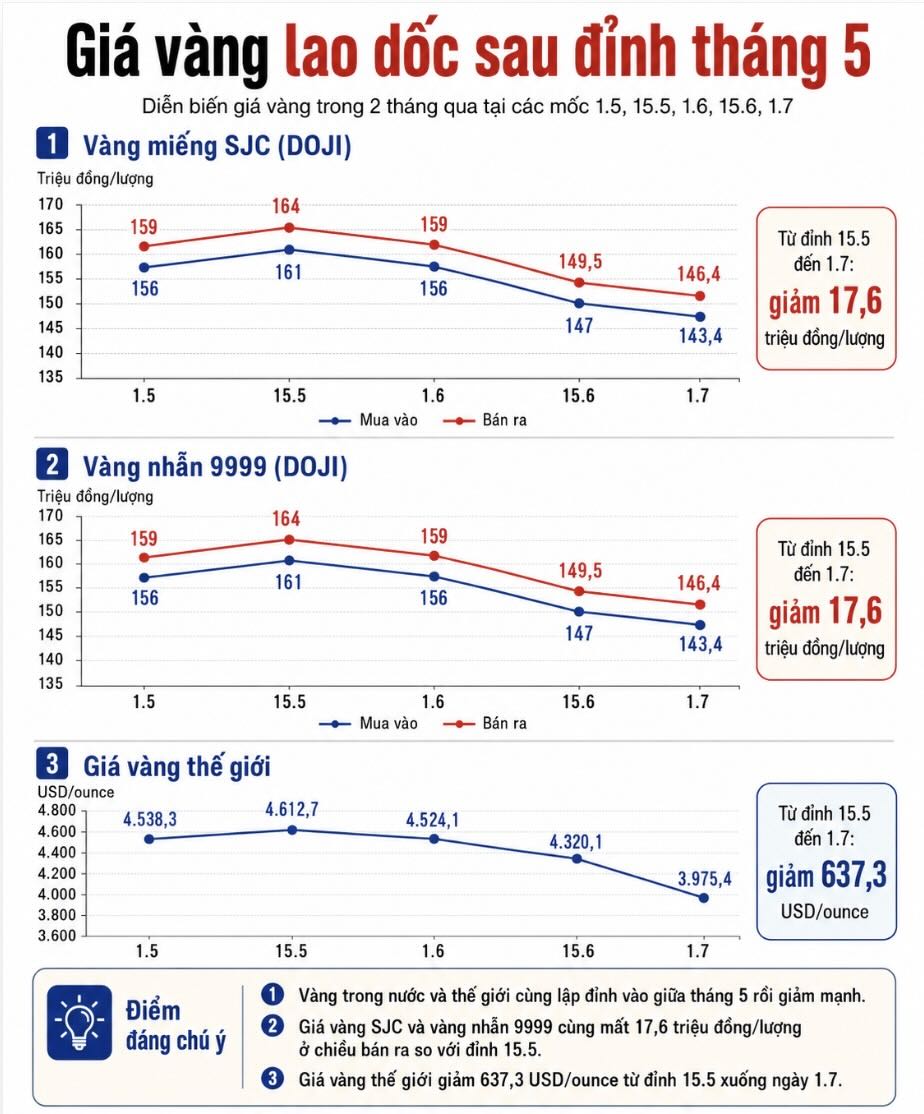
World gold prices also recorded a sharp decrease. From 4,612.7 USD/ounce on May 15, world gold prices fell to 3,975.4 USD/ounce on the morning of July 1, equivalent to a decrease of 637.3 USD/ounce. Compared to May 1, world gold prices also lost 562.9 USD/ounce.
The above developments show that the gold market is undergoing a significant correction after a period of hot increase. For investors buying gold at the peak in mid-May, a decrease of nearly 18 million VND/tael is a significant pressure. Especially, in the context that the buying-selling spread is still maintained at a high level, gold buyers may suffer losses even when market prices have not fallen too deeply.
Can create opportunities to buy in
Although gold prices are falling, some experts from a long-term perspective believe that the recent adjustment may create attractive opportunities to buy in, especially for investors who do not use financial leverage.
Mr. Brad Dunkley - co-founder and investment director of Waratah Capital Advisors - believes that the long-term upward trend of gold has not been broken. According to him, governments and central banks can hardly accept the economy falling into a prolonged recession, while the burden of public debt at a high level makes it difficult for them to let interest rates rise sharply. In that environment, policymakers tend to maintain low, even negative, real interest rates, and continue to expand monetary policy to support growth.
According to this view, gold still benefits from the trend of currency depreciation, the need to preserve purchasing power and the buying activity of central banks. In addition, geopolitical fragmentation and the trend of countries decreasing dependence on the USD are also factors supporting long-term gold demand.
In a more cautious direction, some J.P. Morgan experts believe that the recent tough stance of the US Federal Reserve (Fed) has caused the structural upward momentum of gold to temporarily be "frozen" deeper. As the possibility of raising interest rates or maintaining tight monetary policy still covers the market, investors tend to reduce their participation in gold in the short term.
However, J.P. Morgan has repeatedly emphasized that gold's corrections may only be temporary, while the long-term story of this precious metal is still supported by geopolitical fluctuations, currency devaluation risks, inflation, public debt and asset diversification needs.


