
The gold market is entering a period of many fluctuations, as even experts are making mixed forecasts about the upcoming trend. While some opinions suggest that gold prices may continue to fall in the short term, many Wall Street experts believe that the precious metal still has room to increase. Notably, the neutral forecasting group believes that gold prices may continue to move sideways or have unpredictable fluctuations because the market is waiting for more clear signals.
Adrian Day - Chairman of Adrian Day Asset Management - believes that gold prices are unlikely to change significantly in the short term. According to him, gold may continue to fluctuate back and forth as the situation in Iran is still unresolved.
He said that the market may have witnessed a bottom after the conflict, but it is difficult to set a new peak if monetary and fiscal concerns have not returned to the central position.
Meanwhile, Kevin Grady - Chairman of Phoenix Futures and Options - said that the market is in a state of waiting. According to him, traders do not know how long the current tension will last, as well as which direction it will end in. This makes many banks and investors switch to a risk-avoidance state, limiting trading and waiting for a clearer solution.
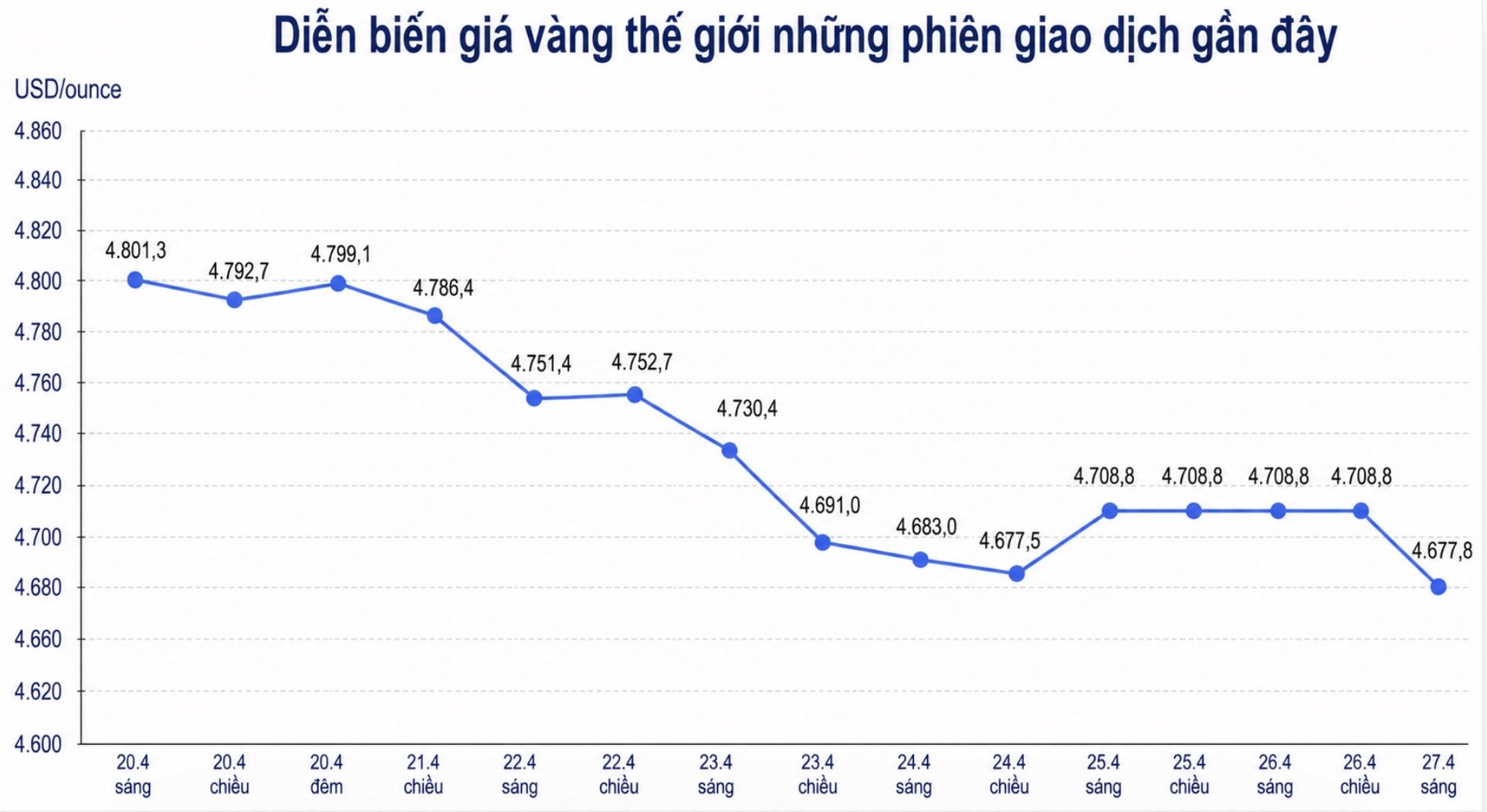
Marc Chandler - Managing Director at Bannockburn Global Forex, also believes that gold prices may break through in both directions this week.
According to him, if the price breaks the 4,600 USD mark, technical prospects will weaken; conversely, if it exceeds 4,915 USD, gold may return to the 5,100 USD zone. This assessment shows that the market is facing a major turning point, but there is no signal strong enough to confirm the trend.
The unpredictability of gold prices also comes from the unusual relationship with other assets. Some experts note that gold is sometimes fluctuating in the same direction as stocks, while still being negatively affected by energy and the USD. When US stocks are supported by a positive profit reporting season, cash flow tends to turn to stocks more than precious metals.
Meanwhile, tensions in the Middle East region continue to be a factor causing strong market fluctuations. Usually, geopolitical tensions can support gold prices due to increased safe-haven demand. However, in the current period, gold prices do not fully respond to the familiar rule. This makes forecasting more complicated.
Monetary policy is also an important variable. Many experts believe that the market is waiting for a meeting of major central banks, including the US Federal Reserve (Fed). Although interest rates are forecast to remain unchanged, the tone in policy statements may strongly affect gold prices. If central banks signal tougher, downward pressure on precious metals may increase.

In the opposite direction, some experts still maintain an optimistic view. Darin Newsom - senior market analyst at Barchart. com - believes that the basic foundation of gold still leans towards an upward trend, especially as central banks around the world continue to buy gold. Mark Leibovit, publisher of VR Metals/Resource Letter, even predicts that gold prices may surprise in an upward direction.
However, there are also many price reduction forecasts. Alex Kuptsikevich - senior market analyst at FxPro - believes that gold prices may continue to weaken, with the base scenario of falling to 4,500 USD, even 4,400 USD.
Sean Lusk - co-director of trade hedging at Walsh Trading, also said that the likely short-term trend is downward, although he believes that investors will eventually still want to return to buying gold and silver at more attractive prices.
In general, the assessments show that gold prices are in an increasingly unpredictable phase. The market is not only dependent on one individual factor, but is also dominated by geopolitical tensions, monetary policy, energy prices, USD, stocks and speculative cash flow.


