
World gold prices surged last night after the latest report showed that recruitment demand in the US continued to weaken. This development reduced concerns that the US Federal Reserve (Fed) would soon raise interest rates again.
At the beginning of the trading session in the US, spot gold prices fluctuated around 4,058.9 USD/ounce, up about 0.11%. However, after labor market data was released, the precious metal quickly attracted new buying power, rising to 4,094.4 USD/ounce.
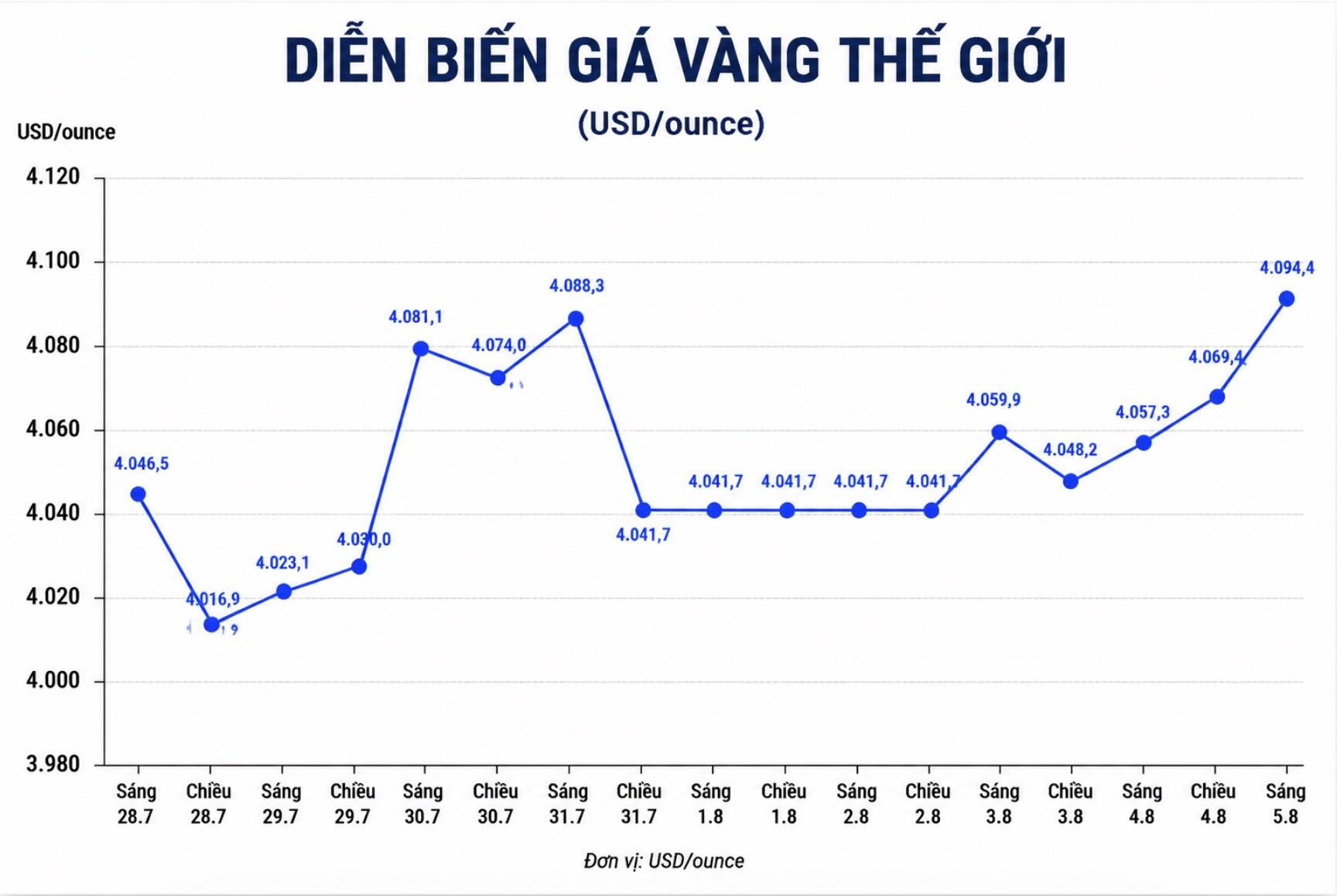
Job data creates momentum for gold prices
According to the US Department of Labor's Employment and Rotation Survey report, the number of job positions recruited in June decreased to 7.36 million, lower than the adjusted 7.54 million of the previous month.
This result is also lower than the forecast of about 7.44 million job positions that the market previously gave. The decrease in the number of vacant jobs shows that US businesses are more cautious in recruitment activities.
Other components of the report did not reflect a sudden decline. The number of people recruited remained around 5.3 million, with a recruitment rate of 3.4%. The number of workers who voluntarily resigned reached 3.2 million, while the number of people who were fired and dismissed was 1.8 million.
The above figures show that the US labor market is still relatively stable but is gradually losing momentum. This is not yet an alarming sign about the risk of recession, but it may make the Fed more cautious before continuing to tighten monetary policy.
Previously, gold prices were under pressure as the possibility of the Fed raising interest rates was brought back for discussion. At the meeting on July 29, the Fed kept the federal interest rate in the range of 3.5-3.75%. However, the agency did not provide a clear direction for the next steps.
Core inflation remains high, while US manufacturing activity shows signs of recovery. The ISM manufacturing index in July rose to 55.6 points, the highest level since 2022. These signals make it impossible for the market to rule out the possibility of further interest rate adjustments.
However, if the labor market continues to cool down, the Fed may postpone its interest rate hike plan. Lower interest rates are often beneficial for gold because the precious metal does not bring fixed cash flows like bonds.
Gold prices face many opposite pulling forces
Gold's upward momentum is still limited by the recovery of the USD and US bond yields. The USD index rebounded after a period of weakness, while the yield of 10-year US government bonds fluctuated around 4.7%.
The strengthening greenback makes gold more expensive for buyers using other currencies. Meanwhile, rising bond yields increase the opportunity cost of holding non-performing assets like gold.
Geopolitical risks in the Middle East have also not been fully resolved. However, signals related to the possibility of resuming normal operations in the Strait of Hormuz have reduced the risk of oil supply disruptions.
Brent oil traded around 84.82 USD/barrel, while WTI oil was around 80.78 USD/barrel. Stable oil prices help reduce inflationary pressure but at the same time weaken part of safe-haven demand for gold.
On the supporting side, cash flow into gold exchange-traded funds in China continues to increase. The gold buying activity of central banks is also expected to compensate for the impact of a strong USD and speculation about the possibility of the Fed raising interest rates.
In the coming days, the market will follow the private sector jobs report, the July non-farm payroll, and the US consumer price index released on August 12. If jobs continue to weaken, gold prices may receive further support. Conversely, positive data will strengthen the Fed's ability to maintain tight monetary policy.
The article only provides information about market developments, not investment recommendations.


