
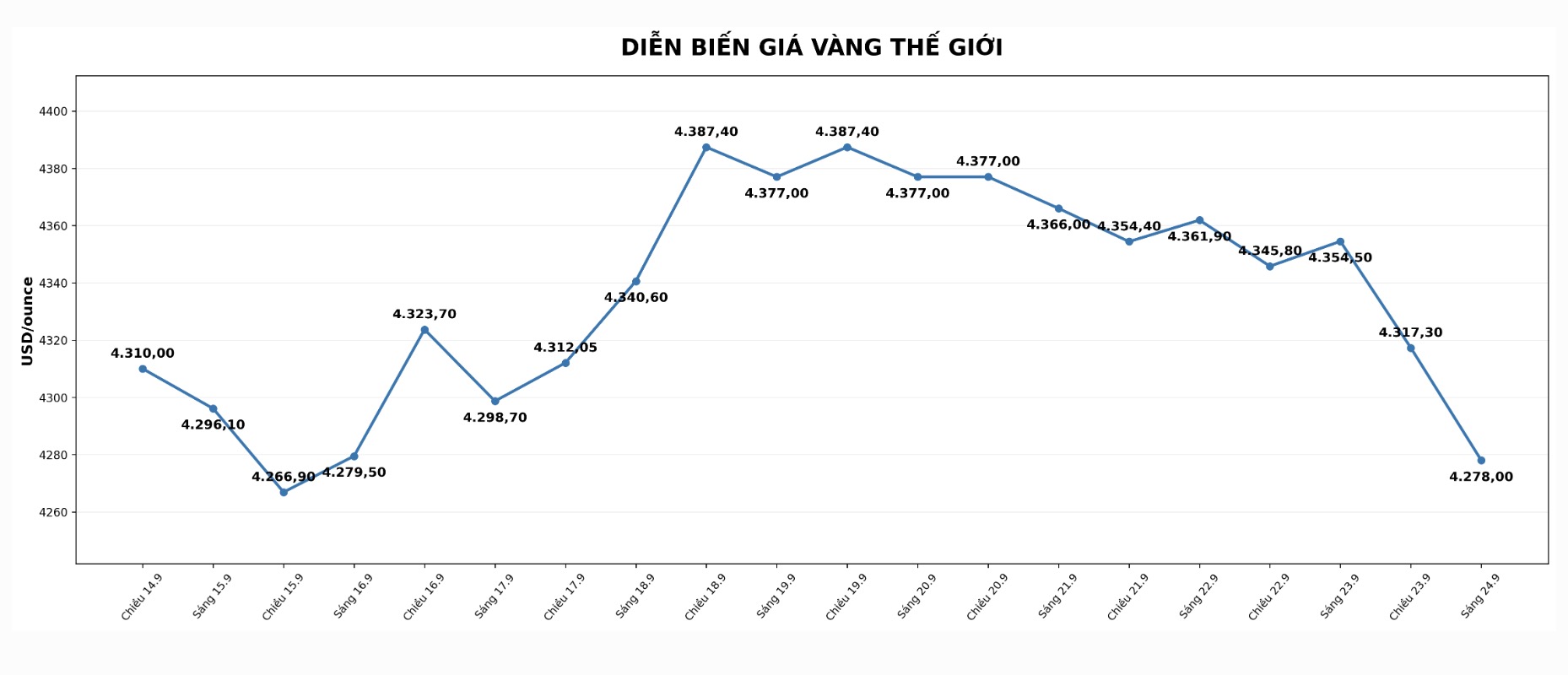
Recorded at 0:05 on September 24, spot world gold prices were listed around the threshold of 4,278 USD/ounce, down 1.82% in the session. At the same time, world silver prices fell sharply by 3.98%, to 64.26 USD/ounce.
The downward trend of the precious metal takes place in the context of the USD continuing to appreciate. The USD Index maintained around 100.79 points in the European trading session, the highest level in about two months. The strengthening greenback makes gold - an asset valued in USD - less attractive to investors holding other currencies.
In addition, the yield of 10-year US government bonds continues to linger around the 5% zone, creating more pressure on gold prices. As bond yields increase, the opportunity cost of holding non-performing assets such as gold increases, causing cash flow to tend to shift to other investment channels.
The market is currently focusing on monitoring a series of US economic data to be released soon, including the preliminary Purchasing Managers' Index (PMI) for September, weekly jobless claims, August durable goods orders and consumer psychology surveys.
Positive economic data, especially signals showing that production and consumption activities remain stable or price pressure has not cooled down, may reinforce the view that interest rates will remain high for a long time. This continues to put pressure on gold prices through the USD and real yields.
Conversely, if data shows the US economy is weakening, expectations of less tough monetary policy may create momentum to help gold recover.
In addition to the interest rate factor, oil price movements are also affecting the precious metals market. Crude oil prices continue to fall as operations at Saudi Arabia's East-West oil pipeline are restored, while the market assesses the possibility of further diplomatic signals related to US-Iran relations.
Brent oil prices retreated to around 98 USD/barrel, while WTI oil traded nearly 89 USD/barrel, marking a series of consecutive declines in many sessions. The cooling of energy prices helps reduce concerns about inflationary pressure, thereby weakening part of the demand for gold defense.
However, geopolitical risks have not completely disappeared. Instability in the Middle East region is still a factor that can support safe haven demand for precious metals in the coming time.
On the technical market, gold is under downward pressure as it has not been able to maintain the previous high price range. The levels monitored by the market include the support zone around 4,291 USD/ounce and deeper at 4,260 USD/ounce. In the opposite direction, to regain the upward momentum, gold prices need to overcome the resistance zone of 4,334 - 4,370 USD/ounce.
For silver, selling pressure also increased as prices fell below important support zones. The market is monitoring the possibility of silver holding in the 64.53 USD/ounce zone. If it continues to weaken, silver prices may head towards lower zones around 62.54 USD/ounce and 61 USD/ounce.
Current developments show that precious metal prices are being affected simultaneously by many factors: the strength of the USD, US interest rate outlook, bond yields and geopolitical situation. Investors continue to wait for new economic data to assess the direction of monetary policy in the coming time.
The article only updates the developments of the gold market and factors affecting the price of precious metals, not investment recommendations.


