
World gold prices fell in the trading session on September 23 as the USD strengthened and expectations that central banks would continue to maintain high interest rates to control inflation weakened the attractiveness of the precious metal.
At the time of writing (16:00 on September 23 - Vietnam time), the spot world gold price decreased by 0.9%, to 4,317.3 USD/ounce.
The downward trend of gold takes place in the context of the market continuing to assess the monetary policy outlook of major economies. The fact that interest rates may be maintained at a higher level for a longer time is putting pressure on the precious metal, because gold is an unprofitable asset and is often less attractive when profit-seeking investment channels become competitive.
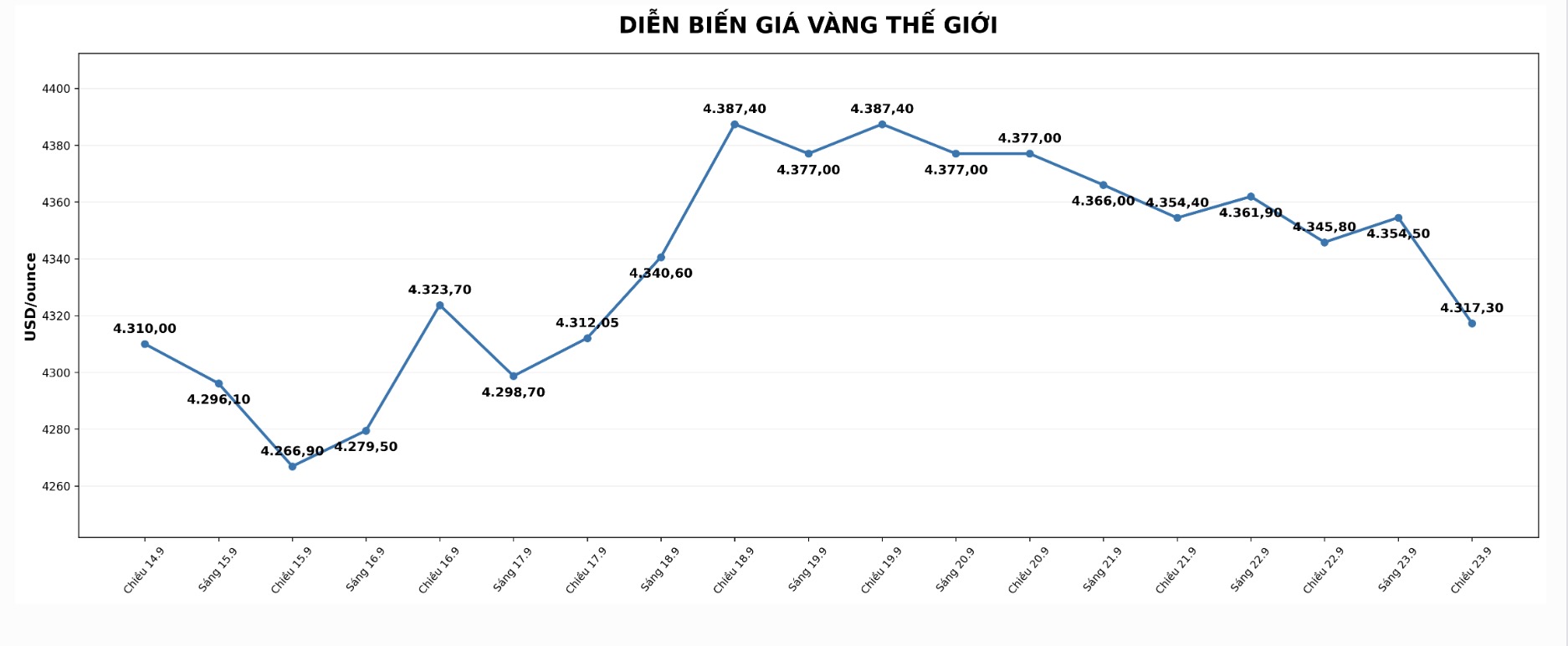
In this session, the USD rose to its highest level in about 2 months. The stronger greenback made gold - which is valued in USD - more expensive for investors holding other currencies, thereby putting more pressure on prices.
Besides the interest rate factor, the gold market is still affected by geopolitical developments in the Middle East. Tensions related to this region continue to create certain support for safe-haven demand. However, fluctuations in oil prices and new diplomatic signals may cause investor sentiment to change rapidly in the short term.
Investors are currently particularly interested in new moves from the US Federal Reserve (Fed) after deciding to raise interest rates by another 0.25 percentage points last week, bringing the reference interest rate to the 3.75-4% range. This agency also sent a signal that it may continue to raise interest rates before the end of 2026 if inflationary pressure remains persistent.
Not only the US, some other major central banks are also tending to maintain a cautious monetary policy. The fact that the global interest rate level has not yet entered a clear easing cycle makes the gold market continue to face unmoved trading sessions.
Despite short-term pressure, gold still receives support from long-term factors such as central bank buying demand and prolonged geopolitical instability. Some market forecasts suggest that gold prices in 2026 may maintain an average of around 4,400 USD/ounce, while the 3,800 USD/ounce zone is considered an area that can create support if the market experiences strong corrections.
On other precious metals markets, spot world silver prices fell sharply by 2.28% to 65.37 USD/ounce. Platinum prices fell 2.4% to 1,788 USD/ounce, while palladium fell 1.86% to 1,267 USD/ounce.
In the domestic market, gold price movements will continue to be monitored as the international market is simultaneously affected by interest rate policies, fluctuations of the USD and geopolitical factors. Investors need to pay attention to the buying-selling price difference and unpredictable fluctuations of the precious metals market.
The article only updates the developments of the gold market and factors affecting precious metal prices, not investment recommendations.


