
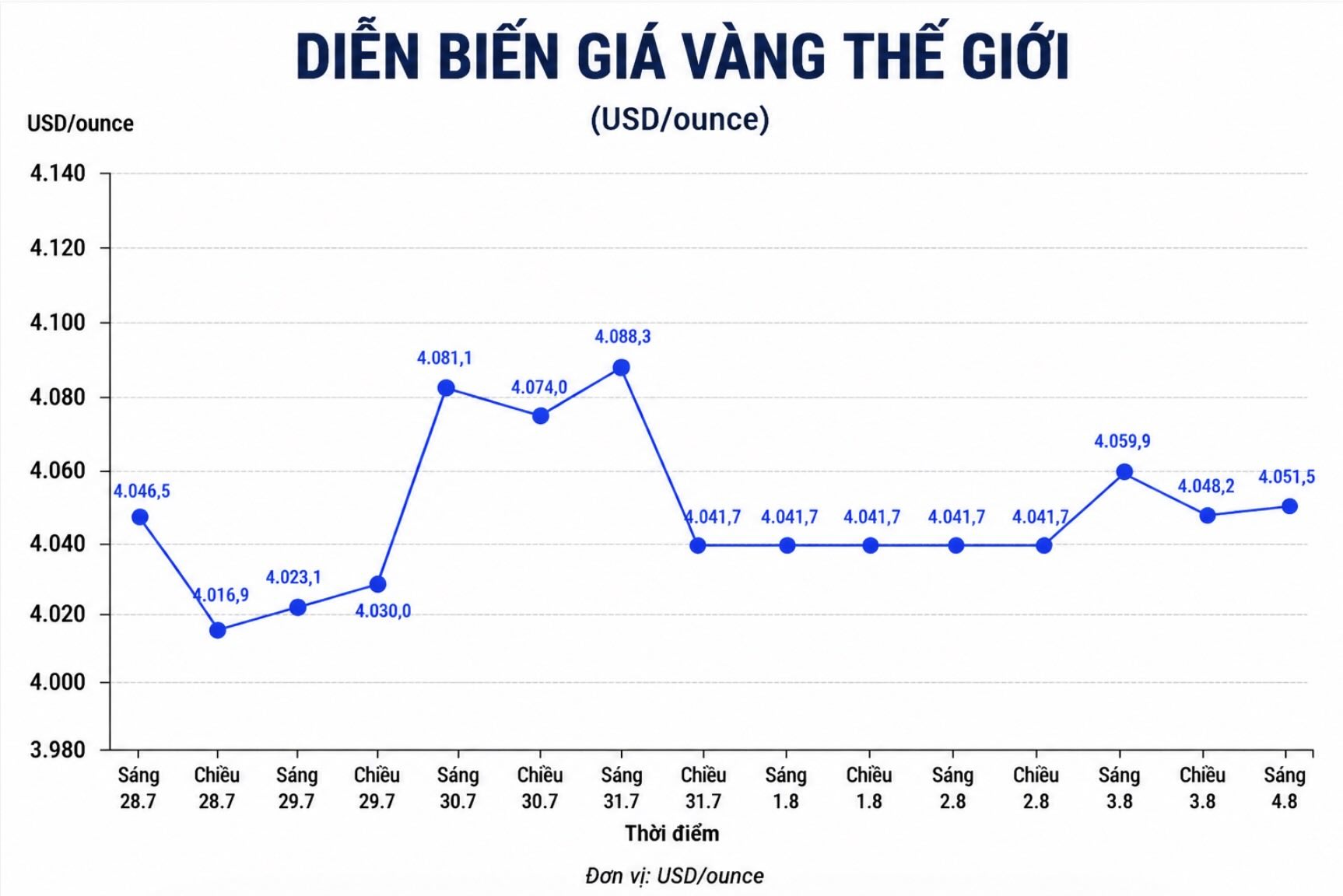
The gold market is struggling around the 4,000 USD/ounce threshold. In the latest precious metal research report, Sucden Financial - an international commodity brokerage company - said that gold prices may continue to move sideways in the third quarter, while the risk of further adjustment has not been ruled out.
According to Sucden Financial, gold prices have fallen nearly 30% compared to the peak set in January 2026. However, after a sharp correction, the valuation of the precious metal is still high compared to macroeconomic factors that often dominate the market, especially real yields and the diễn biến of the USD.
The analysis team believes that gold prices are still higher than the level usually reflected by traditional valuation measures. This shows that the added value due to geopolitical and macroeconomic risks accumulated from the beginning of the year has not been completely eliminated.
The gap between gold prices and fundamental valuation factors has narrowed after the recent decline, but has not disappeared. Therefore, gold prices may still face more pressure if investors continue to withdraw from previously formed safe haven positions.
Gold prices may fluctuate widely
Although saying that gold prices are still relatively high, Sucden Financial believes that the room for decline in the third quarter may not be too large. The precious metal is forecast to continue to receive support until the end of September, but it is difficult to form a clear upward trend in the short term.
Sucden Financial forecasts that gold prices will mainly accumulate in the 3,950-4,300 USD/ounce range by the end of September. Declinings to the low zone of the forecast zone may attract buying power, thereby limiting the market's downward momentum.
In the opposite direction, gold prices are expected to face difficulties when exceeding the threshold of 4,200 USD/ounce. The increases above this price level may not last long if the US Federal Reserve (Fed) does not shift to a more moderate monetary policy stance.
This means that the market may continue to fluctuate in a wide range, instead of a prolonged upward or downward trend appearing. The low price range may trigger buying demand, while profit-taking pressure and unfavorable interest rate factors will limit the possibility of a strong increase.
High real yields continue to put pressure
According to the report, the main obstacles to gold prices have not changed. Persistent inflation forces major central banks, especially the Fed, to maintain restrictive monetary policy.
High interest rates push real yields up, increasing the opportunity cost of holding gold. Unlike bonds or some other financial assets, gold does not generate cash flow or periodic returns for owners.
In the context of increased real yields, investors may prioritize profitable assets, thereby reducing the attractiveness of gold. If the economy continues to grow positively or expectations of monetary easing are pushed back, selling pressure on the precious metals market may increase.
Sucden Financial also noted that investors' positions are still relatively stable, despite the nearly 30% drop in gold prices. However, this also means that the market still has the potential for further liquidation if macroeconomic conditions continue to improve.
Although short-term prospects are still challenging, Sucden Financial does not believe that the current correction marks the end of the long-term upward trend of gold.
The demand for gold from central banks, the trend of reserve diversification, high public debt and prolonged geopolitical instability are still considered important supporting foundations for the precious metal.
Silver prices have not formed a clear trend
For silver, Sucden Financial assesses the outlook as more complex than gold because this metal is also affected by investment demand and industrial production activities.
Silver prices have adjusted sharply along with gold. However, the slowdown in production activity and expectations of weakening industrial demand are creating more pressure on the market.
Sucden Financial forecasts that silver prices may fluctuate in the 56-66 USD/ounce range until the end of September. Declinings in the mid-50 USD/ounce area may attract buying power, but current macroeconomic conditions are not favorable enough for prices to maintain long-term above the upper limit of the forecast range.
Silver is forecast to continue to fluctuate more strongly than gold but has not formed a clear trend. In the long term, this metal is still supported by demand for tangible assets and the trend of using precious metals to diversify investment portfolios.
The content of the article only reflects developments and market opinions, not investment recommendations.


