
World gold prices are in a state of stalemate after failing to maintain the previous strong upward momentum. Selling pressure appeared as the precious metal approached the high price range, while investors continued to assess mixed signals from the USD, inflation and US monetary policy.
At 1:40 PM US Eastern time (ie 0:40 AM Vietnam time), spot gold prices once increased by 1%, to 4,104.59 USD/ounce. August gold futures contracts in the US also increased by 1.6%, closing at 4,160.60 USD/ounce.
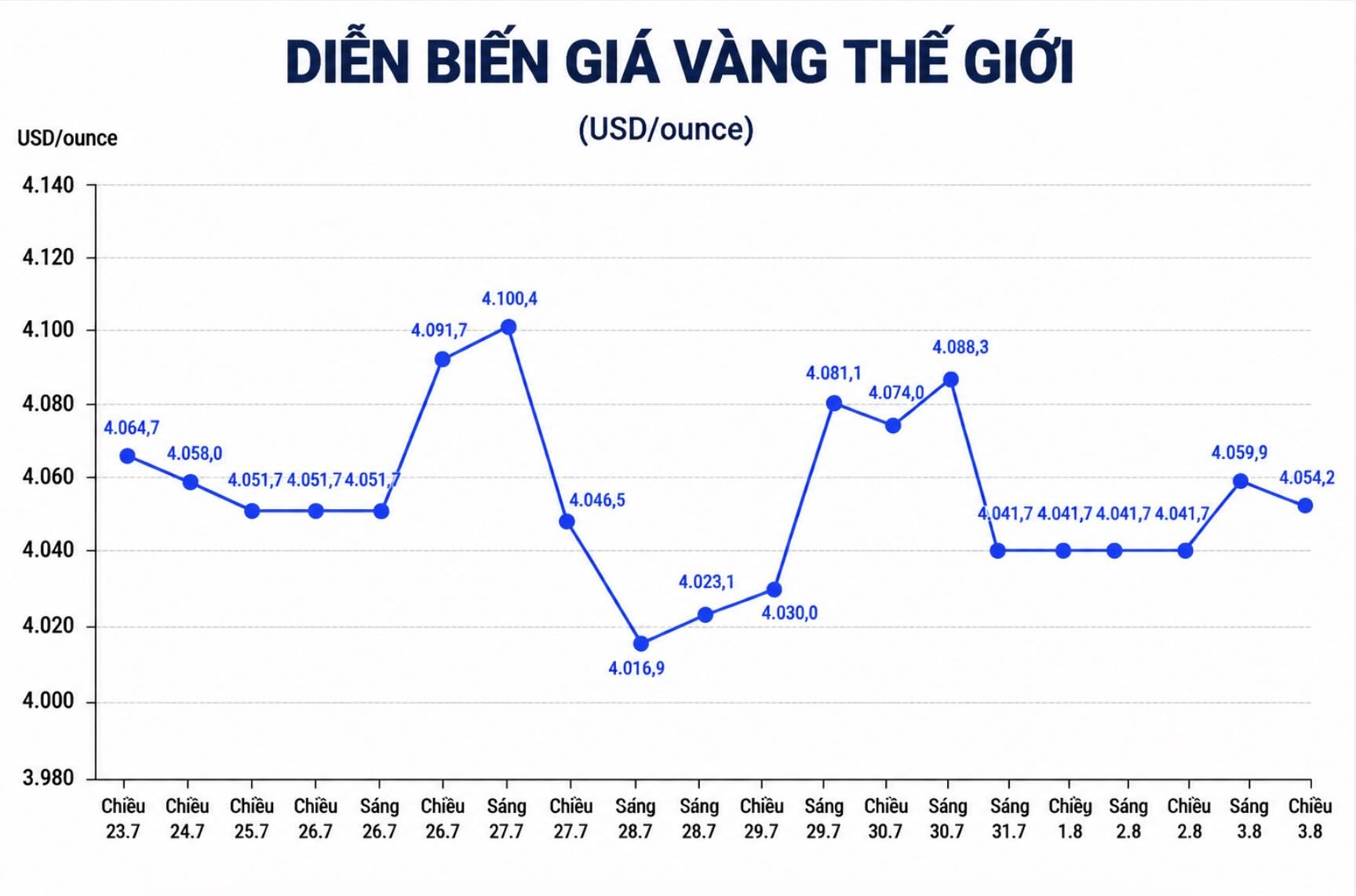
However, the upward momentum was not maintained. At the time of writing the article (5:00 PM on August 3), gold prices turned down and fluctuated around 4,054.2 USD/ounce. This development shows that the market still lacks strong enough momentum to form a clear upward trend.
Gold prices cannot overcome resistance
The reversal of gold prices after exceeding 4,100 USD/ounce shows that profit-taking pressure is increasing. Every time prices rise to a high level, short-term selling pressure appears and pulls the market back to a state of stalemate.
The 4,150-4,200 USD/ounce zone continues to be considered a noteworthy resistance area. This is the gold price threshold to be overcome and maintain stability if you want to confirm a new upward momentum.
In the most recent session, although the futures gold price has exceeded 4,150 USD/ounce, the spot price has not yet been able to clearly approach this resistance zone. The fact that the price then decreased to around 4,050 USD/ounce shows that the buying force in the high zone is not sustainable enough.
If no further supporting factors appear, gold prices may continue to fluctuate in a narrow range. Conversely, a deeper decline may occur if the USD recovers or the market increases expectations that the US will continue to raise interest rates.
Weak USD supports but not strong enough
Gold prices were previously supported when the USD fell by about 0.8%, in the context of the Japanese yen recovering and the market monitoring the possibility of the country's authorities taking measures to support the domestic currency.
A weaker USD often helps gold become cheaper for buyers using other currencies. This is one of the reasons why gold prices at times rose above 4,100 USD/ounce.
However, the impact from the USD is not enough to help the precious metal maintain its upward momentum. The market remains cautious due to the unclear prospects of US monetary policy, while economic data continues to send intertwined signals.
The number of unemployment claims in the US increased lower than expected, showing that the labor market is still relatively stable. This data may create more basis for the US Federal Reserve to maintain high interest rates or continue to tighten policy if necessary.
Market adjusts interest rate expectations
The US Federal Reserve (Fed) kept interest rates unchanged in its most recent meeting. However, the policy message has not helped the market clearly identify the next steps of this agency.
The possibility of the Fed raising interest rates at the meeting on September 15-16 is valued by the market at about 61%, down from 77% before the policy decision was announced.
The probability of interest rate increases has decreased, supporting gold prices in the short term. Gold does not bring fixed yields, so it is often under pressure when interest rates increase, as cash flow tends to shift to profitable assets such as bonds.
However, the 61% probability still shows that the risk of interest rate hikes has not been completely eliminated. This is the reason why investors have not strongly bought in as gold prices rise to a high level.
Inflation cools down but risks remain
The US Personal Consumption Price Index fell 0.1% in June, in line with forecasts. This figure shows that temporary inflationary pressure is showing signs of cooling down.
However, tensions in the Middle East are pushing oil prices up, increasing the risk of energy, transportation and production costs increasing again. If oil prices remain high, inflationary pressure may return in the coming months.
This development creates a two-way impact on gold. Geopolitical risks and inflation may boost safe-haven demand, but may also cause the Fed to maintain tight monetary policy for longer.
In the short term, gold prices are likely to continue to struggle around the 4,050 USD/ounce zone. The market needs more momentum from the USD, economic data or geopolitical developments to be able to overcome the 4,150-4,200 USD/ounce resistance zone.
Information in the article only reflects market developments, not investment recommendations.


