
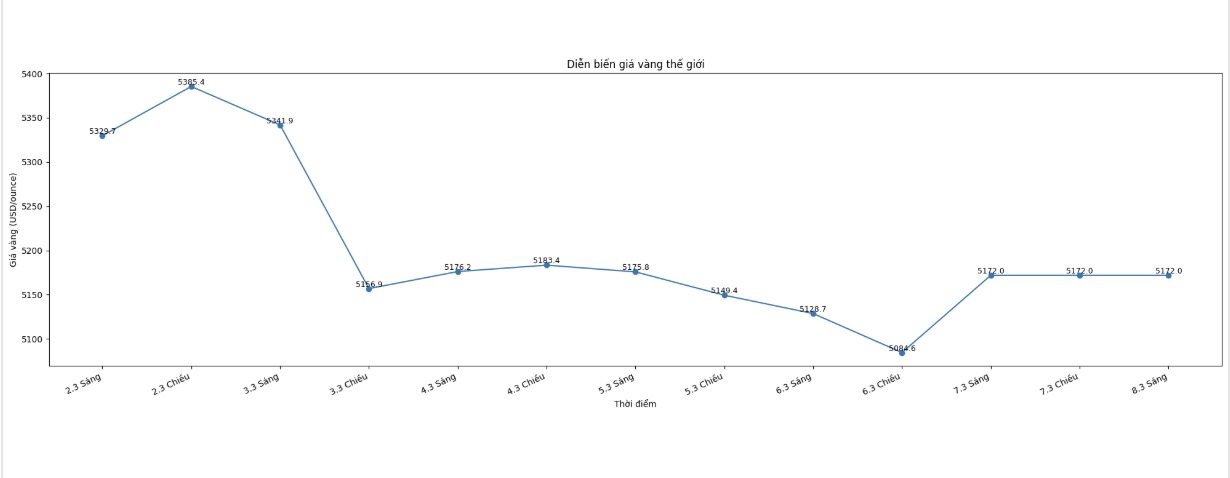
The gold market started the week with optimism as investors reacted to a joint missile attack by the US and Israel against Iran, sparking a new conflict in the Middle East. However, gold's upward momentum quickly weakened, officially ending the week in a downward zone, ending a 4-week consecutive rally.
Spot gold is currently trading around 5,172 USD/ounce, down 106.2 USD compared to a week ago.
Although gold is under selling pressure again, analysts believe that the outlook for the precious metal is still unclear, because the less positive US jobs data released on Friday has partly supported gold prices before the weekend holiday.
According to the US Bureau of Labor Statistics, the non-farm payroll in February decreased by 92,000 jobs. This figure is significantly lower than economists' forecasts, which expected an increase of about 58,000 jobs.
At the same time, the unemployment rate increased to 4.4%, higher than the 4.3% of January, while the market forecasts this rate will remain unchanged.

Analysts believe that gold is falling into a tug-of-war between many factors. On the one hand, weak economic data may push the US Federal Reserve (Fed) to cut interest rates more sharply in the second half of the year. But on the other hand, geopolitical tensions causing oil prices and inflation to rise may force the Fed to maintain a neutral monetary policy longer than expected.
Mr. Neil Welsh - Head of Metals at Britannia Global Markets, commented: "There are many factors pulling and pushing gold prices. Safe-haven cash flow due to the Middle East conflict, strong USD, long-term inflation concerns and constantly changing interest rate cut prospects make gold prices mainly fluctuate in the range.
At times like this, liquidity tensions and portfolio restructuring, including selling to meet margin requirements, often become decisive factors and overwhelm short-term gold gains.
Mr. Michael Brown - senior research strategist at Pepperstone, said that the price drop and fluctuations of gold this week show that the market still needs to "release some" of the speculation accumulated from the strong increase in January.
In fact, gold has never traded like a safe haven asset. Instead, it is moving like a risky asset in momentum, with a near-perfect reverse correlation with oil prices in the past week. This shows that the market still has too much speculation, making gold unable to play its role as a safe haven as expected in the current tense situation.
However, the 5,000 USD/ounce mark is clearly a very strong support zone, we tested this level at the beginning of the week. I think this could be the bottom in the near future, unless the Middle East war ends clearly - which will promote risk-loving sentiment and put pressure on gold. If there is no such thing, gold prices are likely to continue sideways" - he said.
In the context of great instability in the Middle East, analysts recommend that investors closely monitor oil price movements, as this factor is directly affecting the USD and the precious metals market.
Oil prices have risen sharply as military operations targeting Iran disrupt production in the Middle East and destabilize global supply chains. WTI crude oil for April delivery is heading towards the end of the week around $90/barrel, the highest level since October 2023.
Mr. Antonio Di Giacomo - senior market analyst at XS. com, said that recent developments in gold reflect a fragile balance between the traditional safe-haven asset role and the strength of the USD in times of global tension.
As the Middle East crisis continues to cause volatility in the energy and financial markets, investors will focus on US economic data and the Fed's decisions - factors that could shape gold's trend in the coming weeks," he said.


