
Gold prices are not reacting as a traditional safe haven as geopolitical tensions escalate in the Middle East. However, according to a US bank, this precious metal is being affected by recent macroeconomic factors, although long-term prospects remain unchanged.
In the latest global investment strategy report, commodity experts from Wells Fargo (one of the largest banks and financial groups in the US) said that the unexpected drop in gold prices stems from a complex macroeconomic environment, in which higher interest rates, stronger USD and increased real yields have overwhelmed geopolitical risk factors.
The increases in the USD, Treasury bond yields, and narrowed expectations of interest rate cuts are all factors putting great pressure on gold prices," Wells Fargo said.
These comments were made as gold prices are experiencing their strongest decline since 1983. Gold prices have fallen nearly 22% since hitting a record high of $5,600/ounce at the end of January. The nearest spot gold price was traded at $4,391.5/ounce, down nearly 2.7% in the day.
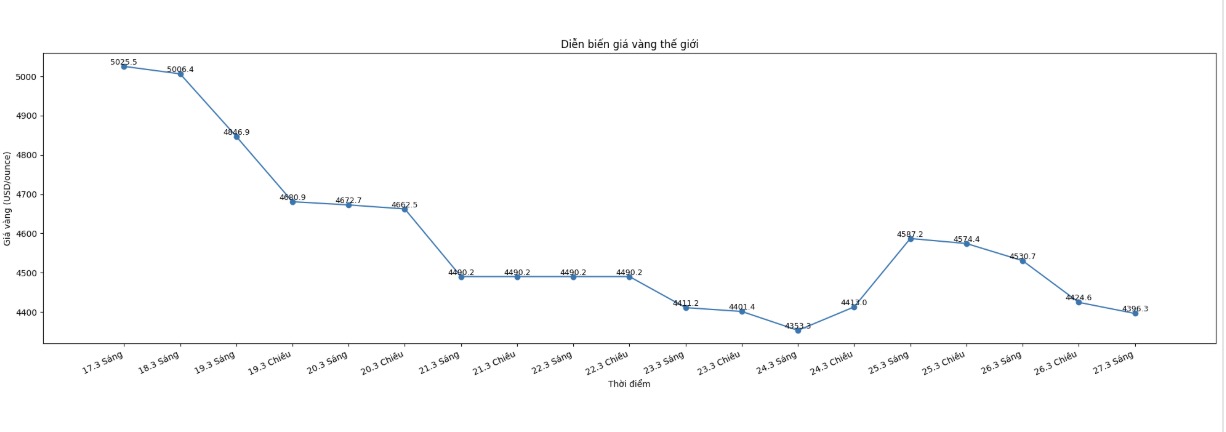
After a slight increase at the beginning of the conflict, the "safe haven" role of gold quickly weakened as investors adjusted interest rate expectations, and safe-haven capital shifted to support the USD.
Wells Fargo emphasized that increased real yields are a particularly disadvantageous factor for gold, because it increases the opportunity cost of holding a non-performing asset.
This factor becomes even more apparent in the context of prolonged concerns about inflation due to rising energy prices. Conflicts have at times pushed oil prices above $100/barrel, raising concerns that central banks will maintain tight monetary policy for longer.
Although gold prices are weakening in the short term, Wells Fargo still maintains an optimistic view on this precious metal in the long term.
The bank forecasts that gold prices will reach from 6,100 to 6,300 USD/ounce by the end of 2026, thanks to continued buying demand from central banks and yields as well as the USD tending to cool down.
Analysts also said that the gold buying activity of central banks is still much higher than the long-term average, thereby creating a solid foundation for demand.

In the near future, Wells Fargo believes that conflict with Iran will only have a limited impact on the economy, as inflationary pressure may gradually decrease and treasury bond yields fall at the end of the year, thereby eliminating the main obstacles to gold.
The bank also believes that the US is in a better position to absorb the energy shock compared to previous crises, thanks to structural changes such as a more service-oriented economy, a net energy exporter position and a lower proportion of household energy spending.
At the same time, Wells Fargo expects the conflict to not last, thereby reducing the risk of high inflation in the long term.
Macroeconomic conditions are generally still positively supportive, as Wells Fargo maintains positive growth prospects for 2026 and believes that the "inflation stop" scenario is not within the baseline forecast.
In this context, instead of showing that gold is losing its safe haven role, Wells Fargo believes the recent price drop is a tactical opportunity.
The bank recommends that investors take advantage of the adjustment phase to gradually accumulate, and believes that capital flows may shift from the energy market to precious metals when the conflict gradually stabilizes.


