
The aspiration to renovate people's knowledge from writers
At the end of the 19th century and the beginning of the 20th century, the South entered a period of strong changes in economy, society and culture. The intersection of East and West, the formation of the urban class and the development of Quoc Ngu script journalism created a new cultural space. In that context, Hat Boi - a stage form that once held a central position in the spiritual life of the people - with a "book-like" language, imbued with conventionality, revealed limitations in approaching the majority of the public.
Recognizing the need to innovate the spiritual life of society, many journalistic intellectuals have seen performing arts as an effective tool to spread knowledge, educate morality and arouse national spirit. They understand that what they want to say in the newspaper can be conveyed more deeply through lyrics, musical instruments and stage stories close to the people.
Leading in that trend was journalist Dang Thuc Lieng, editor-in-chief of Dai Viet magazine. Around 1910, he and his orientation comrades established the "Tung Tan Dien Hi" theater in Sa Dec, Dong Thap, experimenting with bringing the art of Trung Nam Don ca into theatrical performances. This is considered one of the important milestones on the journey of forming Cai Luong stage.
In 1917, journalist Luong Khac Ninh - editor-in-chief of Nong Co Min Dam and Luc Tinh Tan Van newspapers - continued to promote the theater reform movement when presenting the paper "Cải lương hí nghệ" at the Nam Ky Association for Promoting Education in Saigon. The term "cải lương" here implies innovation to become better, in line with the progressive requirements of the times. From that dedication, Southern journalism not only contributed to changing society's view of the singing profession, but also created a favorable environment for a new type of theater to form and develop.
Stepping from the editorial office to the stage
After a period of conceiving ideology, 1918 marked an important turning point, bringing Cai Luong from the idea to a large social movement. According to many research documents, in November 1918, the Nam Ky Daily Association requested permission to establish a troupe to tour the six provinces of Nam Ky to raise funds for social activities. The special thing is that the core force of the troupe were famous journalists of the time. Mr. Nguyen Van Cua, editor-in-chief of Nam Trung Nhat Bao, took on the role of editor-in-chief of the troupe. The supervisor was Mr. Nguyen Phu Khai, editor-in-chief of Tribune Indigène newspaper. Two writers Dang Thuc Lieng and Ho Van Trung served as assistant directors. Mr. Dang Thuc Lieng also participated in compiling scripts for performances. Mr. Le Sum, editor-in-chief of Cong Luan newspaper; Tran Van Chim, editor-in-chief of Nu Gioi Chung, served as columnists...
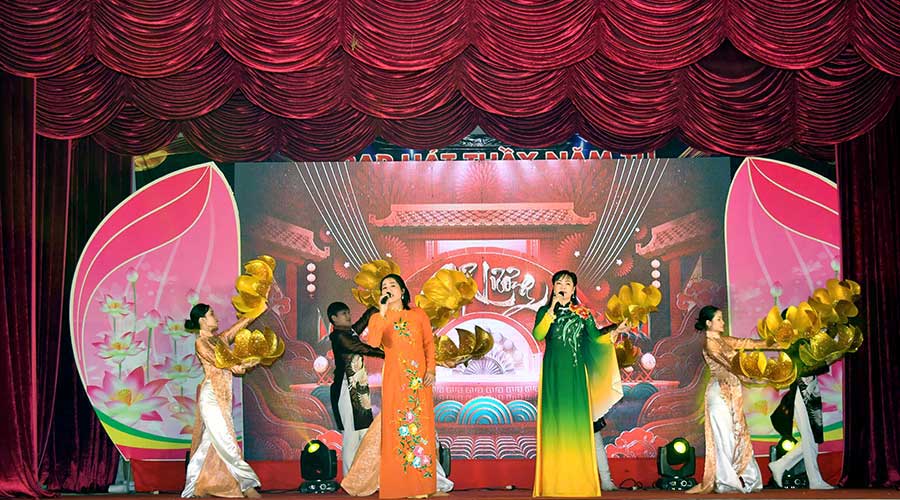
Not stopping at the role of organizers, many journalists also directly stepped onto the stage. Editor-in-chief of Nam Trung Nhat Bao Nguyen Vien Kieu transformed into the character of Master Venerable; journalist Nguyen Chanh Sat - editor-in-chief of Luc Tinh Tan Van and Nong Co Min Dam - played the role of Thuong Cong Le Van Duyet; Ho Van Trung played the role of Ly Truong... That dedication has contributed to changing society's perception of the singing profession, which has long been influenced by the prejudice of "singing no kind". From here, the stage is no longer seen as a simple form of entertainment but is gradually seen as an educational forum, a space to spread ideology and cultural values. It can be said that the Southern press is the pioneering force contributing to enhancing the social position of Cai Luong art in the early 20th century.
From newspapers to the birth of Cai Luong
The connection between journalism and theater continued to be clearly shown in the process of forming the Cai Luong script system. In 1919, when troupes began experimenting with bringing short instrumental and musical songs into plays, the first scriptwriters were also journalists. Nguyen Vien Kieu and Truong Duy Toan were two typical composers of that initial period.
According to Dr. Nguyen Thanh Phong - lecturer at the University of Social Sciences and Humanities, Vietnam National University Ho Chi Minh City, the Cai Luong play "Kim Van Kieu" by Mr. Truong Duy Toan, who used to be the editor of Sai Thanh Newspaper and Trung Lap Newspaper, contributed to shaping Cai Luong in the period "Reforming singing and singing according to progress; Traditional operas and plays are comparable to civilization".
Not only participating in writing, the press also plays an important role in promoting Cai Luong to the public. According to researcher Nguyen Duc Hiep in the work "Stage art: Hat boi, Don ca tai tu and Cai Luong in Saigon and Nam Ky from the late 19th century to 1945", many journalists also actively published poetry collections, Cai Luong plays and stage materials.
Typical is Nguyen Van Cua with the publication of a series of publications from L'Union Printing House, such as: Cai Luong Tuong: Mieu Ly Hoa Chua (Le Van Tieng - 1925), Cai Luong Ca (Le Mai - 1927)... Among them, the work Cai Luong Ca was reprinted up to six times, showing the strong spread of this new art form in the social life of the South.
Thanks to the support of the press and publishing activities, Cai Luong quickly went beyond the scope of theaters to appear in the daily life of a large audience.
Thanh Tam Award - the media revolution of Cai Luong stage
Like a continuous flow of history, after the generation of journalists who contributed to the birth of Cai Luong, there is a generation of journalists who play a role in raising the level and positioning the value of this art form in social life. The most typical is journalist Tran Tan Quoc from Cao Lanh, Dong Thap.
In the 1950s, Cai Luong entered its peak period with dozens of troupes and hundreds of artists actively operating throughout the South. However, rapid development also posed a requirement for an objective, transparent and reputable professional evaluation system. In 1958, Tran Tan Quoc founded the Thanh Tam Award. Although it only existed for a decade, the award is considered a prestigious award of Vietnamese Cai Luong stage.
Not simply a vote for excellent artists, the Thanh Tam Award is built as a complete professional institution. The evaluation criteria are not only based on vocals or acting skills but also value professional ethics, personal character and the spirit of dedication of artists. Through stage specialized pages in the press, the judging panel regularly analyzes, comments and publicizes its views before announcing the results.
It is this transparency that has created special prestige for the award. Many great artists of Cai Luong stage such as Thanh Nga, Bach Tuyet, Ngoc Giau, Diep Lang, Le Thuy... have grown up from the Thanh Tam launchpad before becoming art monuments of the South. It can be said that the Thanh Tam Award is a vivid proof of the power of journalism in discovering, honoring and spreading cultural and artistic values.
Continuing the contemporary fate
Looking back more than a century, from Tung Tan Dien Hi theater in Sa Dec, the troupe of the Southern Daily Arts Association to Giai Thanh Tam, the history of Cai Luong shows that the press has never stood outside of artistic life. On the contrary, the press has contributed to the birth, encouragement, orientation and elevation of a stage type imbued with Southern identity.
More than 100 years ago, Southern journalists used their pens to initiate a stage renovation. Today, generations of journalists continue to carry the mission of preserving and spreading those values. It is not only the continuation of a profession, but also the continuation of a love of culture, so that the sound of the zither, vọng cổ tune and the lights of cải lương stage will forever resonate in contemporary life.


