
Garbage" video surrounds
Quynh Anh (26 years old, office worker in Hanoi) said that she often stays up very late just because she is "stuck" in videos and short films on Tiktok.
According to Quynh Anh, when she watches a video, her fingers will unconsciously scroll on TikTok, from one video to another without stopping.
From a clip of "CEO" teaching employees, algorithms quickly lead to a series of short films mother-in-law and daughter-in-law, then continue to move to revenge content, sensational dramas.
Knowing that there are too many details, but every time I watch this video, I automatically switch to another video, I almost can't get out, when I'm tired, it's already past midnight," Quynh Anh shared.
According to a report by the McKinsey Health Institute, the above-mentioned "passive surfing" content consumption is one of the factors related to mental health decline.
Today, Gen Z and Millennials are warned to be prone to falling into a "negative vortex", where anxious or agitating content keeps them on screen the longest.
The Digital 2026 Vietnam report by We Are Social and Meltwater statistics that by the end of 2025, Vietnam had about 79 million social network users, equivalent to more than 77% of the population. On average, each week, an Internet user spends about 7 hours and 8 minutes watching short videos.
More notably, the frequency of consumption of this content is almost continuous: on average, users access social networks 4.83 days per week and watch short videos 4.7 days per week.
With a rate of 96.2% of Internet users participating in watching online videos and 93.9% accessing short videos. "junk" or negative content has a vast avenue to reach most users in the digital space of Vietnam on digital platforms.
Harmful content storm
A survey by Lao Dong Newspaper on channels specializing in reviewing movies, or producing short film content related to topics such as adultery, mother-in-law and daughter-in-law, love dramas, "president" motifs... on YouTube, TikTok or Facebook in Vietnam recorded: Each episode is less than 3 minutes long but can attract hundreds of thousands to millions of views after a few days of posting.

This attraction does not come from artistic value, but lies in the accurate calculation of algorithms based on human "negativity bias".
Algorithms from platforms like TikTok or Facebook operate based on a mechanism to optimize interaction.
Extreme scenarios such as mother-in-law and daughter-in-law confrontation or betrayal in love, family relations are designed to stimulate anger from the first 3 seconds.
The algorithm on social networks does not distinguish which content is good or bad, the platform only cares about whether users stop to watch a post or not.
According to the Bipartisan Policy Center (BPC), current social media algorithms are built to maintain user interaction over long periods of time by providing continuous customized content.
The reason why extremist "love drama" or "mother-in-law and daughter-in-law" videos are flooding the news boards of people who stopped to watch for more than 3 seconds lies in the phenomenon of algorithmic amplification.
The BPC report indicates that human psychology tends to be attracted to negative and sensational news rather than positive news.
Therefore, algorithms trained based on user behavior will automatically prioritize controversial, polarized or outrageous content because they help that content easily become viral and retain users longer.

Dopamine loop
When negative emotions are pushed to a climax and resolved with dramatic retaliation, the brain releases a large amount of dopamine, forming an addictive loop.
Viewers no longer enjoy the content, they are consuming cheap emotions through industrially produced content.
This is the factor that makes viewers fall into a state of addiction to short videos with toxic and dramatic content.
Answering Lao Dong Newspaper about this issue, BS. Specialist II Tran Minh Khuyen - Specialist in Psychiatry - Psychology at University Medical Center 1 Clinic, analyzed that the human brain has neurotransmitters related to feelings of happiness such as dopamine, serotonin... This is a normal biological mechanism.
However, social networking platforms with short content optimization algorithms have strongly exploited this mechanism.
Short videos of about 30 seconds to one minute, concise titles, and rush make the brain continuously experience dopamine spikes, creating a feeling of immediate pleasure.
When this phenomenon is repeated many times, users are easily drawn into continuous viewing and find it difficult to stop, similar to the mechanism for forming addictive behavior.
In fact, there are people who watch short videos continuously for one to two hours until they are tired and then stop.
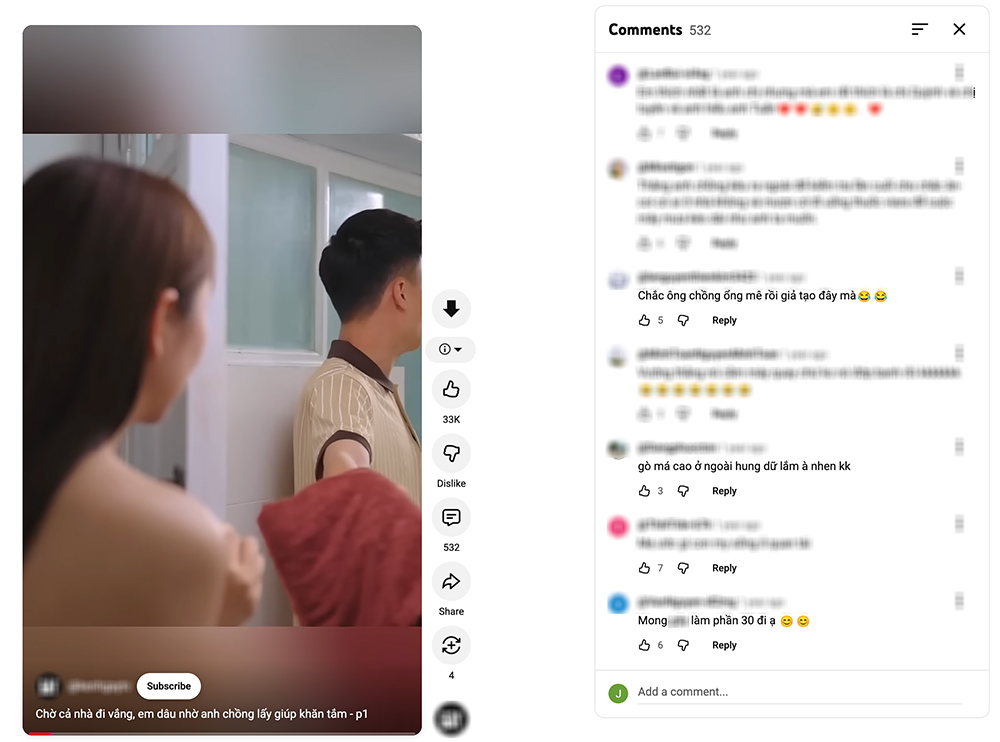
According to Dr. Tran Minh Khuyen, a common manifestation in some social media addicts is that when they do not watch short, tense videos... dopamine is not stimulated, they may feel restless and uncomfortable; but when they watch it again, they feel more comfortable.
This loop increases the risk of dependence on short content.
In addition, the content distribution algorithm of social networks also has a very strong behavioral memory mechanism. As soon as users accidentally view or search for some negative content, the system will record and continue to propose similar content.
The more users search and view, the more those contents appear, causing them to gradually fall into a state of being "surrounded" by the same type of information.
This expert emphasized that getting used to short, fast, and intense content over time can reduce concentration and patience. Previously, a person could read dozens of pages of books, but when they are used to very short videos, they find it difficult to maintain attention for a long time. The greater risk is that when users are long-term surrounded by negative content, their view of the real world is easily distorted.
In addition, shocking and controversial content often strongly stimulates the brain's reward system, making users easily rush into comments and attacks without verification. When the ability to evaluate decreases, social network users are very likely to fall into a state of information chaos.
In the current context, not using social networks is very difficult.
However, users need to stay alert when receiving information. The internet is just a tool; the positive or negative impact depends on how each person uses it.


