The soul of words of spring of the Ancient Capital
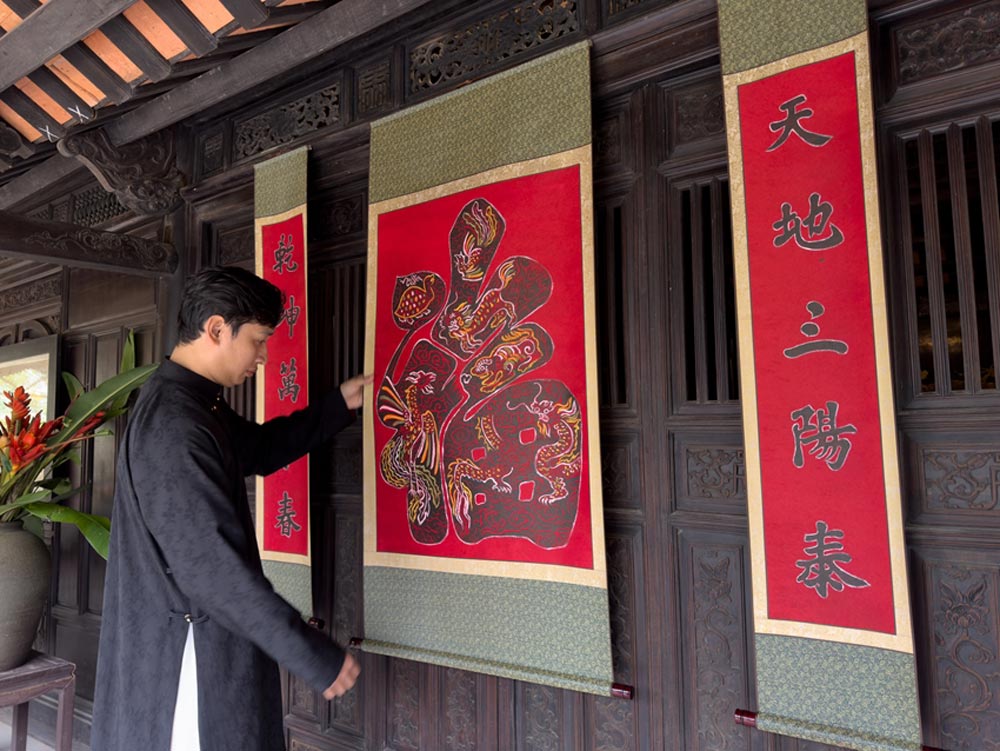
Chuon village parallel painting, also known as An Truyen village Tet painting, was once a familiar image in every Hue house every spring.
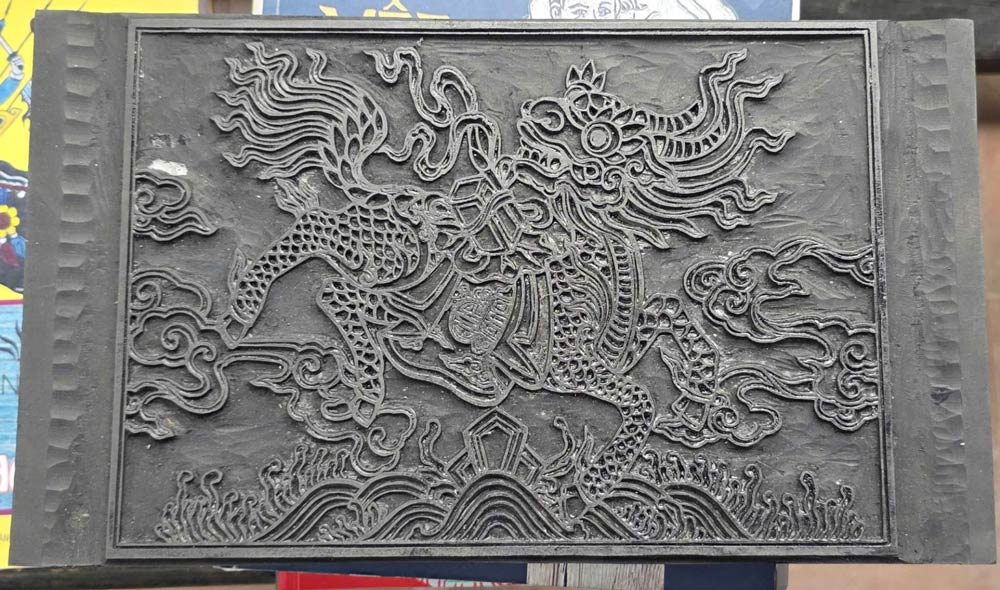
Different from the rustic colors of Dong Ho or the sophistication of Hang Trong, Chuon paintings choose the way of expressing with words: Han - Nom characters are carved on woodblocks, printed on paper, and then colored manually. Great characters such as "Phuc", "Loc", "Tho", "Tam", "Duc" or Tet wishing sentences not only have decorative meaning but also convey family morality, wishes for peace and continuity between generations.
An Truyen village (Chuon village), now belonging to My Thuong ward, Hue city, located on the edge of Tam Giang lagoon, has long been famous as a land of learning, where Confucian thought deeply permeates community life.
Precisely from that cultural flow, lien paintings were born as a spiritual symbol of the spring of Hue. The painting's color palette is not fussy but full of intention: the red background symbolizes auspiciousness, the black or gold-plated letters evoke solemnity, the blue or light green border soothes the eyes. All create a very Hue beauty: restrained, harmonious, not ostentatious but profound.
In the memories of many ancient Hue families, red parallel sentences hanging in the middle compartment or in front of the altar are a sign of spring coming. However, along with the change in tastes and modern rhythm of life, Chuon paintings gradually disappeared from the mid-20th century. The profession is seasonal, requiring patience and high handicraft skills, not enough to ignite the fire for the next generation. When the last artisans passed away one after another, woodblocks fell asleep, Chuon village parallel sentence paintings only lived in nostalgia.
Ngu Ha Vien - where heritage is "revved"
Ngu Ha Vien is a cultural - creative space project in Hue, formed with the goal of restoring, connecting and "awakening" traditional heritage values in contemporary life.
Not operating according to a museum or static display model, Ngu Ha Vien is built as an open space, where heritage is placed in a direct relationship with the community through experience, practice and creativity.
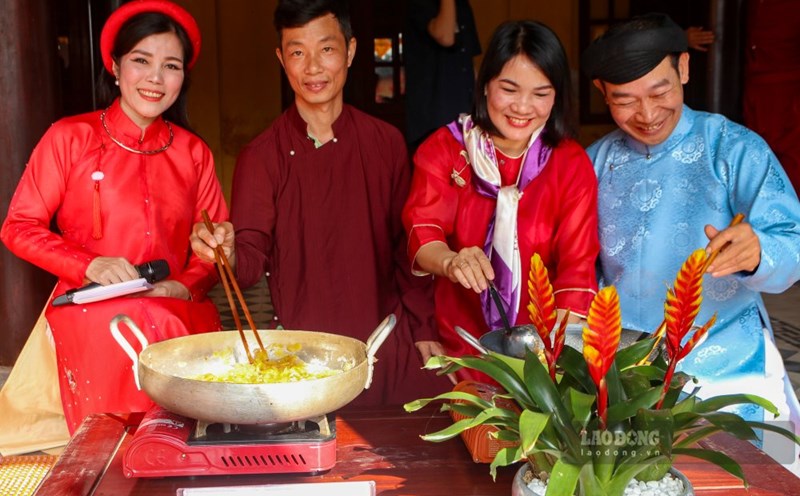
Here, Hue cultural values - from traditional handicrafts, folk art, calligraphy, cuisine, to the traditional Tet space - are introduced with a new approach: so that viewers can see, touch, make and dialogue with heritage.
The heritage is not only "recounted", but recreated in today's rhythm of life, associated with contemporary people, especially young people. From that spirit, Ngu Ha Vien was chosen as the starting point for the project to revive Chuon village parallel paintings, bringing the lost painting line back as a living heritage.
The project to revive Chuon village parallel paintings at Ngu Ha Vien is the result of a persistent journey of young people who love heritage. In the restoration group are Doan Cong Quoc Tuan, from Hue, representative of the "Journeys in Hue" group; Ngo Quy Duc, founder of "Bach Nghe Ward" from Hanoi; and Thanh Dat, a son of Thanh Lieu village (Hai Duong), a land famous for woodblock art and folk wood carvings.
The meeting between Hue, Hanoi and Hai Duong created a lively cultural dialogue. "We do not want to bring Chuon paintings back as a museum artifact, but as a part of today's life," Doan Cong Quoc Tuan shared. According to him, the biggest challenge is not only restoring the traditional technique of carving, printing and mixing colors, but also finding answers to the question: how will lien paintings continue to exist in modern society?
The answer lies in creative adaptation. Besides restoring woodblocks, the project group introduces parallel paintings into familiar products such as Tet cards, lucky money envelopes, handicraft publications; and at the same time organizes painting performances, calligraphy exchanges so that the public, especially young people, can directly touch the heritage. “When young people personally print a word ‘Phuc’, they will understand why the ancients cherished those red parallel paintings,” Ngo Quy Duc said.
From ancient Chuon village to Ngu Ha Vien today, Hue's paintings are having a valuable opportunity to "relive" in contemporary life. If nurtured properly, Chuon village paintings will not only return as a handicraft, but can also become a symbol of Hue's way of preserving and renewing heritage: slowly, kindly but full of inner strength, opening up many doors for the present and future.