Soc Trang ward, Can Tho city is originally the capital of Khmer ethnic Nam Tong Buddhism. In Soc Trang alone, there are more than 90 large and small pagodas, including many famous ancient pagodas. But the most famous is Doi Pagoda, the folksy name of Mahatup Pagoda (which Vietnamese people mispronounce as Ma Toc Pagoda).
The full name in Khmer of Mahatup Pagoda is Wath Sê-rây-tê-chô Mahatup, meaning "Red blessings are formed". According to popular accounts, the pagoda was built by a Khmer man named Thach Ut in 1569. However, there are still many doubts about this origin.
According to research by Dr. Tang Van Thon - Lecturer of the Khmer Language - Culture - Arts School of Southern Vietnam and Humanities, under Tra Vinh University, published in Vietnam Culture Research Journal No. 1 in 2022, from ancient times, the Khmer people did not have a surname, but took the name of their grandfather or father as their surname.
By the early 19th century, after ascending the throne in 1802, King Gia Long of the Nguyen Dynasty issued a decree promulgating clan names for Khmer people in the Mekong Delta region, with 5 main clans including: Thach, Son, Lam, Kim, Danh. Currently, the Thach and Lam clans are still the 2 largest main clans in Soc Trang.
However, if in the early 19th century, Khmer people in Soc Trang and Tra Cu were newly given the surname, how could there be Mr. Thach Ut in the 16th century to build Mahatup Pagoda? Perhaps, the name of this man only appeared after the Nguyen Dynasty's surname decree.
Anyway, Mr. Thach Ut's name is also a sign of the harmony strength of Mahatup Pagoda, which is only younger than Kos Tung Pagoda in Soc Trang. The architecture of Mahatup Pagoda is typical of the religious culture of the Khmer ethnic community and became a National Art Relic in 1999.
The overall pagoda is about 4ha wide, bearing the cultural imprint of the Khmer people. The pagoda is not only a place to practice Southern Buddhist beliefs, but also a center for cultivation and learning of monks, as well as a place for Khmer people to visit during the New Year holiday Chol Chnam Thmay (April of the Gregorian calendar) or the Sene Dolta festival (similar to Vu Lan festival).
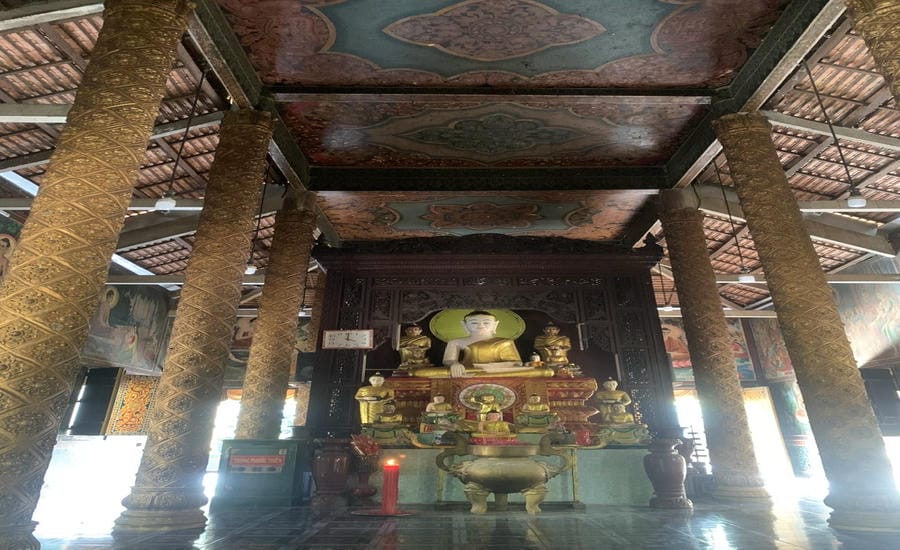
The main hall is built on a foundation about 1 meter higher than the natural ground, nearly 20 meters long and more than 10 meters wide. The pagoda roof is tiled, the 4 ends of the roof on the gable end are curved upwards and create very sophisticated carvings of the snake god Naga.
Supporting the roof are rows of supporting columns, each column also carved with a Kemnar fairy in a position of clasping her hands in front of her chest. Located inside the main hall is a monolithic stone Buddha statue of Shakyamuni on a lotus tower about 2 meters high.
Nearby is another statue of the Buddha residing on the magic snake Muchalinda, which is depicted very vividly, meticulously and has high artistic value. Surrounding it are walls decorated with vivid paintings, depicting the life of the Buddha. In particular, the pagoda also preserves many scriptures written on palm leaves.
In the scorching sun of the dry season, the pagoda is nestled peacefully among rows of oil and black stars tens of meters high, spreading their green peaks to cast shade onto the pagoda's yard. If the gold-plated color of the entire pagoda was not so brilliant that it was dazzling, perhaps the pagoda would be hidden in the forest of trees.
The rows of trees surrounding the pagoda are in rows, in layers like natural towers to create a layer of isolation for the pagoda from the bustling mortal life out there. Wind blowing through the rustling foliage, harmonizing with the sound of dry leaves falling and rolling on the pagoda courtyard, creates a chain of endless Buddhist chants.
Clearly, without the straightforward and loyal oil trees and black star trees, Mahatup Pagoda would be exposed to the dry heat of summer. And if so, hundreds of giant horse-shaped bats, with long wings, would have no place to reside here, to create the reputation of Bat Pagoda.
At the time we visited Doi Pagoda, around 2 pm, hundreds of bats were hanging under trees to sleep, waiting for the sun to set to go for food in the orchards around Soc Trang. They were like monks practicing hard practice, hooking their legs onto tree branches and hanging their bodies upside down.
Occasionally, bats startled, dropped their legs, and then fluttered their wings and flew a few times, disturbing the tranquility of the whole flock. I don't know when bats came to Doi Pagoda to rely on the Buddha's gate, but it must have been a long time ago, when the bat herd was still crowded, covering the entire pagoda yard and the sky.
The monks and Buddhists here do not drive away the bats at all, but also try to protect them, considering them as good omens of the pagoda, just as the blessing "honey blessings come true". But they are also very sad because the bats are becoming increasingly sparse, not understanding whether it is because they are out of luck with the pagoda or being caught while hunting for food.
Don't think that the bats of Doi Pagoda are unintentional breeds, because they seem to understand that this is Buddhist land, these are monks who are full of compassion and generosity, so they have never eaten any fruit in the pagoda garden. When flying, bats also choose to circle instead of flying across the main hall.
The story of the bat colony cherishing the pagoda but increasingly decaying in number reminds us of the impermanence of life, there is a gathering, there will be a dispersion, there will be a birth, there will be a death, nothing can exist forever. Because of the greed of sentient beings, because of the changes in the environment, or because of what cause leads to this dispersion, everything must still be accepted.
Anyway, the harmony of the oil tree forest, the bat herd and the pagoda has created a beautiful predestined relationship, and will probably exist for a very long time later with the simple name Doi Pagoda.