Pioneering the road for innovation
On July 2, 1976, Saigon - Gia Dinh City officially took the name of President Ho Chi Minh. From a city that had just emerged from war with countless difficulties, the Party Committee, government and people of the city gradually overcame the consequences, restored production, stabilized life and opened up an impressive development journey.
In the renovation process, Ho Chi Minh City has always been a pioneer with many bold policies. The clearest symbol is Tan Thuan Export Processing Zone - the first export processing zone in the country.
In 1991, when Vietnam was still cautious about the market economy, Ho Chi Minh City boldly cooperated with Taiwanese (China) investors to build a modern export processing zone model, synchronous infrastructure, "one-stop-shop" mechanism, export-oriented production and strongly attract foreign investment capital.
Tan Thuan's success paved the way for a series of export processing zones and industrial parks such as Linh Trung, Tan Binh and a network of industrial parks to develop throughout the Southeast region, making Ho Chi Minh City the largest production and export center in the country for many years.
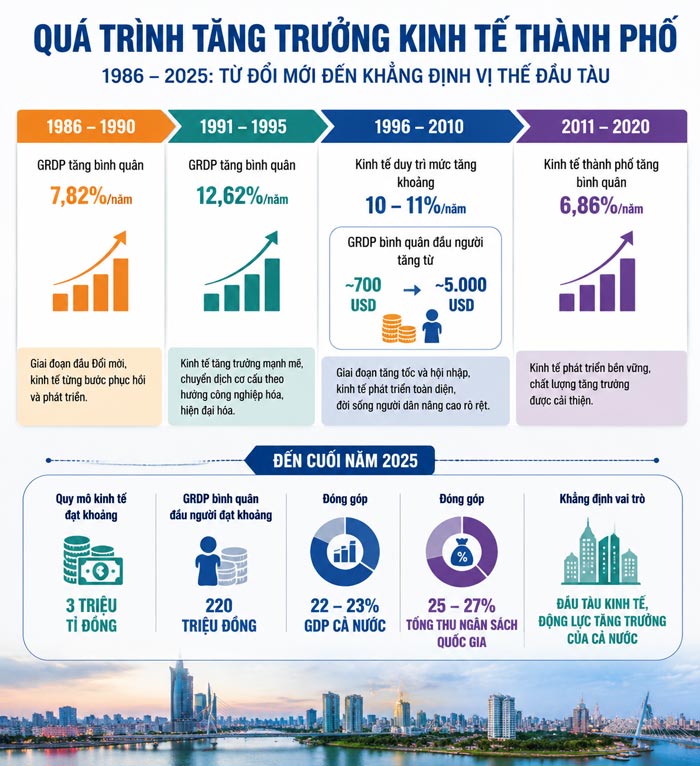
Innovation momentum helps Ho Chi Minh City achieve many impressive growth steps.
Ho Chi Minh City has also strongly transformed its urban appearance, from a narrow, degraded infrastructure system after 1975 to a modern, dynamic city.
After 50 years of development, a series of symbolic infrastructure projects have been successively formed such as Vo Van Kiet Avenue, Thu Thiem tunnel, Phu My bridge, Saigon 2 bridge, Ho Chi Minh City - Trung Luong expressway, Ho Chi Minh City - Long Thanh - Dau Giay, Metro No. 1 (Ben Thanh - Suoi Tien) along with the ring road and inter-regional expressway network being synchronously invested. New urban areas such as Phu My Hung, Thu Thiem, Van Phuc or South Saigon have contributed to shaping the appearance of a modern, dynamic and well-planned city.
In parallel with economic development, Ho Chi Minh City always pays attention to social security. The city has implemented the poverty reduction program since 1992 and by 2025 basically no more poor households according to multidimensional poverty standards. By 2025, Ho Chi Minh City has more than 2,300 educational institutions with over 1.7 million students; more than 130 public and non-public hospitals, with a health insurance coverage rate of over 95%.
The turning point of a megacity
After the merger, Ho Chi Minh City entered a new development phase with a scale of more than 14 million people, becoming one of the largest megacities in Southeast Asia. In the new structure, the old Ho Chi Minh City plays the role of a financial, technology and innovation center; Binh Duong is a high-tech industrial center; Ba Ria - Vung Tau is a logistics, seaport and marine economy hub. However, the city also faces many challenges in terms of institutions, infrastructure, environment, traffic congestion and sustainable development requirements.
According to experts, to continue to play the leading role, Ho Chi Minh City needs to create strong institutional breakthroughs to release resources and open up new growth space.
In May 2026, the Politburo issued Resolution No. 09-NQ/TW on building and developing Ho Chi Minh City in the new era. The Resolution sets ambitious goals: maintaining an average GRDP growth rate of about 10%/year in the period 2026 - 2045; GRDP per capita reaching about 75,000 USD; minimum human development index (HDI) reaching 0.9; net emissions equal to "0" and by 2045 becoming a leading city in Asia, an attractive destination of the world. In the period 2046-2075, Ho Chi Minh City strives to maintain an average GRDP growth rate of at least 6%/year, average GRDP per capita reaching 100,000 USD and HDI above 0.9.
Assoc. Prof. Dr. Tran Hoang Ngan - Chairman of the Advisory Council for Breakthrough Development of Saigon University, said that after the merger, Ho Chi Minh City is like a "new body" with more growth momentum than before.
According to Assoc. Prof. Dr. Tran Hoang Ngan, high-tech industry and green industry will be the most important driving force, expected to contribute about 33 - 35% of GRDP. Industrial parks will be restructured in the direction of smart, green, circular, digitized and high-tech application to attract quality FDI capital flows.
The second driving force is the marine economy and logistics with the Cai Mep - Thi Vai port system, Can Gio international transshipment port, Long Thanh airport and inter-regional logistics network. The city is also studying railway lines connecting industrial parks with seaports to reduce logistics costs and improve competitiveness.
Trade, services, tourism, cultural industry and the international financial center in Thu Thiem, high-quality healthcare, education and science and technology are expected to create new growth poles for the city in the coming decades.
Dr. Tran Du Lich - former Director of the Ho Chi Minh City Institute of Economics - said that Ho Chi Minh City has long been considered the "sandbox of institutions" of the whole country. After the merger, if given a superior mechanism from the Special Urban Law, Ho Chi Minh City can completely promote efficiency according to the formula "1 + 1 + 1 > 3".
According to Mr. Lich, the immediate priority is to build an administrative apparatus capable of implementing new mechanisms; invest heavily in transport infrastructure, seaports, aviation, logistics; develop digital infrastructure, renewable energy and restructure the economy based on innovation, technology and high-quality human resources.
Looking back at the past 50 years to see that the city has deserved the honor of bearing Uncle Ho's name. And in the next 50 years, Ho Chi Minh City must continue to rise to become a global megacity, with a worthy position on the map of major cities in Asia and the world" - Dr. Tran Du Lich emphasized.