
On September 9, a working delegation of the National Steering Committee for searching, repatriating and identifying martyrs' remains led by Senior Lieutenant General Le Quang Minh - Deputy Director of the General Department of Politics of the Vietnam People's Army, inspected Vinh Long.
Participating in the delegation were leaders of agencies under the Ministry of National Defense, the Ministry of Finance and Military Region 9. Receiving and working with the delegation were Ms. Nguyen Thi Be Muoi - Vice Chairwoman of the Provincial People's Committee, Head of the Provincial Steering Committee 515 and members.
In the 500-day and night campaign to promote the search, repatriation and identification of martyrs' remains, Vinh Long province was assigned to search for and repatriate 140 martyrs' remains and take samples for 4,871 graves with unidentified information.
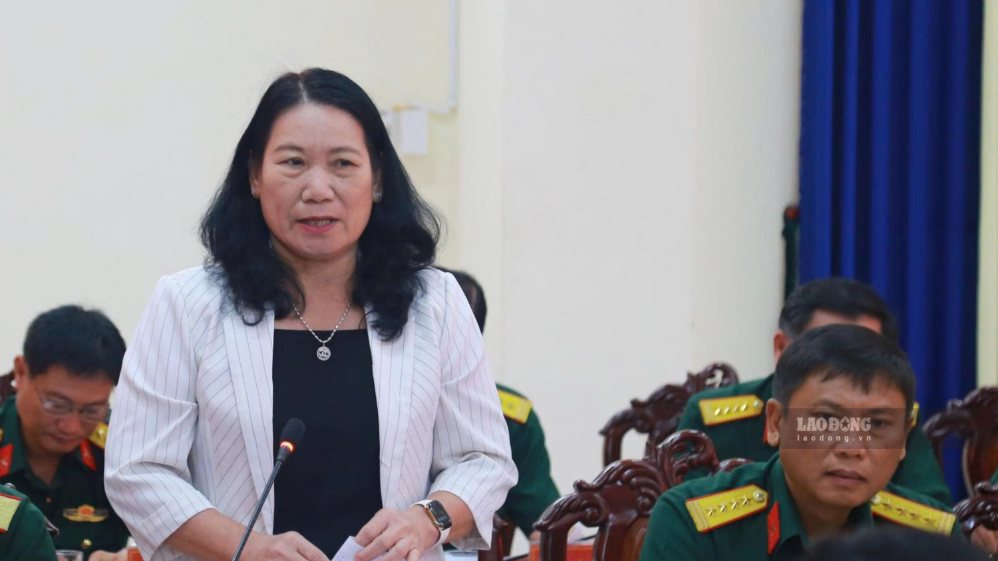
Reporting at the conference, Ms. Nguyen Thi Be Muoi said that the Provisional Team for Searching and Repatriating Martyrs' Remains under the Provincial Military Command coordinated with Team K90 to organize 6 searches and repatriations of 108 martyrs' remains and 1 mass grave.
By September 7, functional forces had taken 2,023 samples at 11 martyrs' cemeteries. Sampling work continued to be deployed at Giong Trom, Cau Ke and Thong Hoa martyrs' cemeteries.
All samples are digitized, dossiered and temporarily stored at 3 sample storage rooms belonging to Vinh Long Martyrs' Cemetery, Ben Tre Martyrs' Cemetery and Tra Vinh Martyrs' Cemetery, ensuring safety according to regulations.
Speaking at the conference, Senior Lieutenant General Le Quang Minh requested the Steering Committee 515 of the province to continue to accelerate the progress of the 500-day and night Campaign, identifying this as a key task of the entire political system.
Senior Lieutenant General Le Quang Minh requested local Party committees and authorities to strengthen direction, promote the role of military agencies and functional forces; regularly inspect and evaluate progress, and promptly remove difficulties.
Regarding taking biological samples to serve the identification of martyrs' remains, it is necessary to organize them tightly, in accordance with procedures, ensuring security principles and technical requirements. Units must review and specifically identify the remaining tasks.
Difficult areas need to be classified and assessed for actual conditions to choose appropriate plans. Thereby, contributing to speeding up the progress of searching, repatriating and identifying martyrs' remains in the province.


