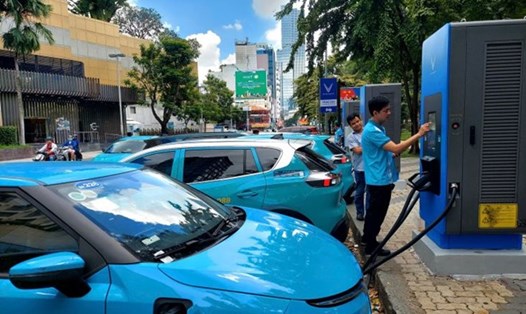
Charging station infrastructure for electric vehicles grows rapidly
According to the Ministry of Industry and Trade, in recent years, the electric vehicle market in Vietnam has developed rapidly, with the increasing participation of domestic manufacturing and assembly enterprises and importing enterprises. In 2023, 15,676 pure electric cars were consumed, of which 15,486 were domestically produced and assembled and 190 were imported.
In the first 6 months of 2024, the number of net electric cars consumed reached 17,536 vehicles, of which 17,482 vehicles were manufactured and assembled domestically and 54 vehicles were imported. These figures show a significant growth rate of electric vehicles and corresponding demand for charging infrastructure. A large network has developed about 150,000 charging ports with a capacity of up to 360 kW nationwide. However, there is still a lack of a unified technical document, fully defining the requirements for the charging cylinder itself as well as the entire charging station system after installation and commissioning.
This gap is posing many difficulties for investors, design and construction units, and local management agencies. From basic issues such as site arrangement, traffic organization, foundation, drainage, operating distance to impact protection measures, there need to be specific and unified requirements to apply in practice.
Another noteworthy issue is the power supply system for charging stations. Currently, the selection of voltage levels, calculation of capacity, coefficients simultaneously, connection plans, measurement, control of power quality and load management still lack integrated guidance specifically for this type of project.
Requirements directly related to electrical safety also need to be standardized. In which, there are overcurrent protection devices (RCD), one-way overcurrent detection, overcurrent protection, short circuit, lightning pulse, ground connection systems and emergency power outage mechanisms. These requirements need to be applied uniformly between each charger and the entire internal power distribution system of the station. For fire prevention and fighting (PCCC), the arrangement of fire fighting equipment, warning signs, regulations, orders, conditions for stopping operation as well as coordination procedures for handling when incidents occur need to be clearly identified and synchronized with current specialized regulations.
From the above practice, the development of the National Technical Regulation (QCVN) on electric vehicle charging poles and charging stations is a necessary and urgent requirement, suitable for the development speed of the market as well as state management requirements. This QCVN is not intended to replace current specialized regulations. Instead, the regulation needs to play the role of establishing a "framework" of minimum technical requirements and clearly defining interface points, thereby ensuring that regulations related to products, electricity, fire prevention and fighting, construction, measurement and data are applied uniformly and synchronously in the process of investing and operating electric vehicle charging poles and charging stations.
New series of standards
For charging pillars, the QCVN draft stipulates requirements for structure, electrical safety, resistance to electric shock, overload protection and short circuit, electromagnetic compatibility, communication and specific requirements for DC charging pillars. The device must also clearly state information about the manufacturer, type, voltage, current, power, IP protection level, working temperature and year of manufacture. The charging pillar must have an interface, instructions for installation and use in Vietnamese; and meet the requirements for certification, declaration of conformity, conformity marking and quality inspection of imported goods.
For charging stations, the draft sets requirements according to the entire life cycle, focusing on site clearance, infrastructure, equipment safety, fire prevention and fighting, power supply and connection. Notably, the measuring device at the charging station must ensure requirements for measuring, displaying electricity, unit prices, service fees, time and total money, and at the same time have the ability to store and retrieve data. This regulation aims to help users control transactions, compare services and limit complaints about charging.
Public charging stations must also have a system to monitor status, warnings, voltage, capacity; measurement and payment data must be synchronized, backed up and protected from the risk of being modified. For integrated solar power stations, energy storage systems (BESS) or distributed power sources, investors must ensure safety, control the risk of back-to-energy and comply with connection regulations.
Because the charging station has network connection and electronic payment, the draft also requires authentication, decentralization, data backup and incident handling solutions. User data collection must comply with legal regulations. A series of new standards are expected to be applied to charging stations located in public places, centralized parking lots and rest stops. For charging stations installed in works, in addition to general requirements, they must also meet construction and fire prevention and fighting regulations.