
The 2024 Law on Social Insurance continues to improve regulations to ensure social security rights for workers, including workers with reduced working capacity. However, to receive a pension, workers need to fully meet the conditions according to the provisions of the law on social insurance.
Understanding the regulations correctly will help workers proactively choose suitable options, ensuring retirement benefits and a stable life in old age.
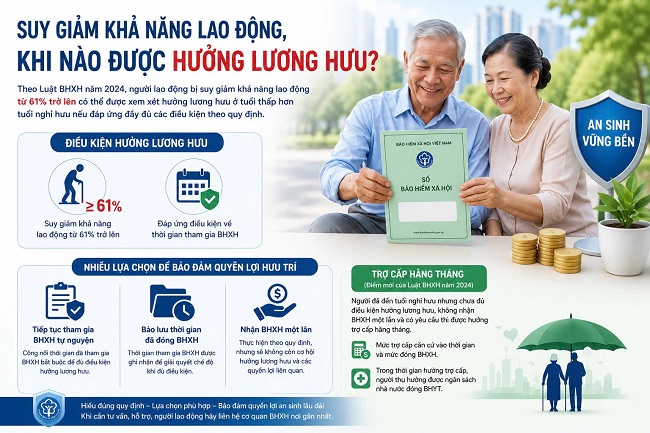
According to the 2024 Law on Social Insurance and Decree No. 159/2025/ND-CP of the Government, employees with a working capacity reduction of 61% or more may be considered for pension benefits at an age lower than the retirement age in normal working conditions if they have enough time to pay social insurance and meet the age conditions as prescribed.
Specifically, employees must have at least 20 years of social insurance contributions and have been concluded by the Medical Examination Council as having reduced working capacity. In case of reduced working capacity from 61% to less than 81%, they can retire at an age a maximum of 5 years lower than the retirement age in normal working conditions.
In case of working capacity reduction of 81% or more, they can retire at a minimum age of 10 years. For people with 15 years or more of professional experience in particularly heavy, hazardous, and dangerous jobs, if working capacity is reduced by 61% or more, they are also considered for pension benefits according to regulations.
Thus, a reduction in working capacity of 61% or more is only one of the conditions for being considered for pension benefits. Employees still have to simultaneously meet the conditions on social insurance contribution time and age according to regulations. In case of not having enough social insurance contribution time, they are not eligible for pension benefits.
Therefore, employees need to monitor their social insurance participation process, proactively choose appropriate options such as continuing to participate in social insurance or preserving the time they have contributed to ensure the opportunity to receive pensions and long-term social security benefits when they are old.
Many options to ensure retirement benefits
For employees who have to quit their jobs early due to declining health but do not meet the conditions to receive pensions, current law still has mechanisms to ensure long-term social security benefits.
Accordingly, employees can continue to participate in voluntary social insurance to add up with the time they have participated in compulsory social insurance before, thereby completing the conditions for enjoying pensions when they reach the age according to regulations.
In addition, employees can choose to preserve the time they have paid social insurance. The entire time participating in social insurance will be recorded and accumulated to serve as a basis for resolving social insurance benefits when they meet the conditions.
In case of needing to receive one-time social insurance, employees can implement it according to the provisions of the Law on Social Insurance. However, receiving one-time social insurance means not continuing to accumulate time to participate in social insurance to enjoy pensions and accompanying benefits of the pension regime in the future.
Increase opportunities to enjoy social security in old age
A noteworthy new point of the 2024 Law on Social Insurance is the addition of a monthly allowance regime for employees who have reached retirement age but are not eligible for pension benefits.
Accordingly, employees who have reached retirement age, have paid social insurance for a period of time but do not meet the conditions to receive a pension, do not receive one-time social insurance benefits and have a request are considered for monthly allowances according to regulations.
The allowance level is determined based on the time and social insurance contribution level of the employee. In particular, during the period of receiving monthly allowances, beneficiaries are also paid health insurance by the state budget, contributing to reducing the burden of medical examination and treatment costs when they are old.
Continuing to participate in voluntary social insurance or preserving the contributed period will help workers have the opportunity to receive pensions, be issued health insurance cards throughout their pension period and enjoy long-term social security benefits.
Therefore, workers with reduced working capacity need to carefully study the provisions of the law on social insurance to choose a plan suitable to their conditions, ensuring social security benefits both in the short and long term.


