
From July 1, 2026, regulations requiring the mandatory use of child safety equipment in cars officially take effect. However, when the mechanism for certifying conformity for child safety seats has not yet been implemented, many parents are wondering about the choice of equipment and the risk of being penalized.
According to new regulations, when carrying children under 10 years old and under 1.35 m tall in a car, the driver must use or guide the use of appropriate safety equipment, except for passenger transport business vehicles. In case of not using appropriate safety equipment, the driver may be fined from 800,000 VND to 1 million VND according to Decree 168/2024/ND-CP.
However, according to Official Dispatch No. 2452/ĐKVN-PTGTĐB dated June 18, 2026 of the Vietnam Register sent to the Ministry of Construction on the implementation of the National Technical Regulation QCVN 123:2024/BGTVT, currently no certification organization is qualified to certify conformity for child safety seats.
This information makes many parents worried when the time to apply the regulation is only a few days away.
Ms. Thuy Hang (residing on Kim Dong street, Hanoi) said that her family has bought a safe chair for her child to meet the new regulations. However, she is still wondering whether the international standards introduced by the sales unit fully meet the requirements and regulations in the country.
I was confirmed by the seller that the product meets European standards, but I don't know if this is considered in accordance with domestic regulations," Ms. Hang shared.
Similarly, Mr. Nguyen Minh Tien (Cau Giay ward, Hanoi) said that he spent nearly 3 million VND to buy a safe chair for his 2-year-old child. What worries him is what the authorities will base on to determine whether a chair is a "suitable safety device" or not when the certification mechanism has not yet operated.
If I bought a chair at a fairly high price but later the product was evaluated as not meeting standards, would I be fined immediately from July 1st?", Mr. Tien asked.
Discussing this issue, Lawyer Hoang Ha (Ho Chi Minh City Bar Association) said that functional agencies cannot just rely on perception or the fact that people cannot present a certificate of conformity to conclude that there is a violation.
According to the lawyer, the basis for penalties must be specific acts prescribed in law, such as carrying children under 10 years old, under 1.35 m tall sitting in the same row as the driver or not using appropriate safety equipment for children.
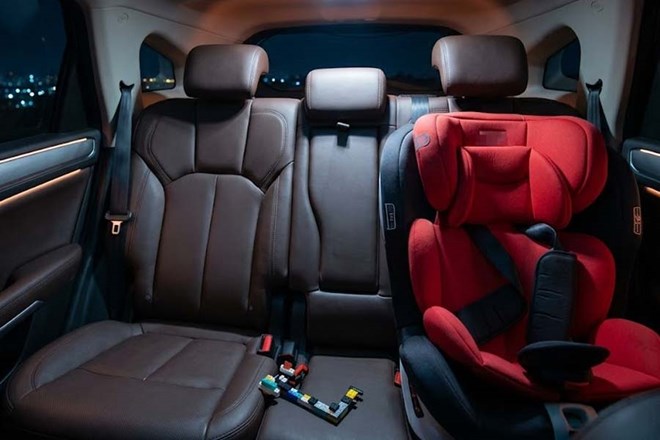
Although QCVN 123:2024/BGTVT is the technical basis for evaluating safety equipment for children, this regulation has only been in effect since the beginning of 2026 and the implementation of the certification mechanism is still facing many difficulties.
In the transitional period, the lawyer believes that functional agencies should consider practical factors such as the origin of the product, labels, user instructions, suitability for the age, height, weight of children as well as the installation and use of seats with the correct function.
If necessary, functional agencies should verify or consult professional opinions before making a decision to sanction. When it has not been proven that the chair is not suitable, it should not be sanctioned immediately," Lawyer Hoang Ha said.
Sharing the same view, Lawyer Tran Dai Lam, ANVI Law Company Limited, said that when the mechanism for assessing conformity for child safety seats is not complete, the application of sanctions may lead to many problems related to the basis for proving violations.


