
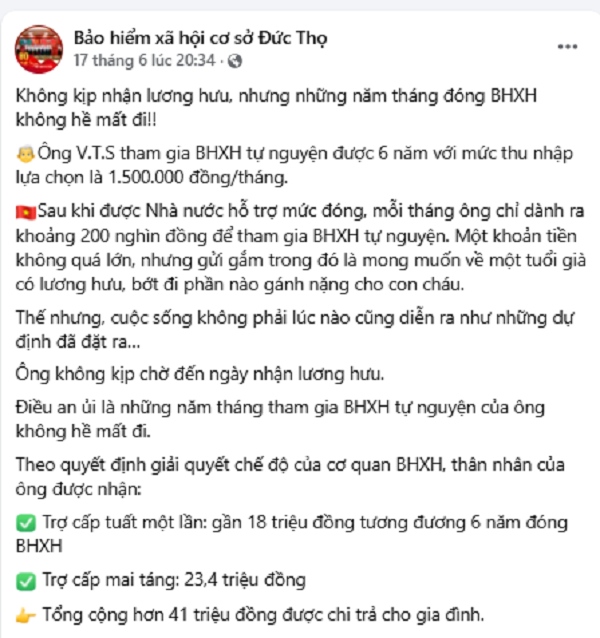
Recently, the story of Mr. V.T.S (Ha Tinh) who, although deceased, continued his social security journey through the death and disability regime after participating in voluntary social insurance has attracted the attention of the community.
The article posted on the fanpage of Duc Tho Grassroots Social Insurance, Ha Tinh province, received many interactions and shares because of the humanistic meaning that the voluntary social insurance policy brings.
Accordingly, Mr. V.T.S participated in voluntary social insurance for 6 years, with a selected income level of 1.5 million VND/month. After being supported by the State with the contribution level, he only contributed about 200,000 VND per month with the expectation of having a stable pension source when he gets old.
The voluntary social insurance contribution level is determined to be 22% of the selected income level after deducting the support from the budget. In addition to the general support policy, Mr. S is also supported by the local budget. Therefore, the total amount he actually contributed in 6 years is only more than 14.2 million VND.
However, Mr. S did not have time to wait until the day he received his pension. However, his entire voluntary social insurance participation time was not lost.
According to the decision to resolve the regime of the social insurance agency, his relatives received a one-time death gratuity of nearly 18 million VND, equivalent to 6 years of social insurance contributions; and also received a funeral allowance of more than 23 million VND. The total amount received by the family is up to more than 41 million VND.
No amount of money can compensate for the spiritual loss when a loved one passes away. But in the most difficult time, the support from social insurance policies has helped the family have more financial resources to cover funeral expenses and reduce the immediate burden.
Mr. V.T.S's story also shows that voluntary social insurance is not only a policy towards pensions in old age but also plays a role as a social security pillar for the family of participants when risks occur.
When eligible to receive a pension, participants receive a monthly salary and are issued a health insurance card for health care. In case of unfortunate death, relatives are still entitled to death benefits according to regulations.
This is also a testament to efforts to expand the coverage of social insurance for the informal labor sector - a group of workers who have little opportunity to access formal social security policies.
On the Duc Tho grassroots social insurance fanpage, many readers expressed their agreement with the voluntary social insurance policy. Many opinions believe that life always contains unexpected events, so participating in social insurance early is a proactive way to prepare for the future of oneself and one's family.
Reality shows that voluntary social insurance is increasingly becoming a sustainable social security accumulation channel thanks to flexible contribution levels, suitable to people's financial capacity. Participants can choose their income level as a basis for contribution and contribution methods suitable to their economic conditions.
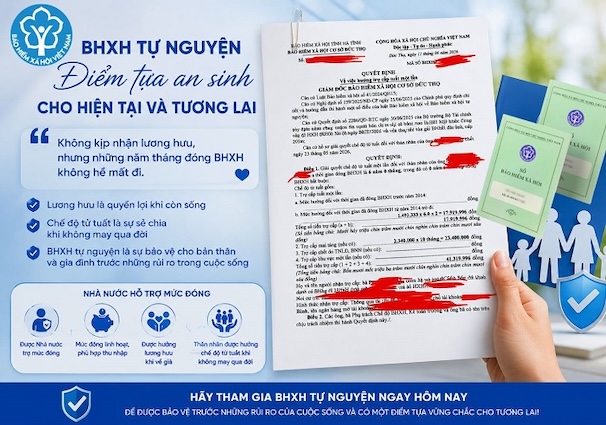
Notably, in recent years, many localities have issued additional support policies from local budgets in addition to the central government's support. This is one of the factors contributing to increasing the number of people participating in voluntary social insurance, towards the goal of expanding social insurance coverage.
From Mr. V.T.S's story, it can be seen that small monthly contributions can still become a practical source of support for families when risks occur. Voluntary social insurance not only helps people accumulate for old age but also contributes to creating a social security support for relatives in the most difficult times.


