
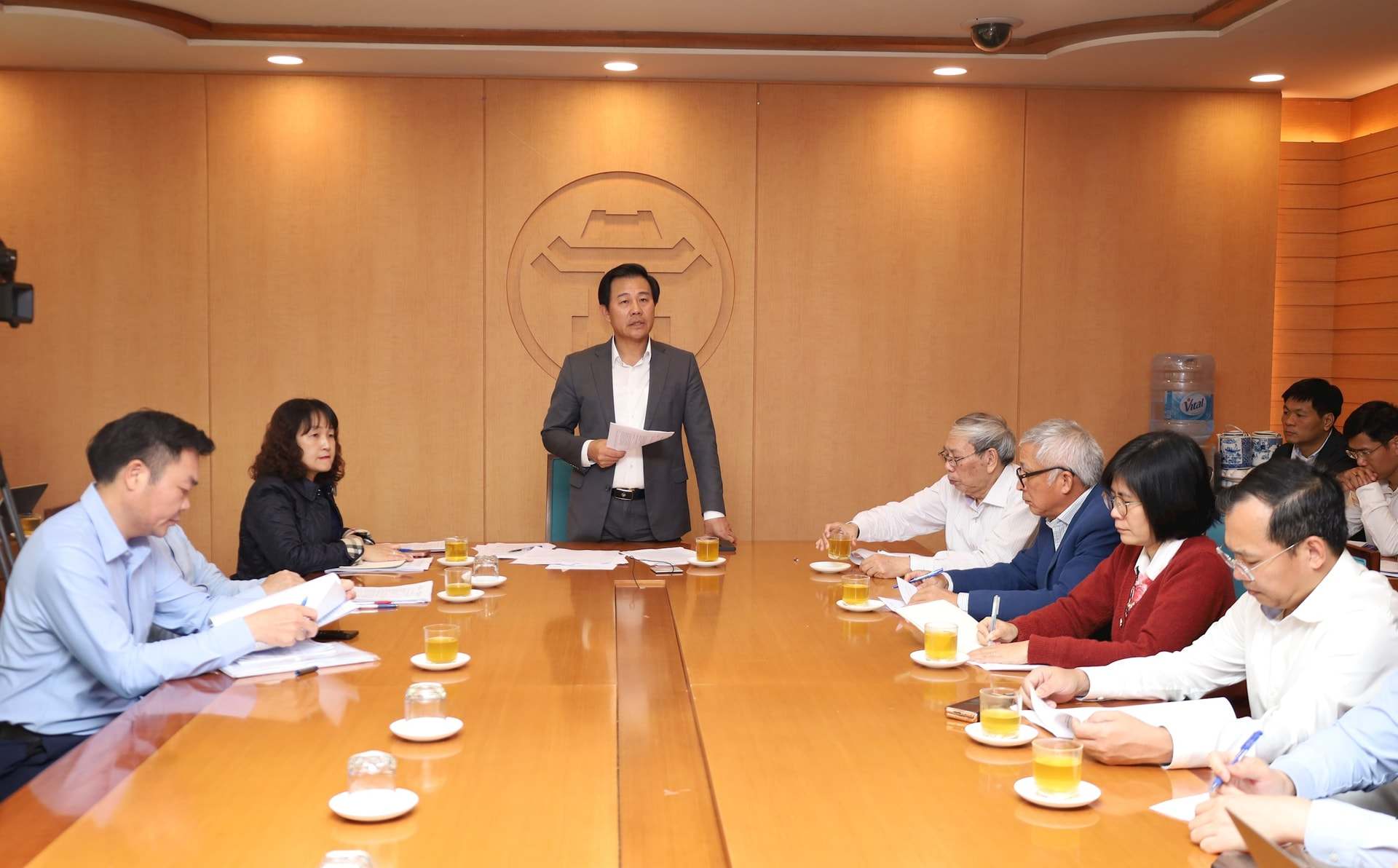
On December 18, Director of the Hanoi Department of Agriculture and Environment Nguyen Xuan Dai chaired a meeting to discuss solutions to control air pollution in the capital.
Reporting at the meeting, the Department of Agriculture and Environment said that monitoring results showed that air pollution in Hanoi in recent years has not shown any signs of significant decline, the pollution time lasted for both hours and days, especially in the period from November to April of the following year.
The largest source of emissions is identified as traffic, accounting for over 50% of PM2.5 fine dust levels, followed by industry, construction, open-pit combustion activities and sources of propagation from outside the city.
Notably, model calculations show that about 58.65% of primary PM2.5 dust comes from waste sources in Hanoi, the rest is affected by neighboring provinces and spreads across borders, posing an urgent need for inter-regional coordination in controlling air pollution...
Prof. Dr. Hoang Xuan Co - Head of the Science Department, Vietnam Environmental Economics Association said that Hanoi needs to focus on basic research to clarify the level and specificity of air pollution, especially the secondary fine dust formation mechanism that accounts for a high proportion.
He emphasized the need to clarify the causes of serious pollution in winter, including the anti-termic factor, through the construction of meteorological measurement stations at heights.
At the same time, Hanoi needs to pioneer in substantial emission inventories, clearly identifying subjects, scale and distribution of emissions from transportation to industry, instead of only relying on old research...
Dr. Hoang Duong Tung, Chairman of the Vietnam Clean Air Network, said that it is necessary to concretize management responsibilities to the commune and ward levels, instead of stopping at the city level or department and branch level.
He proposed strongly applying information technology to digitize waste sources, build a GIS map to manage each enterprise and production household according to fuel types used and emission flows. In the field of transportation, Hanoi can refer to Beijing's experience in controlling trucks using online emission monitoring devices and strongly promoting electric vehicles.
In addition, it is necessary to adjust the penalty mechanism in a progressive direction to increase deterrence, while establishing a substantial regional coordination mechanism to control waste sources from neighboring provinces such as cement plants or straw burning activities...
Concluding the meeting, Director of the Hanoi Department of Agriculture and Environment Nguyen Xuan Dai respectfully thanked the experts and scientists for their profound and valuable contributions in scientific and practical fields.
At the same time, it is recommended that specialized units seriously absorb and research to complete appropriate solutions.
He emphasized that protecting the air environment is not only the responsibility of state management agencies but also a common task of the entire political system, authorities at all levels and each citizen, aiming to improve the quality of life and health of the people.
The Department of Agriculture and Environment will synthesize opinions, advise the City People's Committee to direct the synchronous implementation of immediate and long-term tasks, strengthen coordination in controlling air pollution in Hanoi...
·


