
Many boarding houses are located deep in small alleys, narrow walkways, balconies and windows are surrounded by iron frames. These inadequacies make the risk of fire and explosion always present, requiring increased inspection, post-inspection and strict handling of violations.
Over the past time, functional agencies and local authorities of Hanoi City have strengthened fire prevention and fighting (PCCC) safety inspections at boarding houses. Through inspection, some establishments are still not fully equipped with fire fighting equipment, lack solutions to prevent fire from spreading between parking areas and other areas, or do not ensure escape routes.
In many boarding houses located deep in alleys, the risk of unsafety is even more noteworthy. Telecommunication cables are tangled, clinging to columns, hanging in front of the facades of high floors. Some 4-6 story buildings use iron frames and stainless steel surrounding balconies and windows, with almost sealed positions, making it difficult to escape.
Recorded at Phu Kieu street, Xuan Phuong ward, some boarding areas still lack conditions to handle incidents from the beginning. Some boarding areas only arrange fire extinguishers but lack warning systems; stairs and walkways are not clear.
In Me Tri, Tan My, Phu Do (Tu Liem ward), Phan Van Truong, Nguyen Khanh Toan (Nghia Do ward), many tube houses, built many years ago, still have inadequacies in escape routes and escape ladders.
Many boarding areas are located close together, the entrance is only about 1-2m wide, motorbikes are parked tightly on both sides. This both hinders people from escaping and causes difficulties for firefighters to access the scene.
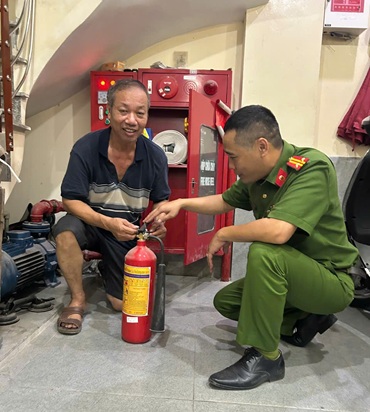
In August 2026, Tu Liem, Cau Giay, Xuan Phuong and Tay Mo wards continuously inspected and reminded landlords to equip fire prevention and fighting equipment; guided the use of fire fighting equipment, alarms, call functional forces and choose safe escape routes.
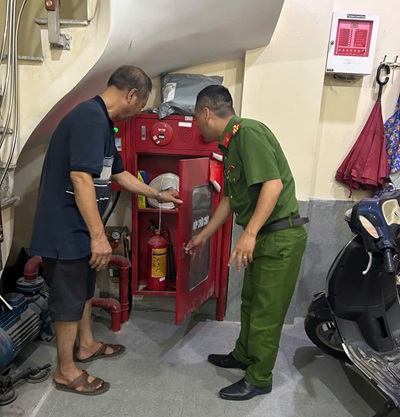
Functional forces strengthen inspection of boarding houses, focusing on electrical systems, escape routes, initial fire fighting vehicles, fire alarm systems, emergency lights and escape signs.
Representatives of the Economic, Infrastructure and Urban Department of Cau Giay ward said that the locality has 119 boarding houses under its management authority, of which 108 establishments have been inspected and no cases have been penalized.
Through inspection, some establishments still lack fire prevention and fighting equipment, including foam fire extinguishers. The ward continues to mobilize and remind landlords. In case of non-compliance or intentional failure to remedy, when re-inspecting, a record of handling will be made and notified to the residential group for coordination in supervision.
In Phu Dien ward, the handling is carried out more drastically. Head of the Economic, Infrastructure and Urban Department of Phu Dien ward - Quach Anh Tuan said that the Ward People's Committee has inspected 25 establishments including office for lease, boarding houses and houses combined with production and business; and issued 12 decisions to sanction administrative violations.
The main violations are related to PCCC and rescue management records that have not been prepared or are incomplete. Some facilities have doors that are not opened in the direction of escape or fire prevention solutions that do not meet requirements.
According to Mr. Quach Anh Tuan, the Ward People's Committee will continue to request facilities to maintain fire prevention and fighting conditions throughout the operation process, and at the same time handle cases of non-compliance, re-offending or continuing to let violations exist.
Reality shows that inspection is only the first step. The important thing is that violations must be substantively remedied. For establishments that intentionally do not remediate or still operate when fire prevention and fighting safety is not ensured, it is necessary to handle them strictly, even suspend operations when there is sufficient basis.
Inspection needs to be linked to post-inspection, clearly defining the time limit for rectification and the responsibility of the facility owner. Only when violations are handled thoroughly, can the risk of fire and explosion in boarding houses be effectively controlled.


