
Consumers still buy food with... trust
In the late afternoon, Ms. Bui Huong Giang (Tay Mo ward, Hanoi) ordered vegetables, meat, and fruits through a group of residents. The seller only introduced "clean vegetables from the countryside", "local pigs sent on the same day" but did not have traceability stamps or documents proving their origin. She still bought because she thought that food in the local market rarely had origin information.
Surveys at many traditional markets in Hanoi show that small traders often only introduce general items such as "Da Lat goods", "local chickens", "clean vegetables" but have no basis to prove it.
At supermarkets, although many products have QR codes for traceability, not everyone checks them. Many codes only provide basic information about businesses or production locations, not fully showing the process of farming, transportation and distribution, making it difficult for buyers to assess safety.
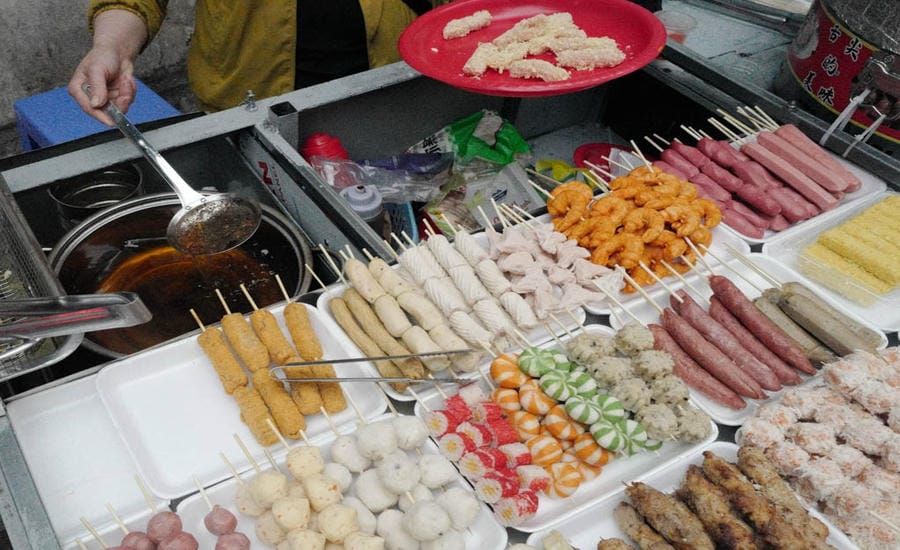
Cheap and convenient, making street food still popular. At the gate of Cau Giay Park (Hanoi), stalls selling skewers, mixed noodles, and milk tea priced at 3,000-10,000 VND are always crowded with students. Many unlabeled foods and sauces are sold on sidewalks in poor hygiene conditions. Sellers and customers often do not know the origin, as long as they are "delicious and cheap".
In June, a case of poisoning after eating bread in Dao Thanh ward (Dong Thap) caused 232 people to be hospitalized. Test results showed that many specimens were positive for Salmonella bacteria, a common cause of food poisoning.
This is not an isolated case. Food of unknown origin, fake goods, and poor quality still appear from traditional markets, small retail stores to e-commerce platforms and social networks, making it difficult for consumers to determine the origin of products.
Dirty food still has "land to live" due to unclear supply chains
According to the Food Safety Department (Ministry of Health), in the first 6 months of 2026, the health sector established more than 5,000 inspection teams, inspected 118,009 establishments and discovered 5,695 violating establishments. Of which, more than 3,500 establishments were fined with a total amount of over 20.2 billion VND.
At the same time, the Ministry of Agriculture and Environment fined 360 violating establishments in the fields of agriculture, forestry, and fishery; the Ministry of Industry and Trade handled 1,832 cases and coordinated to remove more than 14,000 booths and nearly 3,800 fake and poor quality food products on e-commerce platforms. The Ministry of Public Security also discovered 4,688 violations, initiated 95 cases with 192 defendants related to food safety.
Currently, management work is still mainly based on taking samples for testing or inspection after signs of violation. This means that many products have been consumed before functional agencies detect risks. In many cases, even if products are recalled, consequences for consumer health have occurred.
After more than 15 years, the 2010 Food Safety Law has revealed many inadequacies in the face of the development of e-commerce, online business and complex supply chains. The Ministry of Health is proposing comprehensive amendments to the Food Safety Law according to the chain, increasing post-inspection, traceability and tightening responsibility for e-commerce platforms.
The amendment of the Food Safety Law is therefore expected not only to increase sanctions but also to build a new management method, in which the entire supply chain is monitored and traced transparently.
Prevention from the root
Dr. Chu Quoc Thinh - Director of the Food Safety Department (Ministry of Health) - said that the goal of the amendment is to shift from handling violations to preventing risks from the root, protecting people's health and creating a favorable environment for businesses to produce and trade safe food.
Full supply chain management
One of the biggest changes in the draft is the shift from managing each individual stage to controlling the entire food supply chain, from initial production, cultivation, animal husbandry, harvesting, slaughtering, processing, transportation, circulation to when products reach consumers.
Many groups of production facilities will have to apply advanced food safety management systems such as Good Manufacturing Practices (GMP) or Hazard Analysis and Critical Control Point System (HACCP) or ISO 22000 Food Safety Management System or equivalent international standards. Health protection food production facilities are still required to meet GMP standards.
Facilities that have fully applied the international management system may be considered for exemption from food safety eligibility certificates, thereby reducing administrative procedures but still ensuring quality control.
Strongly shift to post-inspection
The draft proposes to manage food according to the level of risk. High-risk groups still have to register the declaration before circulation, while ordinary food only needs to announce standards and undergo post-inspection.
Imported food continues to be inspected according to three levels: Strict, regular and reduced. Businesses that meet international standards will be applied a more favorable mechanism.
Tighten responsibility for e-commerce platforms
According to the proposal, platforms must control product declaration dossiers and advertising content before allowing business. If management is lax leading to food safety violations or causing damage to consumers, e-commerce platforms may be jointly liable.
Building a national database
A noteworthy new point is the proposal to build a national data system on food safety that is unified nationwide.
The system will store information about production facilities, products, test results, inspection history, violation warnings and traceability; and connect with ministries and sectors to serve management, inspection and incident handling.
The draft also orients the application of artificial intelligence (AI), big data (Big Data), QR codes, barcodes and electronic labels to improve traceability and early warning of food safety risks.
Increase management of street food
The draft adds many new regulations, according to which business establishments will have to keep invoices and documents proving the origin of raw materials, store food samples, update professional knowledge and develop incident handling plans.
Commune-level People's Committees are assigned additional tasks of compiling lists of food business establishments, strengthening inspection and examination, receiving feedback from people, handling poisoning cases and updating violation data to the national information system.
Strengthening the role of local authorities will help detect risks early and quickly handle cases right from the area.
The draft Law on Food Safety (amended) is expected to be submitted to the National Assembly for consideration at the end of this year. If passed, the law will create a major shift in food safety management towards risk control right from source, strengthening traceability, tightening dirty food, fake food and better protecting consumer health.
Continue to crack down on establishments violating food safety
On the morning of July 14, at the Government Headquarters, the Central Inter-sectoral Steering Committee for Food Safety held a meeting under the chairmanship of Secretary of the Party Central Committee, Deputy Prime Minister Pham Thi Thanh Tra, Head of the Steering Committee.
The Deputy Prime Minister pointed out 3 major issues that still exist in food safety assurance and requested to solve these issues to change the entire perception of society as well as create public consensus on food safety work. Accordingly, the reality of food poisoning continues to increase and diễn biến very complicatedly in the past 6 months. The whole country recorded 58 cases of food poisoning, 1,573 people affected and 10 deaths. An increase of 23 cases compared to the same period in 2025 and the number of people affected increased very high. In particular, 12 cases of food poisoning occurred at school kitchens. The management of business and advertising of food on e-commerce platforms and social networks still face many inadequacies and difficulties.
The Deputy Prime Minister assigned the Ministry of Health to focus on completing the draft revised Law on Food Safety. The Deputy Prime Minister requested the Ministry of Health, the Ministry of Agriculture and Environment to coordinate with relevant ministries and sectors to urgently complete the national common platform database on food safety, connecting and interlinking from the root (seed, planting, production, business) to the dining table.
In particular, the Deputy Prime Minister requested the Ministry of Public Security to continue to fight more drastically and strongly against organizations and businesses producing and trading counterfeit goods, fake goods, and poor quality goods, especially products related to food. The Ministry of Health focuses on focused and key inspections and examinations of schools, street food and small-scale food services in rural areas. Ha Minh


