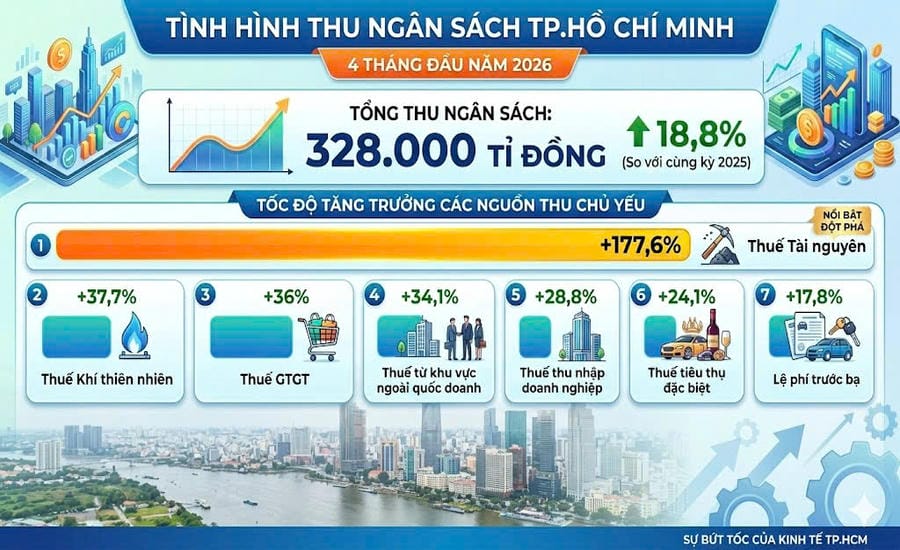
In the first 4 months of the year, revenue was more than 328 trillion VND
At a working session with General Secretary and President To Lam on April 27, Secretary of the Ho Chi Minh City Party Committee Tran Luu Quang affirmed his determination to achieve double-digit growth, and at the same time bring the scale of budget revenue to exceed the threshold of 1 million billion VND. According to calculations, if maintaining an increase of about 20% compared to 2025 (more than 800,000 billion VND), total revenue in 2026 may reach about 964,000 billion VND, still lacking nearly 36,000 billion VND to reach the finish line.
According to the Secretary of the Ho Chi Minh City Party Committee, revenue increase cannot only be based on land, because if exploited in this way, there will be potential risks of resource depletion in the future. The city is aiming to accumulate other resources to ensure sustainability for the budget.
Reality shows that, despite facing many fluctuations, Ho Chi Minh City still maintains its leading position in the country in budget revenue. In the first 4 months of the year, Ho Chi Minh City's budget revenue reached more than 328 trillion VND, an increase of 18.8% compared to the same period.
According to Ho Chi Minh City Tax Department, key revenue sources such as value-added tax, corporate income tax and special consumption tax increased from 24 - 36%, showing a clear recovery of the economic sector.
In addition, revenue from the non-state sector increased by 34.1%; revenue from natural gas increased by 37.7%; resource tax increased by 177.6%; registration fee increased by 17.8%. Revenue related to real estate transactions also increased sharply, reflecting that the market is gradually recovering.
Ho Chi Minh City Tax Department focuses on strictly managing revenue sources, ensuring "collecting correctly and fully", without omissions. High-risk areas such as e-commerce, accommodation, and food are strengthened with control. Promoting digitization and data connection to improve inspection and violation handling efficiency, while simplifying procedures and supporting taxpayers to comply more conveniently.
Series of solutions to increase revenue
According to Director of Ho Chi Minh City Department of Agriculture and Environment Nguyen Toan Thang, in the target of budget revenue of 1 million billion VND in 2026, revenue from land is expected to account for about 10%. Accelerating the determination of land prices is important for the goal of economic growth and increased budget revenue. The city currently has 68 dossiers that need to determine land prices, of which 60 dossiers are eligible for processing. If including the dossiers being completed, about 100 projects may be valued this year, estimated to generate revenue of more than 100,000 billion VND.
However, the process of determining land prices is still problematic due to prolonged legal factors and some inappropriate regulations. To accelerate progress, the Ho Chi Minh City Department of Agriculture and Environment is coordinating with units to advise on issuing the 2026 land price adjustment coefficient (coefficient K) and adjusting the land price list for the first time. Agencies are also processing specific land price determination dossiers expected to be submitted this year.
According to Director of Ho Chi Minh City Department of Finance Hoang Vu Thanh, to achieve the budget revenue target of 1 million billion VND, the city will focus on three key groups of solutions.
First, continue to reform administrative procedures, improve the investment environment, improve competitiveness and support businesses to develop and expand production. At the same time, promptly remove obstacles to accelerate bidding to select investors, increase the occupancy rate of industrial parks and clusters; strengthen digital transformation in tax management, strictly control risk areas such as transfer pricing, related party transactions, and real estate.
Second, effectively manage and exploit land resources, public assets and minerals. The city accelerates land auctions, handles projects that have not fulfilled financial obligations; review and rearrange public housing and land funds, especially redundant facilities after arrangement to put them up for auction, lease or joint venture, association, thereby creating additional revenue for the budget.
Third, review and exploit other sources of budget revenue such as from social housing and apartments. The city will soon issue appropriate rental and lease-purchase prices to recover state capital invested, create resources for reinvestment and expand housing funds in the area.