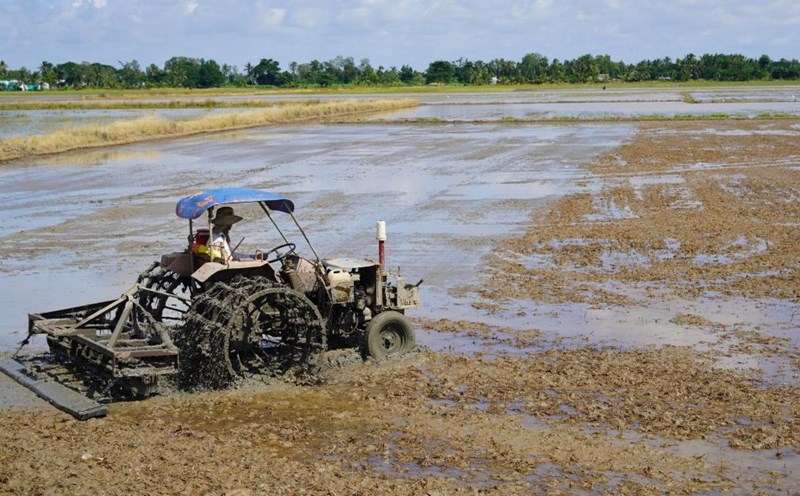
According to the Southern Institute of Irrigation Science, it is forecast that saltwater intrusion in the dry season 2025 - 2026 in the Mekong Delta will be at an average or below average for many years, with the possibility of slow change, close to natural laws for many years. Water sources basically ensure sufficient area of production according to the annual plan of localities.
The highest salinity period is expected to be in the period from the end of February to April, with a salinity limit of 4g/l from 40 - 55km from the river mouth. Unusual water accumulation can cause saltwater intrusion 50 - 60km deep; therefore, localities need to proactively respond to drought and saltwater intrusion in the year according to forecast conditions.
In the forecast week from January 9 to 15, saltwater intrusion will gradually decrease at the mouths of the Mekong River, creating favorable conditions for coastal areas to take advantage of storing water before entering the saltwater period. Coastal localities need to proactively store water when water sources are still favorable, and operate saltwater control works reasonably.
At this stage, according to water source zoning, the upper Mekong Delta is assessed as guaranteed. High mountainous areas such as Tinh Bien and Tri Ton need to proactively store water and use water economically.
In the central Mekong Delta region, the water source is sufficient to serve production according to the plan. Areas bordering salty and barren areas need to take advantage of storing water to ensure sufficient water for the Winter-Spring crop production.
For coastal areas, during the forecast week, saltwater intrusion tends to decrease, the water source is favorable for storage. However, in the dry season, abnormal salinity still has the potential to affect water sources and production at coastal irrigation systems such as Go Cong, Cu Lao Bao, An Hoa Cu Lao, Nam Mang Thit system and Long Phu - Tiep Nhat system. Therefore, it is necessary to proactively store water reasonably when the water source has not been affected by saltwater, especially in the fruit growing areas of Chau Thanh, Cho Lach, Mo Cay Bac, Mo Cay Nam (Vinh Long province); Ke Sach area (Can Tho City), and prepare response plans.