
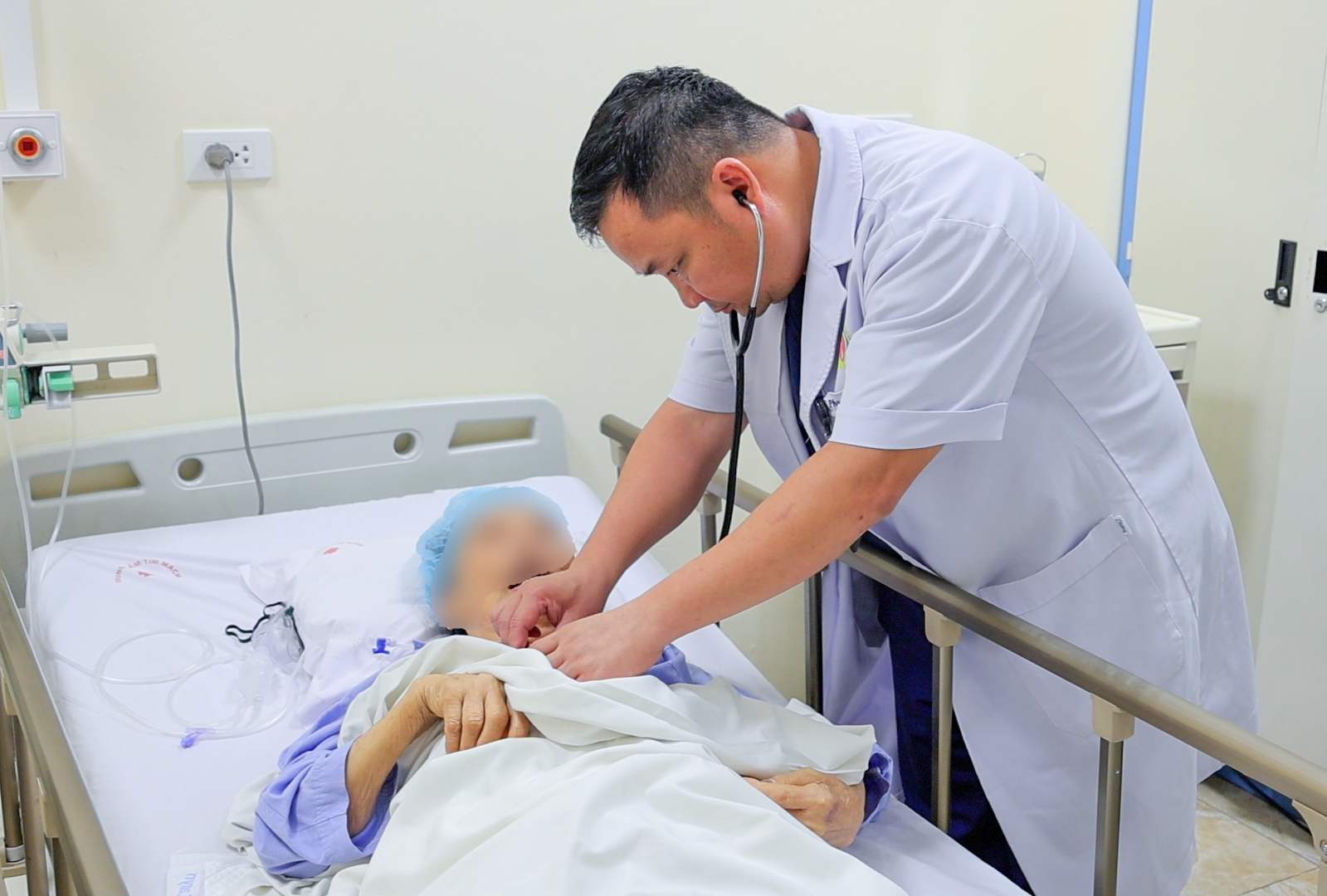
The Cardiovascular Center, E Hospital received emergency care for elderly woman N.T. H. (84 years old, Hanoi) in a critical heart shock condition. Upon admission, the patient's blood pressure dropped to only 70/40 mmHg, heart rate was 130-140 beats/minute, severe respiratory failure and acute pulmonary edema.
According to her family, during a trip to Hung Yen to attend a death anniversary, the old woman suddenly experienced severe shortness of breath, turned purple and then collapsed. The patient was treated at Thai Binh Provincial General Hospital before being urgently transferred to the Cardiovascular Center, E Hospital.
Dr. Phan Thao Nguyen, Head of Adult Cardiology Department (Cardiology Center), Deputy Director of E Hospital, said that at the time of admission, the patient fell into a state of complete hemodynamic collapse. Blood pressure dropped deeply to 70/40 mmHg, rapid heartbeat 130-140 beats/minute. Doctors had to use three types of high-dose vasopressors at the same time to maintain blood pressure and save the patient's life.
The results of cardiac ultrasound and emergency angiography showed that the patient had two severe lesions at the same time. The biological mitral valve replaced 14 years ago had degenerated and completely calcified, causing severe stenosis - valve regurgitation, causing blood stagnation in the lungs and leading to acute pulmonary edema. At the same time, the patient also had acute obstruction of the coronary artery branch (LCx), causing severe myocardial ischemia.
According to Dr. Phan Thao Nguyen, biological heart valves usually have a lifespan of about 10-15 years. For cases of degenerative valves, the classic treatment method is chest open surgery to replace a new valve. However, in 84-year-old patients who are in a state of heart shock, multiple organ failure, the risk of death if open surgery is very high.
Immediately after consulting according to the Heart Team model with the participation of interventional cardiology experts, heart surgery, anesthesia and resuscitation and diagnostic imaging, the team agreed to choose a minimally invasive treatment strategy in two phases instead of open surgery.
Stage 1: Keeping life from the hands of death
Right on the day of admission, when the hemodynamics were extremely fragile, the team decided to solve the cause of acute myocardial ischemia first. The patient was taken to the Cathlab room for intervention to place 01 drug-coated stent to thoroughly resolve the damage in the coronary artery (LCx). However, the coronary stent only solved the problem of irrigation, while the damaged valve continued to cause heart failure. The patient was transferred to the Intensive Care Unit. Here, for a whole week, doctors and nurses devoted all their efforts to adjusting the ventilator, using internal resuscitation protocols, and compressing fluids to get the patient out of acute pulmonary edema, gradually withdrawing from vasopressors. When the hemodynamics and physical condition of the old woman began to show signs of recovery, the "decisive battle" officially began.
Stage 2: "Valve-in-Valve" technique revives the heart
After 1 week of successful resuscitation, the second day of intervention took place. At this time, the team performed top-notch technique: Transcatheter Mitral Valve-in-Valve Replacement (TMViVR). Without needing a cleaver to open the chest, the doctor only went through a puncture hole the size of a ballpoint pen tip in the femoral femur vein. Under the simultaneous guidance of a blood vessel X-ray (DSA) and 3D/4D esophageal cardiac ultrasound (TEE), the catheter carrying the new biological valve was skillfully inserted from the femur vein, piercing through the atrial septum to enter the left heart chamber. A brand new artificial valve was "unfurnished" and nestled right inside the frame of the old degenerate valve.
As soon as the new valve was unlocked, it immediately worked rhythmically, restoring a perfect flow through the mitral valve. The pressure in the heart chamber immediately decreased. The entire intervention room burst into tears when the vital signs on the monitor screen signaled a successful intervention.
Dr. Phan Thao Nguyen said that the technique of valve replacement in a valve through a catheter opens up the opportunity for effective treatment for elderly patients with degenerated biological heart valves but no longer suitable for open surgery due to too high risk. The success of the case also shows the effectiveness of the multi-specialty treatment model (Heart Team) in handling complex cardiovascular cases.


