
Revenue pressure and concern about "brain drain
Decree No. 56/2011/ND-CP stipulates the professional preferential allowance regime for civil servants and public employees at public health facilities. Over the past 15 years, on-duty allowances, surgical allowances, epidemic prevention and food support for medical staff have remained "stuck". High work pressure, increasing living costs, while "outdated" salaries have caused tens of thousands of medical staff at public hospitals to quit their jobs or transfer to private hospitals.
A difficult spinal surgery, the surgical team stood from 9 am to 5:30 pm, but the main surgeon only received 280,000 VND; the assistant surgeon and technician each received 200,000 VND. Not only surgical allowances, the doctor's on-duty fee is also very low. On-duty for 5-7 days each month, the total allowance is less than 1 million VND. Each 24 hour on-duty shift, from the previous morning to the next morning, the doctor only received 9,000 VND for on-duty and 15,000 VND for meals.
At the grassroots health level, the allowance level is even lower. Commune health station staff on duty on normal days only receive 18,750 VND/night, on weekends 32,500 VND/night, meal money is still 15,000 VND. "On-duty money is not enough to eat a bowl of pho," a doctor at the lower level said bitterly.
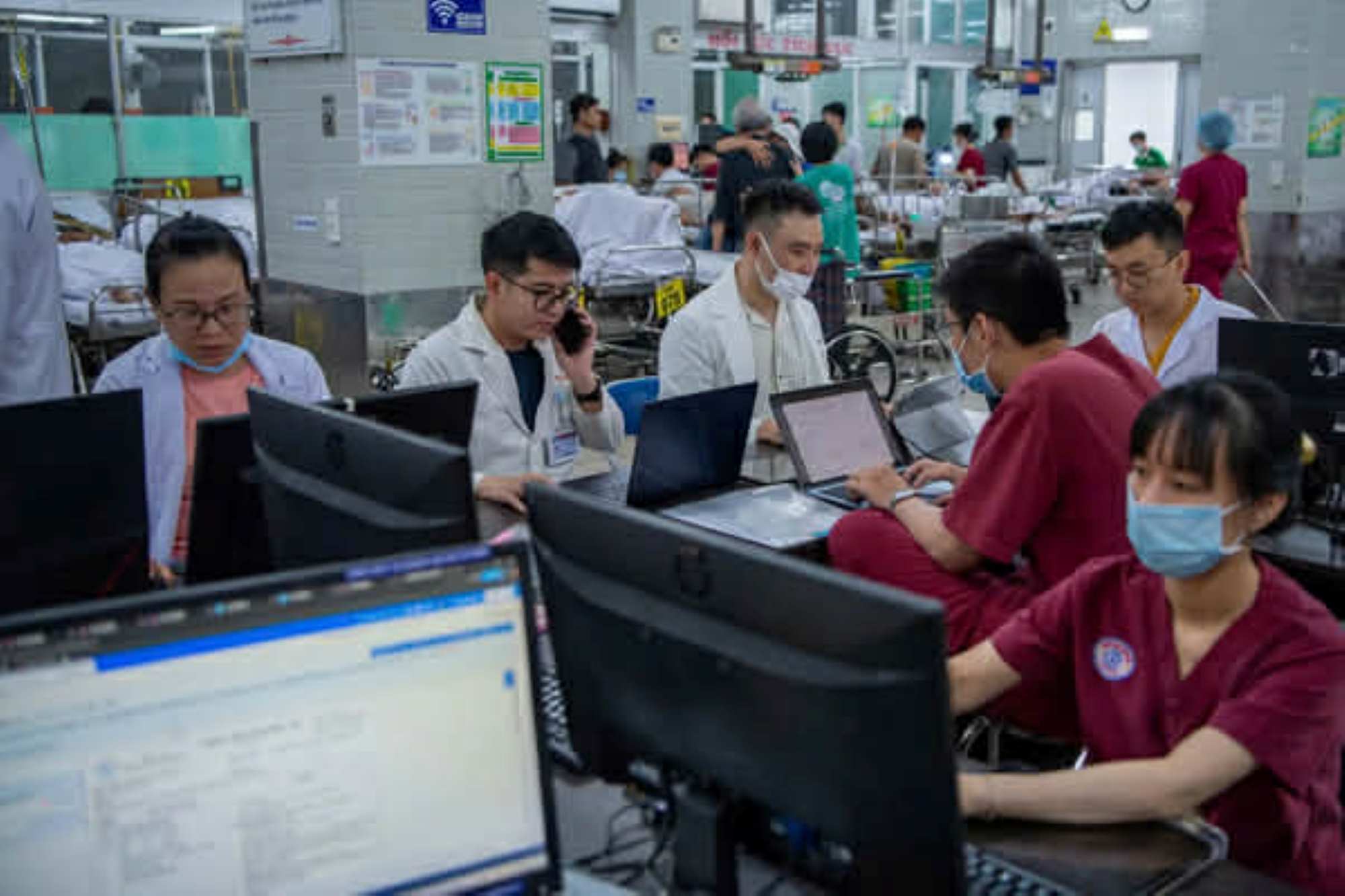
At many public hospitals, increased work pressure while income has not kept up with expectations is directly affecting the psychology of medical staff.
A young doctor working at a final-line hospital in Hanoi shared: "The number of patients is large, the duration of duty is long, and the professional requirements are increasing. But compared to the private sector, the income of public doctors is still a significant gap. This makes many colleagues have to consider other options.
Dr. Nguyen Cong Huu, Director of E Hospital, shared: The "bleeding" of human resources is reoccurring in many public health facilities.
The issue that caused much concern in previous years has now reappeared, putting hospitals in front of a difficult problem of recruiting and retaining talent. Many hospitals are entering an underground competition to "hunt" and retain a team of good doctors. However, in the context of limited revenue, the affordability of public hospitals is not attractive enough. Low income, not commensurate with the workload and professional pressure are considered the main reasons why many doctors choose to leave.
The shortage of high-quality human resources not only affects professional activities but also adds burdens to those who remain. Increased work pressure, risk of overload and decline in the quality of healthcare services are visible consequences.
Experts believe that to limit this situation, there needs to be a synchronous solution from financial mechanisms, preferential policies to the working environment. Because more than anyone else, the team of doctors is the core force that determines the quality of community health care. Maintaining medical personnel is not only the story of each hospital, but also an urgent requirement for the entire public health system.
Ho Chi Minh City adjusts many policies to retain and attract good doctors
Le Van Thinh Hospital receives thousands of patients from wards in Ho Chi Minh City and neighboring provinces every day. In just over 10 years, the hospital's personnel scale has increased significantly to meet the increasing demand for medical examination and treatment.
According to Dr. Tran Van Khanh - Director of Le Van Thinh Hospital, the problem of high-quality human resources is always a concern for the management team.
Ho Chi Minh City needs to continue to research and improve key policies such as strong financial support, housing policies or long-term rentals for good doctors. Attracting human resources should be associated with long-term work commitments and the development of key specialties, avoiding spreading out. Investing in good doctors is investing directly in patients" - Dr. Khanh assessed.
Regarding policies, the Ho Chi Minh City Department of Health said that officials and employees at health stations continue to implement salary policies according to current regulations, without interruption or unfavorable changes when changing management models. Not only stopping at preferential policies, the Ho Chi Minh City Department of Health has just developed a specific policy project to support resident doctor training, expected to be submitted to the City People's Committee for promulgation in the near future. Accordingly, the city will support 100% of tuition fees for resident doctors. In the period 2025-2030, Ho Chi Minh City is expected to train about 655 resident doctors, with a total support budget of about 18.7 billion VND per year.
Assoc. Prof. Dr. Tang Chi Thuong - Director of Ho Chi Minh City Department of Health - said that the Standing Committee of the Ho Chi Minh City Party Committee has basically agreed with the Project on training young talents in the health sector through the form of training resident doctors. According to this orientation, resident doctors will be invested from the budget, do not have to pay tuition fees and will enjoy many other important support regimes.
Need to soon adjust salaries and job allowances
The Ministry of Health is seeking opinions on the draft decree on professional preferential allowances for public health officials and employees, proposing 6 levels from 30% to 100% of salary, expected to be applied from 2026. The allowance is calculated as a percentage of the salary of the title and related allowances; if performing many tasks, only the highest level is enjoyed. The conditions for enjoyment are professional work at least 50% of the working time per month; not applicable when going to school, long-term work without professional work, unpaid leave, social insurance leave, temporary suspension...
The main levels include: 100% for specific fields such as psychiatry, forensic medicine, emergency resuscitation, pathology; commune health and prevention in difficult areas; 70%: direct treatment of leprosy, tuberculosis, HIV/AIDS, group A infectious diseases, newborns; working at high-security biosafety labs; commune health stations, provincial CDCs, preventive institutes; 50%: burns, dermatology, pediatrics, diagnostic imaging, infection control, clinical pharmacy; 40%: medical examination and treatment, testing, rehabilitation, traditional medicine, pharmaceuticals, medical equipment, food safety... 30%: Health education communication, population, school health, or not directly involved in professional work.
Minister of Health Dao Hong Lan affirmed that the Politburo has agreed on the policy of gradually increasing allowances for medical staff, aiming to improve income and retain industry human resources.
Dr. Nguyen Viet Hung, Vice Chairman of the Vietnam Society for Infection Control, pointed out the inadequacy: Infection control staff at facilities with HIV/AIDS, tuberculosis, leprosy, and mental illness only receive a 40% allowance, lower than the 70% level of treating colleagues, even though the job requires direct supervision, handling of tools, waste and contact with polluting sources.
Decree 56/2011 stipulates a level of 40%, but the new draft proposes to raise it to 70% to be synchronized with preventive medicine. The previous 30% was also proposed to be increased equally, raising concerns about fairness.
Dr. Hung proposed applying a 70% rate for infection control to accurately reflect the nature of the profession, create motivation, contribute to reducing labor shortages, limiting job losses and improving the quality of health services. This is considered a recognition after many years of waiting for the community health protection force.


