
On May 22, the Tobacco Harm Prevention and Control Fund (Ministry of Health) organized a workshop with the theme of World No Tobacco Day 2026 selected by the World Health Organization: "Exposing Fake Attractiveness - Action to Repel Nicotine and Tobacco Addiction" and updated the implementation of tobacco harm prevention and control policies.
At the Conference, Dr. Nguyen Thu Huong - University of Commerce presented a report titled "Exposing Fake Attrtraction", focusing on clarifying the tricks of tobacco and nicotine marketing campaigns targeting young people.
Cigarettes disguised as entertainment and sweets
According to Dr. Nguyen Thu Huong, the tobacco industry has never stopped, but is constantly changing strategies to maintain the market. In which, teenagers, from Gen Z to Gen Alpha - that is, the generation born from 1997 onwards, become the target customer group.
This is a business, and to survive, they need new users. That target is young people" - Ms. Huong emphasized.

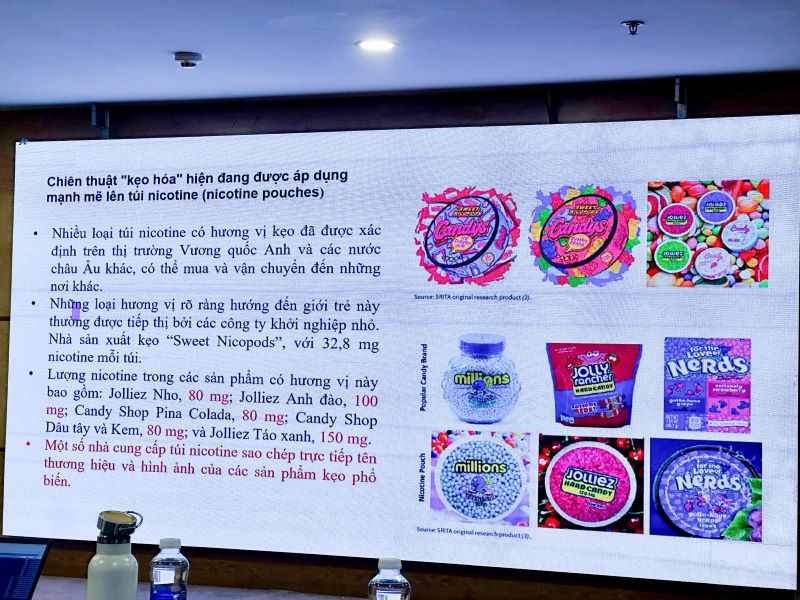
One of the prominent tactics is "candyizing" products.
New generation cigarette products are designed with bright colors, eye-catching packaging, and even copied images from confectionery brands. Not stopping at form, the product is also supplemented with a series of sweet flavors such as soft candy, chewing gum or fruit, making young users easily access and reduce their vigilance against risks.
The principle is very simple: No matter how confectionery is designed, tobacco products are also made similarly," Ms. Huong said.
Even when countries tighten flavor management, businesses still find ways to circumvent the law with vague "conceptual flavors", concealing the nature of the product. The reality in the Netherlands shows that after flavor bans, about 40% of users reduce use and 22% completely abandon them.
At the same time, the "game-making" strategy is also being promoted. Many e-cigarettes are integrated with touch screens, Bluetooth connections, and even e-games such as Pac-Man or Tetris. This design makes the product look like a technology toy, helping users easily disguise it.
According to Ms. Huong, playing and using at the same time causes teenagers to unconsciously increase the frequency of nicotine intake, thereby accelerating the process of dependence. Even some platforms apply the "vape-to-earn" model, rewarding virtual currency based on the number of times they smoke, creating a double addictive loop both chemically and psychologically.
Social networks, disguised advertising and image "whitening" strategies
Not only changing products, the tobacco industry also strongly utilizes the digital environment to reach young people. Dr. Nguyen Thu Huong's report said that there are currently about 16 million people under 18 years old exposed to online tobacco advertising.
Brands use social networks and influencers to build a tobacco image associated with a modern, fashionable and personal lifestyle.
In real life, disguised advertising forms also appear densely.
In many countries, tobacco products are sold near schools, placed on par with children's eyes or next to confectionery and toys. Packaging uses cartoon images, bright colors, memes... to attract the attention of teenagers, with more than 58% of products having design elements aimed at young people.
Notably, besides direct marketing campaigns, the tobacco industry also implements an image "whitening" strategy. Businesses position themselves as technology or healthcare companies, investing in health and environmental projects to create sympathy with the public.
All to make them look like part of the solution, rather than the cause of the problem" - Dr. Nguyen Thu Huong emphasized.
From the above analysis, the report recommends that there should be stronger measures such as strictly controlling new generation tobacco products, protecting public health policies from industry intervention, and strengthening law enforcement.
In the context of increasingly sophisticated marketing tricks, "exposing artificial appeal" is not just a communication message, but an urgent requirement to prevent a new generation from becoming dependent on nicotine.


