
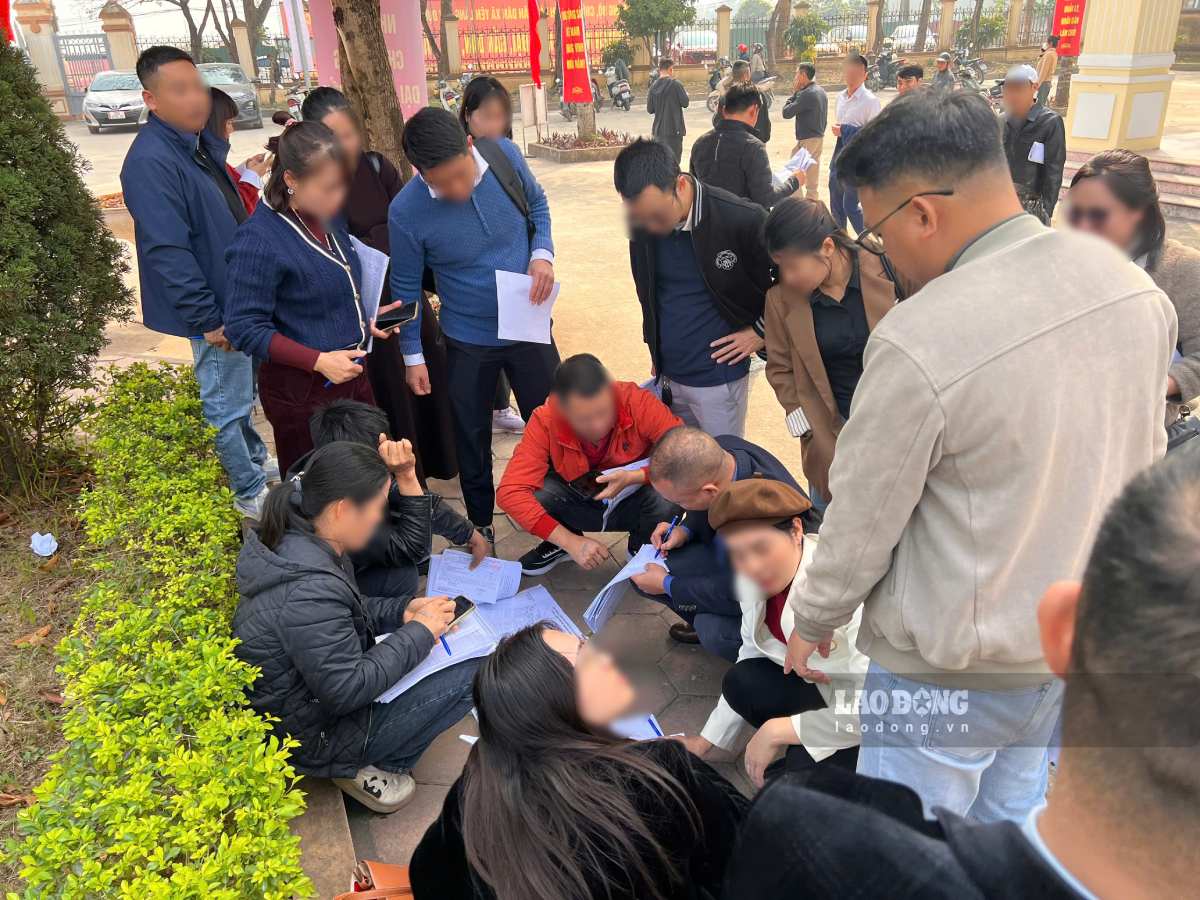
On December 29, Yen Lang Commune People's Committee coordinated with Vietnam Auction Partnership Company to organize an auction of residential land use rights for 33 land plots in Yen Lang commune, Hanoi City (formerly Me Linh district).
As a result, all 33 land plots were successfully auctioned. The winning price ranged from 34.5 to 57.6 million VND/m2, about 7 times higher than the starting price. The total winning bid amount reached more than 174 billion VND, about 151.6 billion VND higher than the total starting price.

Investor sentiment is more cautious
Previously, in 2024, the Me Linh district (old) was once considered a land auction hotspot, when many sessions recorded winning prices of nearly 100 million VND/m2.
Typically, the auction of 11 land plots in Dong Cao village, Trang Viet commune took place on December 19, 2024. After 7 rounds of auction, all 11 land plots were successfully auctioned. In which, the land plot with the highest winning price reached more than 97.5 million VND/m2, the lowest was also over 79.5 million VND/m2, many times higher than the starting price.
However, according to recent actual records, the winning land auction price in the Me Linh (old) area has shown signs of cooling down compared to the peak period of 2024.
Talking to Lao Dong Newspaper, Mr. Tran Xuan Luong - PhD in Real Estate, National Economics University - said that recently, investor sentiment has changed significantly. The first reason comes from the change of institutions, especially the organization of the government according to a two-level model, abandoning the district level. Previously, the role of the district level in local auctions was very large, but now, the process is expected to be more transparent.
In addition, the State's determination to transparentize the real estate market is clearly shown through the direction of the General Secretary and the Prime Minister. Commitments related to publicizing data and market information, as well as building a direct tax policy on speculation and abandoned land... have made investors more wary.
Another important factor is credit control. Previously, borrowing capital to participate in auctions was relatively easy, but now, loans must be appraised more closely, loan applications must accurately reflect actual needs and financial capacity. This forces investors using high financial leverage to recalculate.
According to Dr. Tran Xuan Luong, through actual surveys, many auctioned land areas have infrastructure that has not been synchronously invested, located far from residential areas, even in the middle of fields. With such areas, if prices are pushed too high, liquidity is a very big problem.
Along with that, many auctioned land plots in the past time have implemented projects very slowly, mostly serving speculative purposes, not real housing needs. When policy, legal and credit factors interact, market sentiment has changed, causing the "FOMO" effect in land auctions to gradually slow down.

Tightening management, data transparency to limit speculation
Although the winning auction price has stagnated compared to before, in reality, there is still a situation of brokers selling land plots at a price difference of several hundred million VND immediately after the auction ends.
Commenting on this issue, Dr. Tran Xuan Luong said that the fact that land data is being interconnected will help cases that regularly participate in auctions in many localities to be easily identified. This forces auction groups to consider more carefully, no longer easily "fishing offshore" as before.
Previously, when data was not connected, there were groups that viewed auctions as a "profession", continuously participating in many localities, inflating prices and then withdrawing, leaving risks for later buyers. Even, in some cases, auction design was carried out in many phases to create a virtual price level, causing participants in the later sessions to eventually fall into a "bankruptcy". Tightening management and information transparency will gradually limit this situation.
The important thing is that the State needs to continue to maintain and consistently implement the commitments made, especially the commitment to transparentize the real estate market and control real estate prices. When senior leaders clearly show determination, local authorities at all levels will be forced to comply more seriously, thereby interest groups will also be wary" - Dr. Tran Xuan Luong shared.
In addition, perfecting real estate market data, especially data on land and housing prices, is a prerequisite. When there are complete and transparent data, the State can build an effective tax policy, targeting the right speculators. If there are no data and tax is imposed hastily, it will be very difficult to implement.
However, the implementation process needs to have a suitable roadmap. Inspection and review to collect data are necessary, but if "shocking" measures are applied, criminalization or massive collection can have the opposite effect, affecting the market and the economy. The market needs to be adjusted in a direction of gradual reduction, controlled, instead of sudden stopping.
For people with real housing needs, Dr. Tran Xuan Luong recommends that people need to remain calm. The current market is very different from previous periods, when the psychology of fear "if you don't buy now, the price will increase" once made many people have to buy at all costs.
With the determination in the State's management, along with changes in institutions, laws and smart city development orientations, transportation and technical infrastructure are being invested more methodically.
The development of compact urban areas, associated with advanced transport infrastructure, shows that the ability to meet housing needs in the next 5-10 years is completely feasible. The Vietnamese real estate market, although still young, has learned many lessons, creating a premise for regulation in a more stable and sustainable direction.


