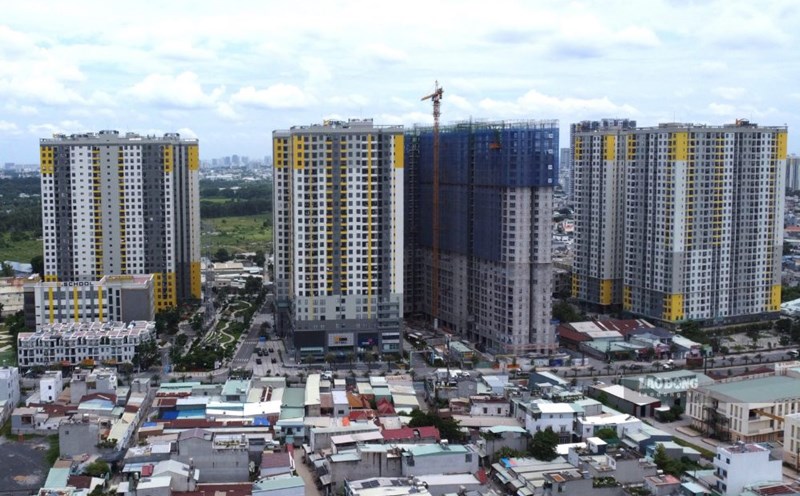
According to Savills' report, in the second quarter of 2026, the apartment market in Ho Chi Minh City recorded a new supply of 1,800 units. In the context of high home loan interest rates maintained, causing cautious sentiment to still prevail, the market in general still maintained signs of improvement as new supply increased year-on-year.
Accumulated in the first half of the year, new supply reached 3,700 units from 7 new projects. However, the biggest barrier currently is that new sales are mainly concentrated in the Grade A and B segments. All of these products have prices above 90 million VND/m2 clear area, especially up to 80% exceeding the threshold of 120 million VND/m2.
This development proves that the gap in people's ability to pay is increasing, as the market shifts strongly to products that require high financial capacity.
Although supply has improved, market activity is still quite quiet. As of Q2/2026, the average home loan interest rate has reached about 13%, up 4 percentage points compared to the same period last year. As a result, the market-wide absorption rate, including new supply, decreased to only 32%, equivalent to more than 1,500 transactions.
The fact that supply is concentrated in the high-end segment has increased the market's sensitivity to credit conditions, because high-priced products always require buyers to use a larger leverage ratio.
Experts affirm that the demand of the group of customers buying real houses is very large, but the current obstacle is still the price divergence when most customers are looking for apartments priced below 50 million VND/m2. Meanwhile, 80% of newly offered supply has prices exceeding this level. This difference makes it impossible for actual needs to be converted into successful transactions in the primary market.
The market is sparse in buyers also because the group of investors is absent. The disappearance of speculative capital is the main reason for the general absorption rate of the market to decrease. Short-term speculative capital seems to have withdrawn from the market also due to financial pressure.
Mr. Doan Quoc Viet - a real estate investor in Ho Chi Minh City - said that in 2024 he invested in buying 3 apartments from an apartment project in Tan Phong ward in the old District 7 with a total value of more than 15 billion VND. He borrowed money from the bank and has paid 30% to the investor according to the progress. By September, he must immediately pay 45%, which is about 7 billion VND for all 3 apartments. But in the current context, the financial situation is not as expected and the loan interest rate is increasing, so he is planning to sell to pay the loan.
He has continuously advertised for sale for more than 2 months but has not had liquidity despite sending many brokers. To have a transaction soon, he accepted a price reduction but still few customers asked to buy. This situation, according to him, is different from the peak period, when many buyers had to "fight" to have the right to choose to buy an apartment.
According to many brokers, in addition to not wanting to "surf to become residents", paying nearly half of the house value in the context of the principal debt grace period about to end increases financial pressure, so many investors are selling off.
Escaping" apartments at this time is not easy, especially for projects opened for sale during the hot season. With unit prices ranging from 80 million VND to more than 100 million VND/m2, subsequent buyers must immediately pay a large amount of several billion VND in the context of high interest rates, which makes them very cautious. In the context of old goods not being sold, let alone buying new goods.
From now until the end of the year, many market research units forecast that the general level of home loan interest rates will continue to be high, putting pressure on investment demand. Interest rates may continue to be an important variable determining market developments in the coming time. If the general level of interest rates is maintained around 13-15%, the absorption rate may decrease to below 20%, while selling prices are difficult to maintain the upward momentum.