
Reader asks: After scanning the QR code printed on the Certificate of land use rights, ownership of assets attached to land (commonly called a red book), what information will the phone screen display?
YouMe Law Company Limited answers: Starting from January 1, 2025, the issuance of Certificates of land use rights and ownership of assets attached to land according to new forms with QR codes has been implemented nationwide.
The QR code is shown in the upper right corner of page 1 of the land use right certificate, with dimensions of 2.0 cm x 2.0 cm.
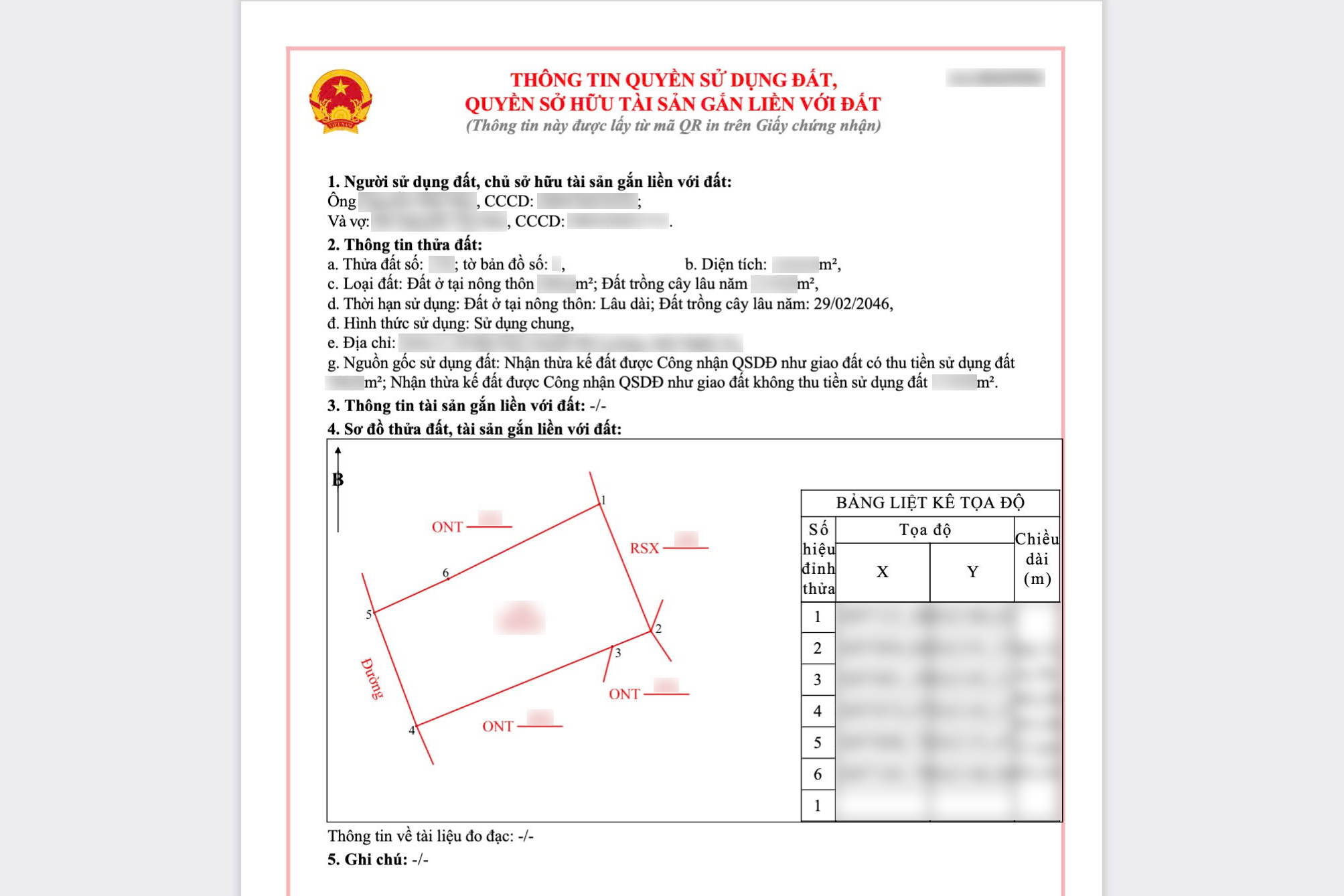
When scanning the QR code, all information about real estate is presented in the following form:
.PDF file type;
210 mm x 297 mm;
In the top left corner;
- Line "Information on land use rights, ownership of assets attached to land (This information is taken from the QR code printed on the Certificate)";
- Certificate issue number (serial number): Includes 2 Vietnamese letters and 8 digits (in the top right corner).
- 5 main contents:
Section 1: Information on land users, owners of assets attached to land;
Section 2: Information about the land plot;
Section 3: Information on assets attached to land;
Section 4: Diagram of land plots, assets attached to land;
Section 5: Notes.
According to the Hanoi Department of Agriculture and Environment, the integration of QR codes on land use right certificates is one of the outstanding new points, aimed at promoting comprehensive digital transformation in the field of natural resources and environment, while bringing practical benefits to both management agencies and people.
The most obvious benefit is reducing the situation of forging papers, information loss, and shortening the time in transactions of buying and selling, transfer, mortgage... Relevant parties can quickly verify legality through the national land database system. This not only helps protect the legitimate rights of land users, but also facilitates the process of handling administrative procedures.
The integration of QR codes also contributes to reducing the use of hard copy papers, promoting land management by electronic methods, protecting the environment, and saving social costs.


