
Chairman of Ho Chi Minh City People's Committee Nguyen Van Duoc has just directed departments, branches and related localities to urgently review and adjust urban planning to implement the program to renovate and rebuild old, damaged and degraded apartment buildings in the area.
According to the current project, Ho Chi Minh City has 39 old apartment projects in 16 wards that need to be renovated and rebuilt, including: Tan Son Nhat, Tan Hoa, Ben Thanh, Xuan Hoa, Xom Chieu, Khanh Hoi, Cho Lon, Phu Lam, Saigon, Vuon Lai, Binh Quoi, An Dong, Binh Tay, Chanh Hung, Dien Hong and Ban Co.
Among these, there are 16 level D apartment projects - the highest level of danger of old apartment buildings, heavily damaged, with a potential risk of collapse.
There are 13 apartment buildings that are not class D (of which 12 apartment buildings were deployed before 2016 and one apartment building at 518 Vo Van Kiet encountered an inclination and subsidence incident).
10 apartment buildings built before 1975 that have not been relocated or urgently dismantled are currently proposed for renovation.
The Chairman of the Ho Chi Minh City People's Committee assigned the People's Committees of wards to proactively review and evaluate the current status of planning in each apartment building area, thereby proposing local adjustments to the zoning plan (scale 1/2000) in accordance with the provisions of the 2024 Law on Urban and Rural Planning.
The Department of Planning and Architecture is assigned to coordinate with the Department of Construction to consider review reports, summarize proposals to adjust the overall zoning plan, as a basis for implementing apartment renovation projects. At the same time, units continue to work with localities to remove obstacles, ensure feasibility and compliance with current regulations.
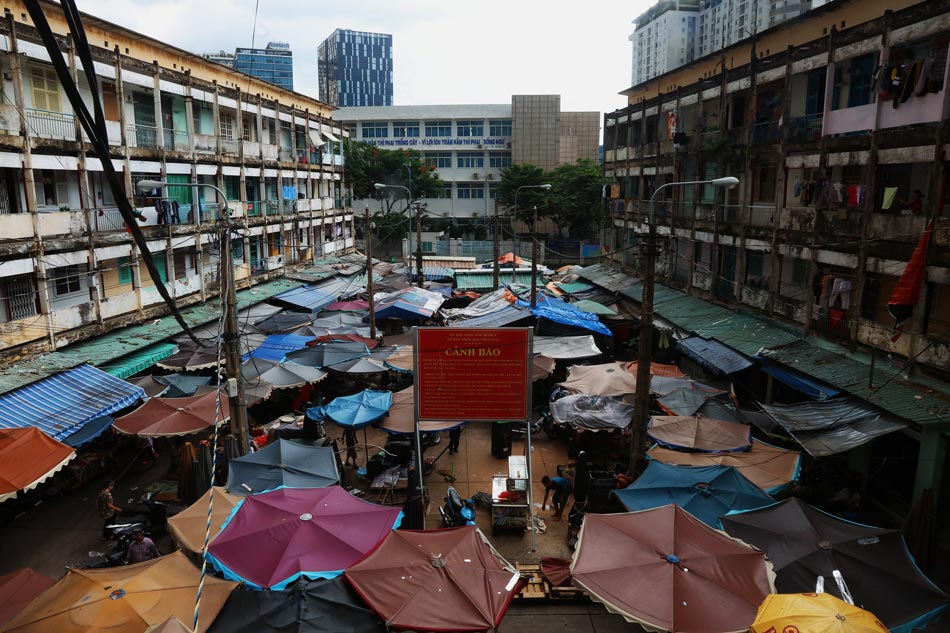
According to the Department of Planning and Architecture, most old apartment buildings built before 1975 have high construction density but low floor height and land use coefficient. Meanwhile, these areas are located in the inner city with high population density, but the land fund for social infrastructure such as schools, parks, and parking lots is still limited.
If the old planning targets are maintained, renovation projects will not ensure financial efficiency because the costs of compensation, on-site resettlement, temporary residence and construction are very large, making it difficult for investors to participate. Therefore, the need to increase planning - architectural targets is necessary.
However, the increase in height, land use coefficient and population size increases pressure on technical and social infrastructure systems such as transportation, drainage, schools..., leading to many cases not meeting the conditions for local planning adjustment according to regulations.
In addition, some apartment buildings have small, fragmented areas, not enough land to arrange parking lots, green trees, public works or do not ensure rearview, traffic connection and fire prevention and fighting, escape requirements.
In many areas, the current population size has exceeded the approved plan, making it legally unfounded to adjust population increases to implement new projects.
Faced with this situation, the Ho Chi Minh City Department of Construction proposed grouping for handling. For apartment buildings that meet the conditions for local planning adjustment, localities need to proactively prepare, appraise and approve adjustments to soon implement the project.
For cases that do not meet the conditions for local adjustment, it is necessary to consider in the process of overall zoning planning adjustment to re-determine appropriate planning - architectural indicators.
For apartment buildings with too small areas, not ensuring infrastructure, traffic, safety conditions... it is necessary to consider not rebuilding apartment buildings but converting land use functions or organizing auctions to ensure efficiency and feasibility.


